Need help? Ask an expert your product and motorbike gloves questions
Need help? Ask an expert your product and motorbike gloves questions
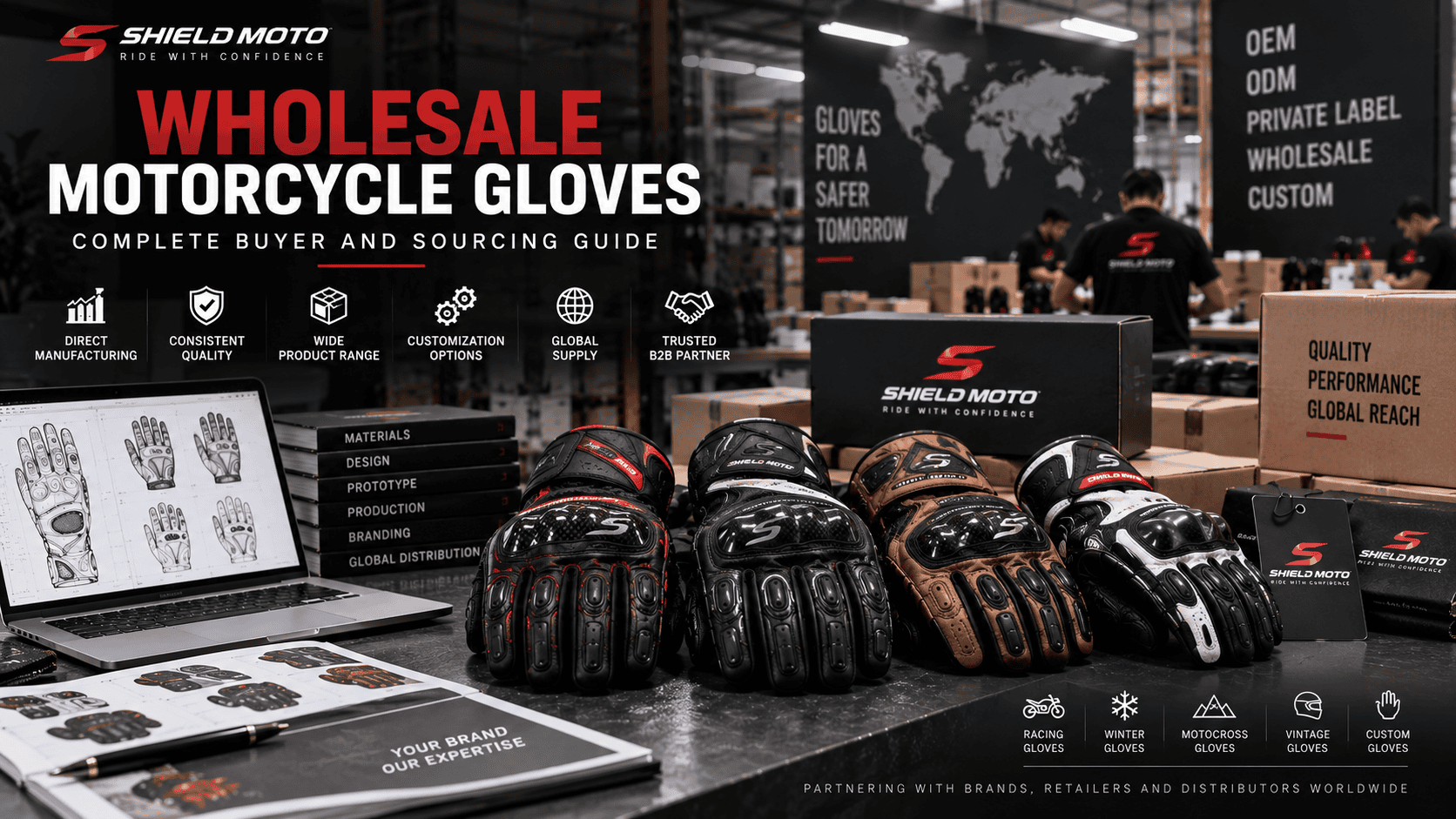
Buying motorcycle gloves wholesale is not simply a matter of finding the lowest unit price. For retailers, distributors, motorcycle brands, clubs, and other B2B buyers, the better approach is to evaluate product type, materials, construction, fit, protection features, quality control, customization, sampling, packaging, production capability, and commercial terms together.
The right wholesale motorcycle glove supplier should be able to provide products that fit your target market and explain what can be customized, what is already standardized, and what documentation is available for the products you intend to sell.
For businesses sourcing motorcycle gloves in volume, the central question is:
Are you looking for ready-to-sell wholesale gloves, or do you need a customized, private-label, or OEM product?
That decision determines how you should approach manufacturers and suppliers.
Wholesale motorcycle gloves are motorcycle riding gloves purchased in commercial quantities for resale, distribution, club use, or business requirements.
Wholesale buyers may include:
The products can range from everyday riding gloves to specialized racing, winter, vintage, half-finger, and motocross gloves.
Shield Moto currently lists long racing gloves, short racing gloves, winter gloves, vintage gloves, custom biker gloves, half-finger gloves, and motocross gloves within its motorcycle glove range.
One of the first decisions a buyer should make is which sourcing model fits the business.
| Sourcing Model | Best For | Main Characteristic |
|---|---|---|
| Wholesale | Retailers and distributors | Purchase existing products for resale |
| Private Label | Brands wanting their own identity | Products sold under the buyer’s brand |
| OEM | Brands with defined specifications | Manufacturer produces according to agreed requirements |
| ODM | Brands wanting manufacturer design involvement | Manufacturer contributes to product design and production |
| Custom Manufacturing | Buyers needing specific products | Product developed around defined requirements |
These terms can be used differently by different manufacturers, so buyers should always confirm exactly what the supplier means by each service.
For a retailer wanting ready-to-sell products, standard wholesale may be the simplest option.
For a motorcycle brand wanting its own product identity, private-label or OEM manufacturing may be more appropriate.
The best wholesale motorcycle gloves are not necessarily the most expensive or the cheapest.
Start by defining:
This prevents a common sourcing mistake: selecting a product first and trying to find a market for it later.
Different riders need different glove characteristics.
Racing gloves are designed around a performance-oriented riding application.
Long racing gloves generally extend farther over the wrist than short gloves, providing greater cuff coverage.
They may be appropriate for:
Shield Moto lists long racing gloves as a dedicated product category and describes the category around speed, agility, protection, grip, and comfort.
Short gloves can be more suitable for buyers targeting everyday motorcycle use.
Potential applications include:
Their shorter cuff can make them convenient for riders who do not want the extended construction of a long racing glove.
Winter gloves should be evaluated differently from summer or racing gloves.
Important considerations include:
Shield Moto lists winter gloves as a dedicated category and describes them as insulated and waterproof gloves for harsh conditions.
For wholesale purchasing, verify the specifications of the exact model rather than assuming that every winter glove provides identical weather performance.
Vintage motorcycle gloves can target riders who prioritize classic styling.
They may be particularly relevant to:
Shield Moto identifies its vintage gloves as suitable for cruiser and touring riders seeking old-school styling.
Motocross gloves serve a different riding environment from road-oriented gloves.
Buyers should consider:
The manufacturer should clearly identify the intended use of the product.
Material selection affects the characteristics of the finished glove.
Important considerations include:
There is no universal “best” motorcycle glove material.
A material appropriate for a summer motocross glove may not be appropriate for an insulated winter glove. Likewise, a race-oriented leather glove may have different construction priorities from an everyday urban riding glove.
Shield Moto provides a material guide as part of its product and manufacturing resources.
When requesting wholesale samples, ask the supplier to identify the actual materials used rather than relying only on general descriptions such as “premium material.”
For wholesale buyers, the material decision should be connected to the intended product.
Leather can be used for products where durability, tactile feel, and a traditional motorcycle aesthetic are important.
Potential applications include:
Textile constructions can be useful when flexibility, ventilation, lightweight construction, or weather-oriented features are important.
Potential applications include:
The specific performance depends on the material, construction, reinforcement, and finished product.
Wholesale buyers should inspect the palm rather than focusing only on the glove’s appearance from the back.
The palm affects:
Ask the supplier:
A strong-looking glove can still have weaknesses if the palm construction does not suit the intended application.
Protective features should be evaluated as specific product components.
Possible features include:
However, buyers should distinguish between a design feature and a verified certification or test result.
Do not advertise a wholesale glove as “CE certified,” “crash-proof,” or having another specific safety rating unless the exact product has the appropriate supporting documentation.
The manufacturer’s documentation should correspond to the exact product being sold.
Sizing is one of the most important commercial considerations for retailers.
Poor sizing can lead to:
A wholesale buyer should request:
Never create your own size measurements based on assumptions.
Use the supplier’s documented size information and confirm the final production specification.
A reliable supplier should be evaluated beyond product photographs.
Look at the complete manufacturing and sourcing process.
Does the supplier offer the categories your customers actually need?
For example:
Shield Moto currently lists all of these categories, along with half-finger gloves.
A manufacturer can offer a different level of control from a trading supplier.
Shield Moto identifies capabilities including:
Its website also states production infrastructure including 600+ stitching machines, automatic palm stitching machines, 50+ cutting presses, 15+ CNC machines, sublimation machines, heat-transfer printers, and 15 production halls.
The site currently states production capacity of more than 6 million gloves annually.
These published figures are useful when evaluating manufacturing scale, but buyers should still assess whether the supplier’s capabilities match their specific product requirements.
Quality control should be defined before the order is placed.
A buyer should establish what will be inspected.
Check:
Check:
Check:
Check:
Shield Moto states that quality inspections are performed throughout its manufacturing process, from material selection through final inspection.
For a larger wholesale program, buyers should agree on the inspection process and acceptance requirements in advance.
A product photograph cannot tell you everything about a motorcycle glove.
Before placing a significant wholesale order, evaluate a physical sample where possible.
Inspect:
Shield Moto provides a Request a Sample option through its website, alongside a request-a-catalog process.
Packaging is part of the retail product.
Depending on your market, packaging can include:
If you are purchasing gloves for resale, confirm whether the supplier’s standard packaging is suitable for your sales channel.
For premium retail, you may also want customized packaging that matches your brand.
Shield Moto states that packaging and branding can be incorporated into its customized manufacturing solutions.
Wholesale can be the better option when:
Private label can be more appropriate when:
OEM or custom manufacturing becomes more relevant when the product itself needs to be developed around your specifications.
Retailers should think about assortment rather than ordering a single product.
A balanced range could include different price and usage positions.
For example:
| Product Type | Potential Retail Position |
|---|---|
| Short Gloves | Everyday riding |
| Long Racing Gloves | Performance |
| Winter Gloves | Cold-weather riding |
| Vintage Gloves | Cruiser/heritage |
| Motocross Gloves | Off-road |
| Half-Finger Gloves | Lightweight/casual |
The appropriate assortment depends on your customers and market.
Do not purchase every available category simply because a supplier offers it.
Distributors need to evaluate scalability and consistency.
Important questions include:
A distributor’s biggest risk is often inconsistency between the first shipment and subsequent shipments.
Documented product specifications can help reduce that risk.
If you already have a motorcycle apparel brand, standard wholesale may not be the best long-term strategy.
A private-label or OEM relationship can give you more control over:
Shield Moto states that it specializes in OEM and private-label manufacturing and offers customization from material selection and design through packaging and branding.
For a brand building a long-term product line, this can be more strategically useful than reselling generic products.
Before requesting a quotation, prepare a clear list of questions.
MOQ, pricing, lead time, payment terms, and shipping conditions should be confirmed for your specific order rather than assumed.
Do not compare suppliers on unit price alone.
Use a broader evaluation.
| Factor | Supplier A | Supplier B | Supplier C |
|---|---|---|---|
| Product range | |||
| Material options | |||
| Customization | |||
| Sample availability | |||
| Quality process | |||
| Packaging | |||
| Manufacturing capability | |||
| MOQ | |||
| Lead time | |||
| Communication | |||
| Documentation | |||
| Total landed cost |
This makes the sourcing decision more objective.
A wholesale buyer should not look only at the factory price.
Your actual cost can include:
Product cost + customization + packaging + freight + insurance + duties/taxes + inspection + other applicable import costs
A supplier with the lowest unit price may not have the lowest total landed cost.
This is particularly important for international buyers.
Be cautious when a supplier:
A professional manufacturer should be able to discuss the product in technical terms rather than relying only on marketing language.
Shield Moto is a Pakistan-based motorcycle glove manufacturer operating under Solehre Brothers Industries. The company’s website states that its parent company was established in 2002 and that Shield Moto specializes in OEM and private-label manufacturing.
Its current product structure includes:
The manufacturer also publishes production information covering R&D, cutting, printing, stitching, quality assurance, and packing, along with its stated manufacturing infrastructure and annual production capacity.
For a wholesale buyer, this makes Shield Moto relevant not only for ready product sourcing but also for businesses considering a transition toward private-label or OEM motorcycle glove manufacturing.
Before placing an order, confirm:
Evaluate product category, materials, construction, fit, protection features, quality control, sample availability, packaging, supplier capability, commercial terms, and documentation. Price should be considered together with the total landed cost and product requirements.
Yes, if the manufacturer offers branding customization. Logo application can be part of a private-label or custom manufacturing arrangement. Confirm the available branding method and placement before production.
Wholesale ranges can include racing gloves, short gloves, winter gloves, vintage gloves, motocross gloves, half-finger gloves, and custom biker gloves. Shield Moto currently lists these categories on its website.
For a significant wholesale order, sampling is strongly recommended. A physical sample allows you to evaluate fit, construction, materials, appearance, branding, and packaging before committing to production.
Wholesale generally involves purchasing existing products for resale. Private label involves selling products under your own brand. Private-label projects can include branding and other customization depending on the manufacturer’s capabilities.
Look at manufacturing capabilities, product range, quality-control processes, materials, customization, sampling, documentation, communication, commercial terms, and the supplier’s ability to maintain consistent specifications.
They can be, depending on the supplier and product. Customization may include colors, materials, branding, printing, embroidery, construction, and packaging. Confirm which options apply to the exact product.
Shield Moto’s website includes a Request a Sample form and a Request a Catalog option for prospective buyers.
Buying wholesale motorcycle gloves should be approached as a product and supply-chain decision rather than simply a price comparison.
Start with your customer and riding application. Then evaluate glove type, material, construction, fit, protection features, quality control, packaging, samples, and commercial terms.
If you need ready-to-sell products, wholesale sourcing may be the most straightforward route.
If you need your own branding, private label can provide greater brand control.
If you have detailed product specifications, OEM manufacturing may be more appropriate.
For businesses that want manufacturer involvement in product development, ODM may also be worth considering.
Shield Moto provides motorcycle glove categories alongside OEM, private-label, customization, product-development, and manufacturing capabilities, making it relevant for buyers evaluating both wholesale sourcing and longer-term manufacturing relationships.
The best next step is to prepare a clear product requirement sheet, request samples, compare suppliers on total value rather than unit price alone, and confirm all production and commercial terms before placing a bulk order.