Need help? Ask an expert your product and motorbike gloves questions
Need help? Ask an expert your product and motorbike gloves questions
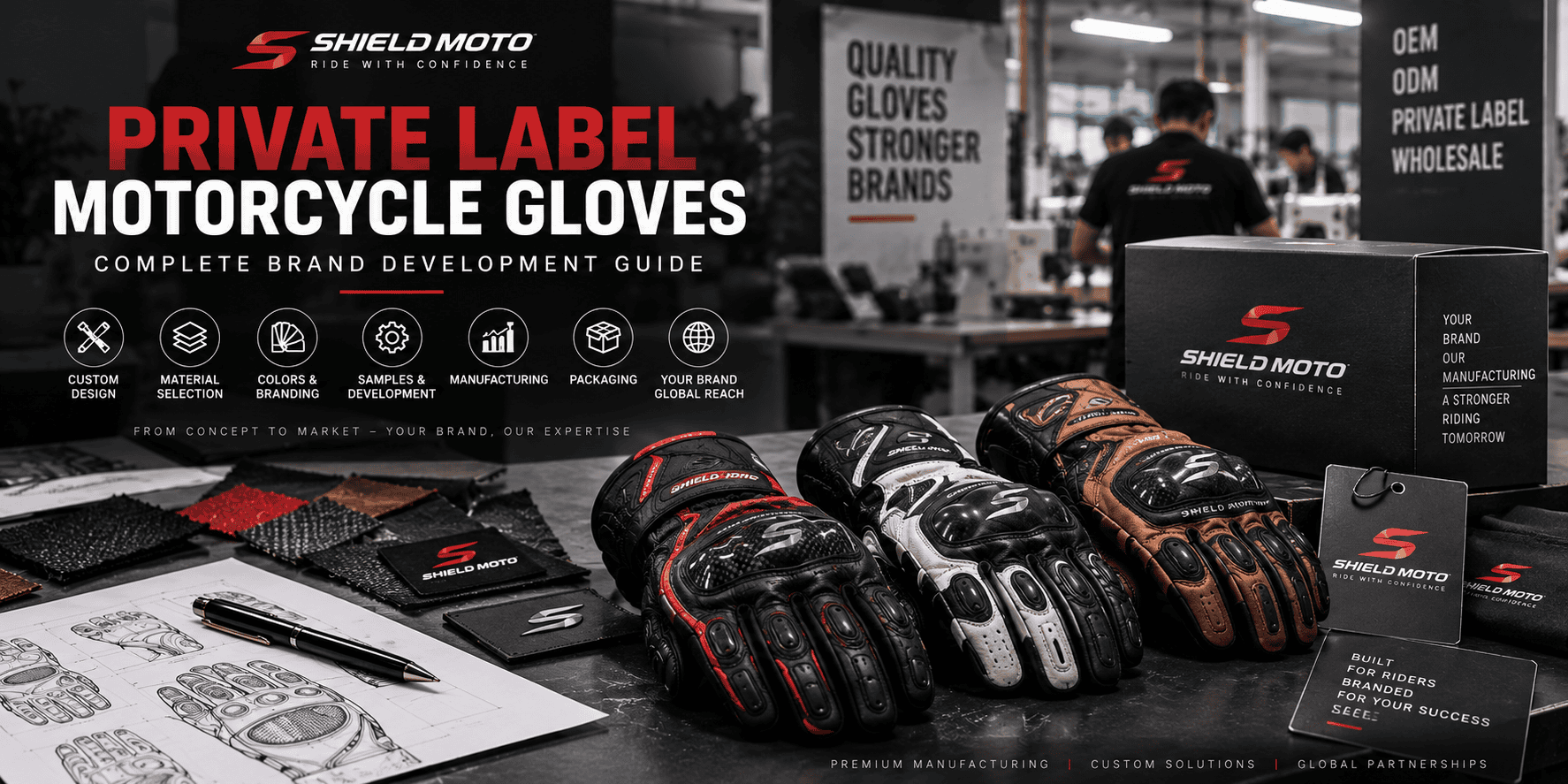
Launching a motorcycle glove collection under your own brand involves much more than putting a logo on an existing product. Private-label motorcycle gloves allow brands, retailers, distributors, and motorcycle clubs to develop branded gloves without necessarily building their own manufacturing operation.
The process can include product selection or development, materials, colors, construction, branding, packaging, sampling, quality requirements, and bulk production. The right manufacturing partner should be able to clearly explain which elements can be customized and which requirements must be confirmed for a specific project.
For brands evaluating private-label motorcycle gloves, the key decision is simple:
Do you need an existing glove adapted to your brand, or do you need a more extensively customized product developed around your specifications?
Shield Moto identifies OEM and private-label manufacturing as part of its business model and positions its manufacturing services around customized solutions for brand identity and performance requirements.
Private-label motorcycle gloves are gloves manufactured for sale under another company’s brand name.
Instead of operating its own glove factory, a motorcycle apparel company can work with a manufacturer to produce gloves carrying its own:
The exact level of customization depends on the manufacturer and the agreed production arrangement.
Private labeling can therefore provide a practical route for businesses that want to build a motorcycle glove collection while outsourcing manufacturing.
These terms are related, but they are not identical.
| Manufacturing Model | Main Idea | Buyer Control | Manufacturer Involvement |
|---|---|---|---|
| Private Label | Manufacturer produces products sold under the buyer’s brand | Medium | Medium |
| OEM | Manufacturer produces according to buyer-defined specifications | High | Manufacturing-focused |
| ODM | Manufacturer contributes product design and manufacturing | Medium | High |
| Custom Manufacturing | Product is developed around specific customer requirements | High | High |
The terminology can vary between manufacturers, so businesses should focus on the actual agreement rather than relying only on the label.
For example, a manufacturer may offer a private-label program based on existing glove designs while also offering OEM/ODM development for customers requiring more customization.
Private labeling can solve several problems for a growing motorcycle brand.
A business may have:
Instead of investing in its own cutting, stitching, printing, quality-control, and packing infrastructure, the business can work with an established manufacturer.
This allows the brand to focus more heavily on:
while the manufacturing partner handles the production side according to the agreed specifications.
Customization can range from simple branding to substantial product development.
The most basic private-label project may involve applying a company’s branding to an existing glove design.
Possible branding elements include:
The manufacturer should confirm which techniques are available for the specific glove.
Shield Moto states that its custom manufacturing services can include branding, material selection, design, packaging, embroidery, and sublimation printing.
Color is one of the easiest ways to create a recognizable private-label collection.
A brand might develop:
For a professional product line, colors should be documented rather than communicated only through general descriptions such as “dark red” or “bright black.”
Material selection should be based on the intended use of the glove.
Relevant considerations include:
A private-label buyer should ask the manufacturer to identify the materials used in the proposed product and confirm whether substitutions are permitted.
Shield Moto’s material guide identifies technologies and materials including HIPORA®, CORDURA®, COOLMAX®, KEVLAR®, and Teflon™.
The appropriate material depends on the product rather than simply choosing the most expensive option.
Your private-label collection should begin with the customer and riding application.
Shield Moto currently lists several motorcycle glove categories, including:
Each category serves a different product position.
Long gloves generally provide more wrist coverage and are suited to race-oriented product positioning.
They can be appropriate for:
Shield Moto’s published long racing glove example includes an adjustable cuff, wrist closure system, reinforced palm construction, and protective components.
Short gloves can be useful for brands targeting everyday riders who prioritize convenience and a shorter cuff design.
Potential applications include:
The exact construction should still be selected according to the intended application.
Winter gloves require a different product-development approach.
Consider:
Shield Moto lists winter gloves as a dedicated category and describes them as insulated and waterproof products for harsh conditions.
Any specific waterproofing or performance claim for a private-label product should be confirmed for the exact finished model.
Vintage-style gloves can target riders interested in classic motorcycle aesthetics.
Design considerations may include:
The important distinction is that a vintage appearance does not automatically mean the glove has a particular level of protection or performance.
Motocross products have different requirements from road-oriented motorcycle gloves.
A buyer should consider:
The final specification should match the intended riding environment.
Protection should be treated as a technical specification, not a marketing slogan.
Potential design features can include:
A reinforced palm, for example, can add material to an area exposed to wear, while a knuckle protector is designed to provide protective coverage over the knuckle region.
However, a design feature should not automatically be presented as a certification or safety rating.
If your target market requires a specific standard or certification, request the relevant documentation for the exact product.
Shield Moto’s published long racing glove example identifies a CE-compliant model and lists TPU carbon knuckle protection, SuperFabric® components, and palm reinforcement.
For a private-label project, do not assume that the specifications of one existing model automatically apply to every custom product.
A private-label motorcycle glove needs to fit the intended customer.
Poor fit can affect:
A buyer should therefore evaluate samples before committing to bulk production.
Ask the manufacturer:
Shield Moto’s custom biker glove page states that pre-production samples can be provided for approval before bulk production.
A professional private-label project should follow a structured workflow.
Before contacting a manufacturer, determine what your glove collection represents.
For example:
Performance brand
Focus on racing, track-oriented designs and technical construction.
Urban motorcycle brand
Focus on short gloves, everyday comfort, style, and convenience.
Heritage brand
Focus on leather, classic styling, and vintage-inspired products.
Adventure/off-road brand
Focus on motocross or off-road requirements.
Your positioning influences every later decision.
Choose the product type before discussing details.
For example:
A manufacturer can then determine which existing designs or development options are relevant.
Prepare a specification sheet containing:
The more clearly requirements are documented, the easier it is to evaluate the final product.
Prepare your:
Do not wait until production begins to decide where the logo belongs.
Sampling is one of the most important stages.
Inspect:
Shield Moto specifically states that pre-production samples are available for its custom biker glove manufacturing process.
Do not rely on a verbal description of the product.
The approved specification should identify the important details that production must follow.
This can include:
Once the sample and specifications are approved, the manufacturer can proceed according to the agreed commercial and production terms.
MOQ, lead time, payment terms, inspection arrangements, and production schedules should be confirmed directly for your project.
Do not evaluate manufacturers solely by their website or product photographs.
Look for evidence of capability across the complete production process.
Ask whether the manufacturer provides:
Consider whether the supplier has appropriate:
capabilities.
Shield Moto states that its manufacturing operation includes R&D, cutting, printing, stitching, quality assurance, and packing. Its website also currently identifies 600+ stitching machines, automatic palm stitching equipment, and production capacity exceeding 6 million gloves annually.
Quality should be defined before production rather than discussed only after receiving the shipment.
Create a checklist covering:
For larger programs, buyers should also discuss inspection procedures and acceptance criteria with the manufacturer.
Packaging is part of the product experience.
Depending on the project, packaging can include:
The packaging should match the positioning of the brand.
A premium motorcycle brand should not treat packaging as an afterthought.
Shield Moto states that packaging can be part of its customization process.
There is no universal number.
A new brand may be better served by a focused collection rather than launching every glove type simultaneously.
A practical starting structure could be:
One recognizable everyday motorcycle glove.
One long racing or performance-focused glove.
One winter glove if the target market requires it.
One vintage or casual model where it fits the brand.
The final assortment should depend on the target customer, market, budget, and manufacturing plan.
Before moving forward, ask:
Ask for project-specific answers rather than generic promises.
Private labeling can be especially useful for new motorcycle apparel brands.
A new company does not necessarily need to establish an entire manufacturing operation before launching its first glove collection.
Instead, the brand can concentrate on:
The manufacturing partner handles the production process according to the agreed requirements.
This approach can reduce the operational burden of entering the motorcycle glove market, although the actual investment, MOQ, development time, and commercial terms vary by project.
Established motorcycle apparel companies can use private labeling differently.
They may already have:
For these businesses, private-label manufacturing can be used to expand the product range without building additional internal manufacturing infrastructure.
An established brand may also choose OEM or ODM development when a more customized product is required.
Shield Moto is a Pakistan-based motorcycle glove manufacturer operating under Solehre Brothers Industries, with a company history dating to 2002. The company’s website states that it provides OEM and private-label manufacturing solutions and serves brands requiring customized motorcycle glove products.
Its published manufacturing capabilities include R&D, cutting, printing, stitching, quality assurance, and packing. Shield Moto also lists dedicated motorcycle glove categories and custom biker glove manufacturing.
For a brand evaluating Shield Moto, the appropriate discussion should focus on the actual project:
That approach makes the manufacturer relationship more precise than simply asking for “private-label gloves.”
Before placing an order, confirm:
Private-label motorcycle gloves are products manufactured for a business and sold under that business’s brand. The level of customization can range from branding an existing glove to developing a more customized product, depending on the manufacturer’s capabilities and the agreement.
Yes, branding can be incorporated when the manufacturer supports the required branding method. Depending on the supplier, options may include embroidery, printing, labels, and other branding techniques.
Yes. Customization may include colors, materials, design elements, construction, branding, and packaging. The available options should be confirmed for the specific glove and manufacturing project.
A manufacturer may provide a pre-production sample so the buyer can evaluate the product before bulk manufacturing. Shield Moto states that pre-production samples are available for its custom biker glove program.
Not necessarily. Private label describes selling a manufactured product under the customer’s brand, while OEM generally refers to manufacturing according to buyer-defined specifications. A supplier may offer both private-label and OEM services.
Potential categories include racing, short riding, winter, vintage, motocross, half-finger, and custom biker gloves. The available range depends on the manufacturer.
Ask about customization, materials, product development, samples, branding, quality control, testing documentation, packaging, MOQ, lead time, payment terms, and intellectual-property arrangements.
It can be. Private-label manufacturing can allow a new brand to develop a branded motorcycle glove range without establishing its own glove manufacturing facility. The commercial suitability depends on the brand’s budget, product requirements, market, and manufacturing agreement.
Private-label motorcycle gloves provide a practical way for motorcycle brands, retailers, distributors, and clubs to launch branded glove collections without operating their own manufacturing facility.
The most successful projects begin with a clear product strategy.
Define the intended rider first. Then select the glove category, materials, construction, protection features, branding, sizing, packaging, and quality requirements.
Do not choose a manufacturer solely because it offers a low price or attractive product photographs. Evaluate its ability to support the complete process from product development and sampling through manufacturing, quality assurance, branding, and packing.
For businesses considering a private-label motorcycle glove collection, Shield Moto offers an established motorcycle glove manufacturing route with OEM and private-label capabilities, custom biker glove production, product-development support, and manufacturing infrastructure.
The logical next step is to prepare your product requirements and discuss whether an existing glove, customized private-label model, OEM development, or ODM approach best fits your brand.