Need help? Ask an expert your product and motorbike gloves questions
Need help? Ask an expert your product and motorbike gloves questions
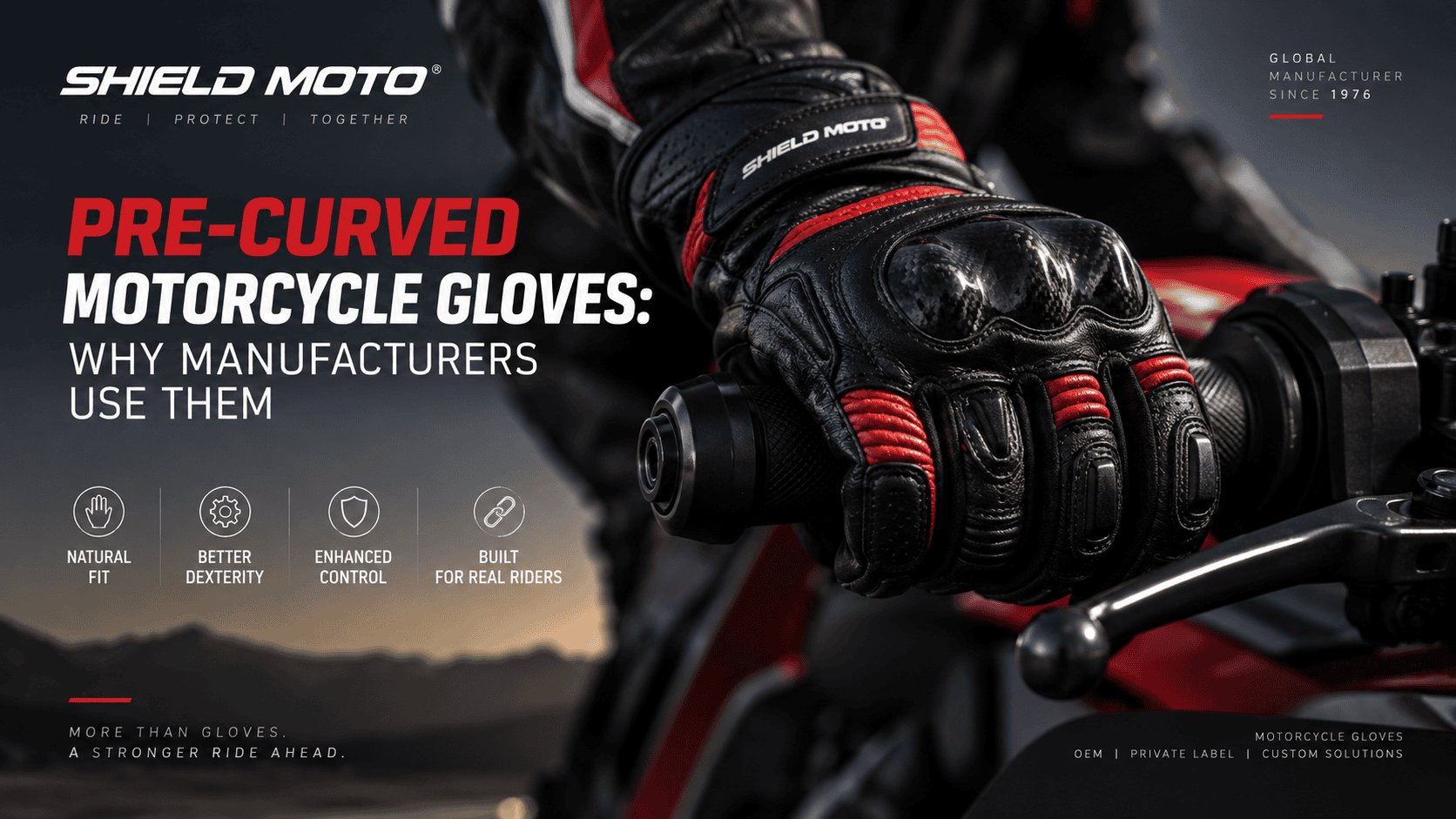
Pre-curved motorcycle gloves are designed with the fingers and hand positioned closer to the natural shape of a rider’s hand when gripping a motorcycle handlebar. Manufacturers use this construction because it can improve hand conformity, reduce unnecessary material folding, and support a more natural riding position.
For motorcycle glove brands, retailers, and riders, pre-curved construction is not simply a styling choice. It is a product-development decision that affects fit, dexterity, comfort, grip, and how different glove components work together.
Pre-curved motorcycle gloves are gloves manufactured with a shaped pattern that follows the natural curve of the hand and fingers rather than being constructed as a completely flat hand shape.
When a rider grips a handlebar, the fingers naturally bend around the controls. A pre-curved glove is developed with that riding position in mind.
This can help the glove sit more naturally around the fingers and palm instead of requiring the rider to create the entire bend through the glove material.
A motorcycle glove needs to perform while the hand is repeatedly opening, closing, gripping, and operating controls. Construction that follows the hand’s natural position can help manufacturers balance:
The exact result depends on the pattern, materials, stitching, reinforcement, and intended riding application.
Manufacturers use pre-curved construction primarily to create a glove that works with the rider’s natural hand position.
A motorcycle glove is different from a casual fashion glove because the hand is frequently positioned around a handlebar. The pattern therefore needs to account for movement and grip rather than only how the glove looks when the hand is relaxed.
When riding, the fingers are normally flexed around the throttle, clutch, or other controls.
A pre-curved pattern builds some of this flex into the glove itself. This can reduce the amount of work the rider’s fingers need to do simply to bend the glove into position.
Dexterity is particularly important for motorcycle riders because the hands operate controls while maintaining a secure grip.
A well-developed pre-curved pattern can allow the glove to move with the fingers instead of creating excessive resistance or bunching.
However, pre-curving alone does not guarantee good dexterity. Finger length, material flexibility, seam placement, lining, reinforcement, and overall sizing all influence the final result.
A flat glove pattern may create more material folds when the hand closes around a handlebar.
Strategically shaping the glove can reduce unnecessary folding in areas where the rider repeatedly bends the fingers.
This is particularly relevant around the finger joints and palm because excessive material movement can affect the way the glove feels during prolonged riding.
Motorcycle gloves often contain multiple components, including palm reinforcements, knuckle protection, finger panels, closures, and grip materials.
Pre-curved construction allows manufacturers to develop these components around the intended hand position.
The goal is not simply to curve the glove. The complete pattern needs to work as a system.
The main difference is the starting shape of the glove.
| Feature | Pre-Curved Motorcycle Gloves | Flat-Pattern Gloves |
|---|---|---|
| Hand position | Shaped closer to a flexed riding position | More relaxed or flat starting shape |
| Finger curvature | Built into the pattern | Created primarily when the rider bends the fingers |
| Riding grip | Designed around a gripping position | May require more material movement |
| Dexterity | Can support natural finger movement when properly patterned | Depends heavily on material and pattern |
| Construction | Requires intentional panel and seam placement | Generally simpler pattern geometry |
| Development focus | Ergonomics and riding position | General glove shape and construction |
Neither construction should automatically be considered suitable for every application. The appropriate pattern depends on the intended riding style, materials, glove length, protection system, and target customer.
Fit is one of the most important considerations when developing pre-curved motorcycle gloves.
A glove can have technically sophisticated construction but still feel uncomfortable if the pattern does not match the intended hand shape.
A good motorcycle glove pattern needs to consider:
Pre-curving should therefore be treated as part of the overall pattern-development process rather than as an isolated feature.
For manufacturers, sample testing is especially important because the glove needs to be evaluated in the position in which it will actually be used.
Pre-curving does not determine glove performance by itself.
The material selected for the glove can significantly influence how easily the pattern conforms to the rider’s hand.
Motorcycle glove manufacturers may develop products using different leather and textile constructions depending on the intended application.
For example, Shield Moto’s current racing-glove range includes products using materials such as cowhide, kangaroo leather, goat leather, Pittards® leather, and Chamude® grip materials.
The relevant considerations include:
A material needs to accommodate repeated finger movement without making the glove feel unnecessarily restrictive.
Palm and finger materials can influence how the glove interacts with motorcycle controls.
Material selection needs to account for the intended riding environment and areas exposed to repeated wear.
A material that works well for a particular riding application may not be the ideal choice for another.
This is why manufacturers generally evaluate the material and pattern together rather than treating them as separate decisions.
The palm is one of the most important areas of a motorcycle glove because it remains in contact with the motorcycle controls during riding.
Manufacturers need to consider how palm panels, seams, reinforcement, and grip materials behave when the hand is closed around a handlebar.
A pre-curved palm can help the glove follow the riding position, but the final result depends on the complete construction.
Shield Moto’s manufacturing infrastructure includes automatic palm stitching machines alongside 600+ stitching machines, supporting its motorcycle-glove production process.
For a B2B buyer, this makes palm construction an important topic to discuss during product development rather than focusing only on the glove’s exterior appearance.
Pre-curving can also influence how manufacturers position protective components.
Motorcycle gloves may incorporate features such as:
The important consideration is positioning.
A protective component should be developed to work with the glove’s intended hand position rather than simply being added to an existing pattern.
For example, Shield Moto’s long racing glove range includes models with hard-shell knuckle protection and adjustable wrist gauntlet closures.
Specific protection performance should always be evaluated against the applicable product specification and verified testing or certification documentation rather than assumed from the presence of a particular component.
Pre-curved construction can be particularly relevant to racing and performance-oriented motorcycle gloves because the rider spends substantial time with the hand in a gripping position.
However, “pre-curved” does not automatically mean “racing.”
A racing glove also needs to be evaluated for factors such as:
Shield Moto currently offers both long racing gloves and short racing gloves, allowing the glove construction to be matched to different riding requirements.
The ideal pattern depends on how the glove will be used.
| Riding Application | Pre-Curved Construction Consideration |
|---|---|
| Track riding | Prioritize natural gripping position, dexterity, protection-component placement, and wrist coverage |
| Sport riding | Balance finger movement, grip, fit, and protective construction |
| Touring | Consider long-duration comfort and repeated hand movement |
| Commuting | Focus on practical fit, control operation, and everyday comfort |
| Motocross | Consider hand movement, grip, durability, and off-road requirements |
| Cruising | Consider comfort, control operation, cuff design, and overall fit |
This is why motorcycle glove manufacturers should define the target riding application before finalizing the pattern.
For motorcycle brands developing their own gloves, pre-curving should be considered during the product-development stage.
A useful development checklist includes:
Determine whether the glove is intended for racing, sport riding, touring, commuting, motocross, cruising, or another application.
Material selection should reflect the desired balance of flexibility, durability, grip, comfort, weather performance, and cost.
The pattern should reflect the intended riding position and target customer.
Knuckle, palm, finger, and wrist components should be positioned according to the glove’s final pattern.
Check how easily the rider can operate motorcycle controls while wearing the glove.
Evaluate the palm, fingertips, knuckles, thumb, seams, and wrist closure.
A sample allows the brand and manufacturer to evaluate fit, construction, branding, materials, and component positioning before bulk production.
Shield Moto’s current manufacturing pages state that the company provides OEM, ODM, and private-label motorcycle glove manufacturing, with customization covering areas such as materials, colors, branding, protection features, sizing, and packaging.
For an established motorcycle brand or a company launching a new riding-glove collection, pre-curving is one of many specifications that should be defined in the product brief.
A manufacturer should understand:
This creates a clearer development process and makes sample evaluation more objective.
Shield Moto identifies itself as a Pakistan-based motorcycle glove manufacturer specializing in OEM and private-label production. Its website also lists R&D, cutting, printing, stitching, quality assurance, and packing among its manufacturing capabilities.
The company’s current website lists production infrastructure including 600+ stitching machines, automatic palm stitching machines, 50+ cutting presses, 15+ CNC machines, 15 production halls, sublimation machines, heat-transfer printers, and stated capacity exceeding 6 million gloves annually.
A specification sheet cannot show everything about a pre-curved glove.
Physical samples help a brand evaluate whether:
For this reason, sample development should be treated as an important part of motorcycle glove product development.
If you are sourcing pre-curved motorcycle gloves for your brand, ask the manufacturer specific questions rather than simply requesting a “custom glove.”
Useful questions include:
The answers should be documented against the specific product being developed.
For a motorcycle glove manufacturer, pre-curving affects much more than the visual shape of the finished glove.
It influences pattern development, material behavior, panel placement, stitching, finger construction, palm construction, reinforcement placement, and the relationship between the glove and the rider’s hand.
That makes it a useful specification for brands that want to develop motorcycle gloves around a particular riding application rather than simply selecting a generic glove and adding a logo.
Shield Moto manufactures motorcycle gloves for brands, retailers, distributors, and other motorcycle businesses, with product categories including long racing gloves, short racing gloves, winter gloves, vintage gloves, custom biker gloves, half-finger gloves, and motocross gloves.
For brands developing a custom pre-curved glove, the relevant next step is to define the intended riding application, materials, fit, protection requirements, branding, and target market before requesting a development sample.
You can explore Shield Moto’s custom biker glove manufacturing options or contact the company to discuss an OEM/private-label glove specification.
Pre-curved motorcycle gloves are manufactured with the fingers and hand positioned closer to the natural curve used while gripping motorcycle controls. The construction is intended to support natural hand movement, fit, and comfort during riding.
Manufacturers use pre-curved patterns to account for the hand’s natural riding position. The construction can help reduce unnecessary material folding and support finger movement, grip, and overall fit.
No. Pre-curved construction can be used across different motorcycle glove applications. Its suitability depends on the intended riding style, material, protection system, glove length, and target fit.
A well-developed pre-curved pattern can support natural finger movement, but dexterity depends on the complete glove construction. Material flexibility, finger dimensions, seam placement, lining, sizing, and reinforcements also matter.
Pre-curving by itself should not be treated as a safety certification or guarantee of protection. Protection depends on the complete glove design, protective components, construction, applicable standards, and verified testing where relevant.
Yes. Shield Moto’s current custom motorcycle glove offering states that buyers can customize areas including materials, colors, logos, printing, embroidery, sizing, protection features, and packaging, subject to the manufacturer’s capabilities and the specific project.
A development sample is useful for evaluating fit, finger movement, materials, stitching, branding, component placement, and overall construction before proceeding with bulk production.
A useful product brief should include the intended riding application, target customer, glove length, materials, desired fit, colors, branding, protection requirements, size range, packaging requirements, and any applicable compliance or testing requirements.