Need help? Ask an expert your product and motorbike gloves questions
Need help? Ask an expert your product and motorbike gloves questions
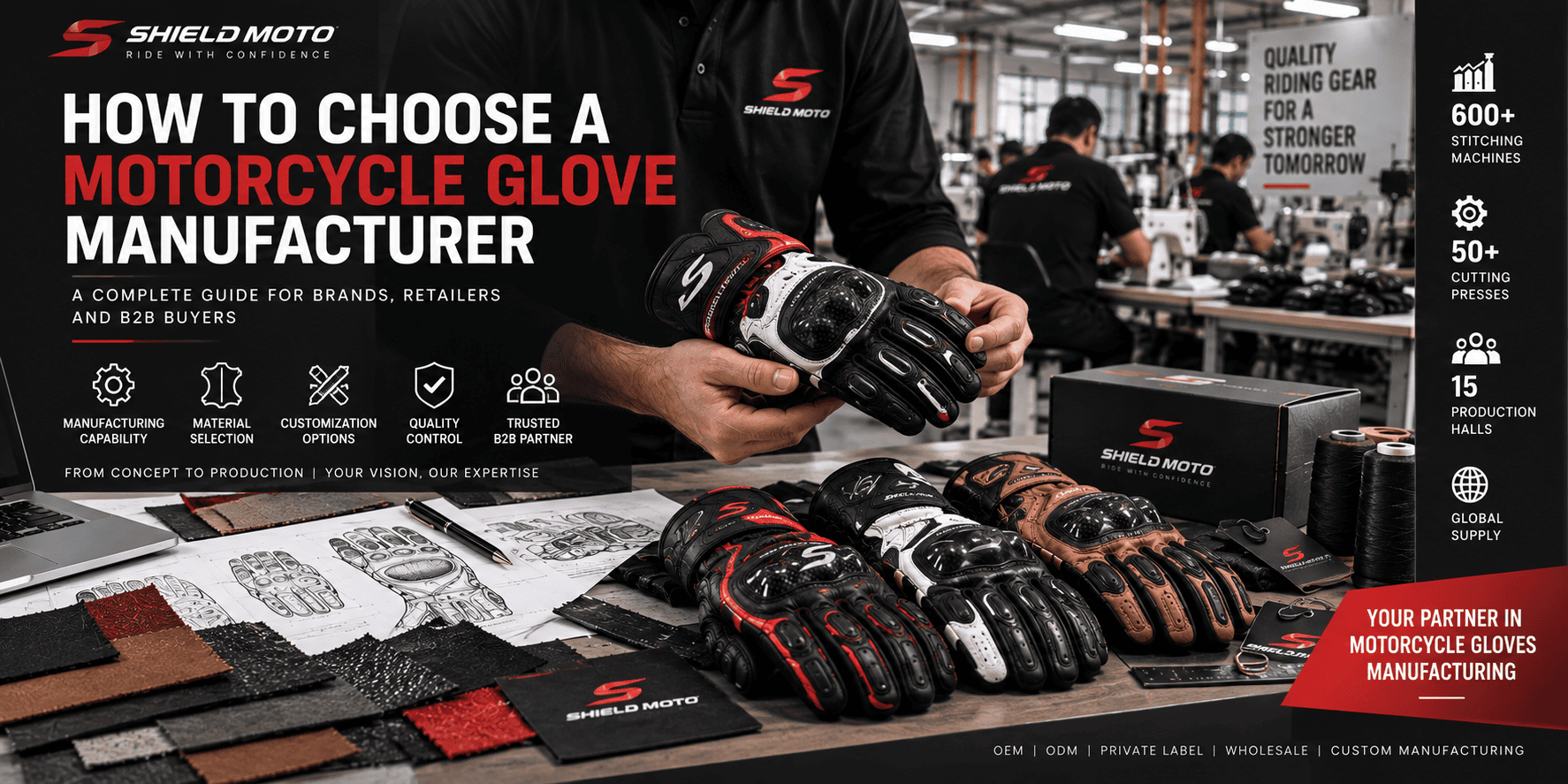
Choosing a motorcycle glove manufacturer is not simply a matter of finding a supplier with a competitive price. The right manufacturer should be able to consistently produce the glove construction, materials, fit, branding, quality requirements, and packaging your business needs.
For motorcycle brands, retailers, distributors, and clubs, the decision should be based on manufacturing capability, product expertise, customization, quality control, sampling, communication, and long-term sourcing requirements.
A good motorcycle glove manufacturer should match your product requirements with its actual manufacturing capabilities.
Before selecting a supplier, evaluate:
The lowest quoted price is rarely enough information to make a reliable supplier decision.
Different motorcycle glove categories require different designs, materials, construction methods, and features.
Define your product range before approaching manufacturers.
| Glove Type | Typical Buyer Requirement |
|---|---|
| Long Racing Gloves | Extended wrist coverage and race-oriented construction |
| Short Racing Gloves | Shorter cuff design for riders seeking a more compact glove |
| Winter Motorcycle Gloves | Insulation and weather-oriented construction |
| Vintage Gloves | Classic styling for cruiser, cafe-racer, and heritage markets |
| Custom Biker Gloves | Brand-specific designs and customization |
| Half-Finger Gloves | Lightweight design and increased finger exposure |
| Motocross Gloves | Lightweight, flexible construction for off-road riding |
Your manufacturer should have relevant experience with the category you intend to develop.
For example, a supplier specializing only in general fashion gloves may not be the best choice for a technical racing glove requiring specialized construction and protective components.
One of the first questions to ask is:
Are you a direct manufacturer, or are you a trading company sourcing gloves from another factory?
This distinction matters because direct manufacturers may provide greater visibility into product development, materials, production processes, quality assurance, customization, and packaging.
Ask the supplier to explain:
A supplier should be able to give clear answers rather than simply presenting a product catalog.
Motorcycle gloves are not simply ordinary gloves with motorcycle branding.
A manufacturer should understand factors such as:
Ask how long the manufacturer has worked with motorcycle gloves or related protective gear.
Experience is particularly important when developing a new product because design decisions can affect both usability and manufacturability.
Shield Moto identifies its parent company, Solehre Brothers Industries, as established in 2002 and positions Shield Moto around motorcycle gloves, OEM manufacturing, private-label manufacturing, and customized production.
Material selection should be based on the intended use of the glove rather than simply choosing the material with the lowest cost.
Depending on the product, buyers may need to evaluate:
The manufacturer should be able to explain why a particular material or construction is suitable for your product.
Do not accept vague statements such as “premium material” without asking what the material actually is and where it is used.
For a custom product, document the agreed materials and construction specifications in the product specification or purchase documentation.
A capable motorcycle glove manufacturer should be able to support more than bulk stitching.
Product development may involve:
Ask how design changes are handled between the first prototype and the approved production version.
This is especially important for brands creating their own glove collection.
Shield Moto states that its manufacturing operation includes R&D, cutting, printing, stitching, quality assurance, and packing. Its website also identifies dedicated production infrastructure including stitching, cutting, CNC, sublimation, and heat-transfer equipment.
If you are building your own motorcycle glove brand, customization may be one of the most important selection criteria.
Ask whether the manufacturer can support the elements you actually require, such as:
Do not assume that every manufacturer offering “custom gloves” can provide every customization method.
Request confirmation of each required customization separately.
Shield Moto’s custom biker glove category specifically identifies customization involving logos, colorways, embroidery, sublimation printing, material selection, and sampling.
These terms are often used interchangeably, but buyers should clarify exactly what the supplier means.
| Manufacturing Model | Suitable For | Main Consideration |
|---|---|---|
| OEM | Brands with defined product requirements | Confirm specifications, responsibilities, and production requirements |
| Private Label | Businesses selling products under their own brand | Confirm available product customization and branding |
| Custom Manufacturing | Brands developing a specific glove design | Confirm design, materials, construction, sampling, and production process |
| Wholesale | Retailers and distributors purchasing existing models | Focus on product range, pricing, consistency, and ordering requirements |
The exact commercial relationship should always be defined in writing.
For custom or private-label projects, clarify ownership and usage rights for designs, artwork, branding, packaging, and other intellectual property before production begins.
A sample is one of the most useful tools for evaluating a motorcycle glove manufacturer.
Do not judge a supplier entirely from photographs or a digital catalog.
Use the sample to evaluate:
Check finger length, palm fit, wrist fit, cuff position, and closure security.
Inspect stitching, seams, panels, reinforcement, closures, and overall workmanship.
Confirm that the delivered material matches the agreed specification.
Check logo placement, printing, embroidery, labels, and other branding details.
Evaluate whether the glove allows the hand to move naturally and operate motorcycle controls comfortably.
Compare the physical sample against the approved drawings, specifications, and reference materials.
Shield Moto’s website provides a request-a-sample option and its custom glove page states that sampling is available before bulk production.
Quality assurance should not be treated as a final inspection only.
Ask how quality is managed throughout production.
Important areas include:
Ask the manufacturer what happens when a production issue is identified.
A useful supplier should be able to explain its quality process rather than simply saying that every product is “high quality.”
Shield Moto identifies quality assurance as one of its production processes and states that quality inspection is incorporated into its manufacturing operation.
Production capacity matters when you are scaling a motorcycle glove collection.
A manufacturer with substantial production infrastructure may be better positioned to handle larger recurring orders, but capacity alone does not guarantee that the supplier is right for your business.
Evaluate capacity together with:
Shield Moto currently states that its facilities include more than 600 stitching machines, 50+ cutting presses, 15+ CNC machines, 15 production halls, and production capacity exceeding 6 million gloves annually. These are manufacturer-stated figures and should be evaluated alongside your specific production requirements.
A motorcycle glove manufacturer should understand the requirements of the markets where you intend to sell.
Before placing an order, clarify:
Do not assume that a manufacturer supplying one market automatically satisfies every requirement of another market.
If your product requires specific certification or testing, request the relevant documentation and verify its validity rather than relying on a general marketing statement.
Price comparisons are difficult when every supplier is quoting a different product.
Create one standardized specification covering:
Then send the same specification to each manufacturer.
This allows you to compare suppliers more accurately.
| Evaluation Area | Supplier A | Supplier B | Supplier C |
|---|---|---|---|
| Motorcycle glove specialization | |||
| Manufacturing model | |||
| Materials | |||
| Customization | |||
| Sampling | |||
| Quality assurance | |||
| Production capability | |||
| Packaging | |||
| Communication | |||
| Required documentation | |||
| Commercial terms |
The goal is not simply to identify the cheapest supplier. It is to identify the supplier offering the best fit for your actual product and business requirements.
Before moving forward, ask the manufacturer:
A manufacturer that provides clear, specific answers is easier to evaluate than one that relies on generic sales language.
Be cautious when a supplier:
A low initial price can become expensive if it leads to inconsistent quality, incorrect specifications, defective products, or repeated production problems.
Shield Moto is a Pakistan-based motorcycle glove manufacturer operating under Solehre Brothers Industries, whose history dates to 2002.
The company states that it provides OEM and private-label manufacturing and offers customized solutions involving areas such as material selection, design, packaging, and branding. Its product ecosystem includes racing, winter, vintage, custom biker, half-finger, and motocross gloves.
For a buyer developing or sourcing motorcycle gloves, the relevant next step is not simply to select a supplier from a webpage. It is to provide the manufacturer with a clear product specification and evaluate the resulting sample, manufacturing process, quality requirements, and commercial terms.
For custom projects, Shield Moto’s Custom Biker Gloves category is particularly relevant because it is structured around custom product development and B2B manufacturing.
Before choosing a manufacturer, confirm:
If several of these points remain unclear, the supplier should not be selected solely because of price.
A good manufacturer should have relevant motorcycle glove experience, appropriate production capabilities, consistent quality control, clear communication, and the ability to meet the product’s material, construction, branding, packaging, and customization requirements.
It depends on the project. A direct factory may provide greater visibility into manufacturing and customization, while a trading company may coordinate products from multiple factories. In either case, confirm who actually manufactures the gloves and who is responsible for quality.
Yes, when possible. A sample allows you to evaluate fit, construction, materials, branding, and workmanship before committing to larger production.
OEM arrangements generally involve manufacturing according to defined customer requirements, while private-label products are manufactured for sale under the customer’s brand. The exact responsibilities, customization, and intellectual-property terms should be defined in the commercial agreement.
Yes, depending on the manufacturer’s capabilities. Customization may include elements such as design, materials, colors, branding, printing, embroidery, construction, and packaging. Each capability should be confirmed with the manufacturer.
Start with the manufacturer’s production model, motorcycle glove experience, available product categories, materials, customization capabilities, sampling process, quality-control procedures, and commercial requirements.
Send both manufacturers the same detailed product specification and compare their responses across materials, construction, customization, sampling, quality control, production capabilities, documentation, commercial terms, and communication—not price alone.
Choosing a motorcycle glove manufacturer should be treated as a product-development and sourcing decision, not simply a price comparison.
The strongest evaluation process starts with your product requirements, verifies the manufacturer’s actual capabilities, reviews materials and construction, requests samples where appropriate, evaluates quality control, and establishes clear commercial and technical responsibilities.
For motorcycle brands, retailers, distributors, and other B2B buyers, a manufacturer that can support product development, customization, sampling, production, quality assurance, and packaging can provide a more complete sourcing solution.
If you are developing a custom motorcycle glove collection, the next practical step is to prepare your product requirements and discuss them with the manufacturer before moving into sampling or bulk production.