Need help? Ask an expert your product and motorbike gloves questions
Need help? Ask an expert your product and motorbike gloves questions
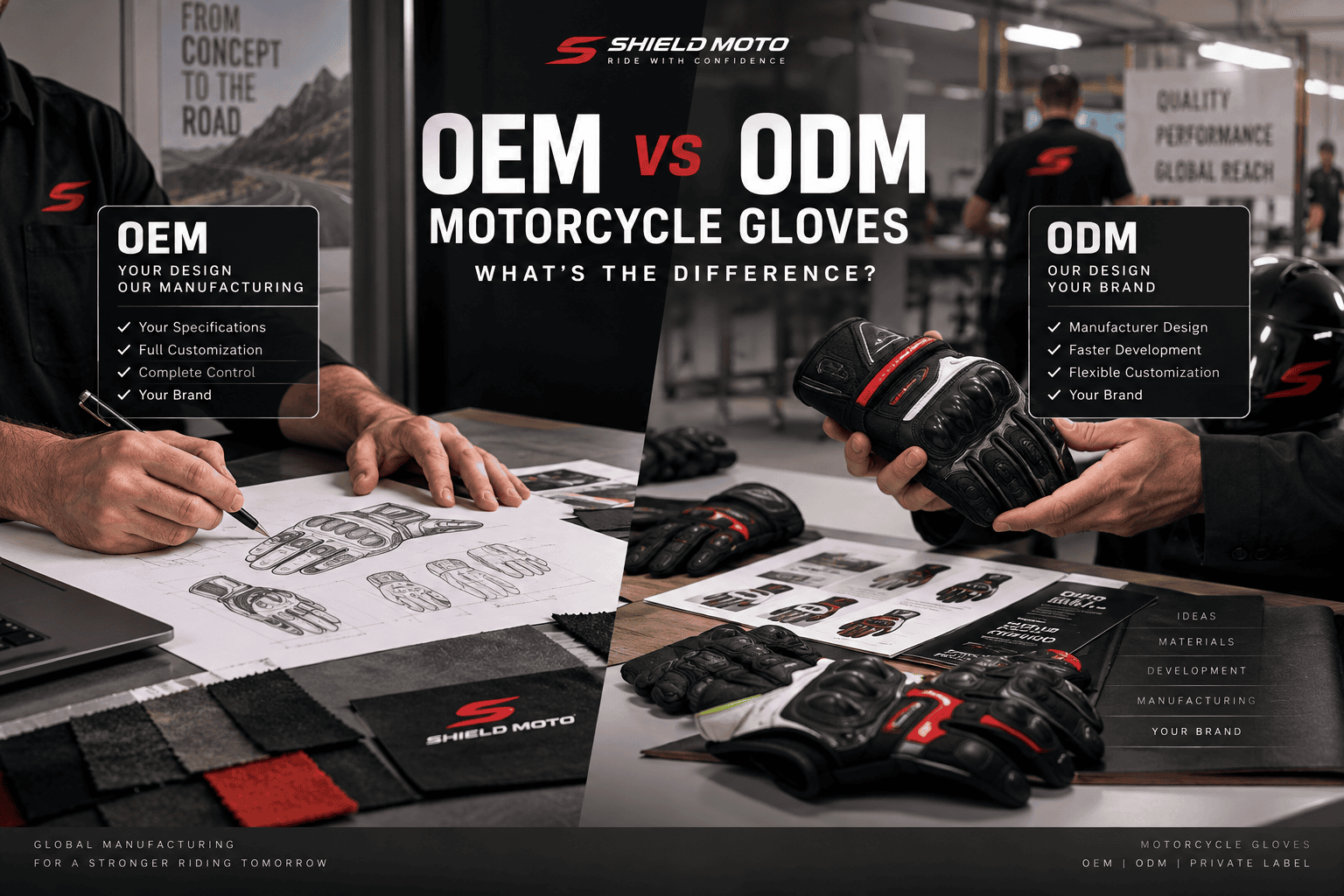
If you are developing a motorcycle glove collection for your brand, OEM and ODM manufacturing offer two different ways to bring the product to market. The main difference is where the product design comes from: in a traditional OEM arrangement, the buyer provides the product specifications and the manufacturer produces to those requirements; in an ODM arrangement, the manufacturer contributes the product design and manufacturing, while the buyer sells the finished product under its own brand.
For motorcycle gloves, that distinction affects design control, customization, product development, intellectual-property arrangements, sampling, production workflow, and how much development work your brand needs to handle.
For brands, retailers, distributors, and motorcycle clubs, choosing the right model starts with one question:
Do you already have a glove design you want manufactured, or do you want a manufacturer to help provide the product design?
| Factor | OEM Motorcycle Gloves | ODM Motorcycle Gloves |
|---|---|---|
| Product concept | Usually supplied by the buyer | Manufacturer contributes the design |
| Manufacturing | Manufacturer produces the agreed product | Manufacturer designs and produces |
| Design control | Higher buyer control | More manufacturer involvement |
| Customization | Can be highly specific | Depends on the manufacturer’s available designs and customization |
| Product development | Buyer typically provides more input | Manufacturer can provide more development support |
| Branding | Customer’s brand | Customer’s brand |
| Best suited for | Brands with defined product specifications | Brands wanting a faster route using manufacturer-developed designs |
| Main consideration | Development and specification work | Design ownership and customization terms |
The exact commercial arrangement can vary between manufacturers, so the contract should clearly define design ownership, specifications, approvals, branding, tooling where applicable, and production responsibilities.
OEM motorcycle glove manufacturing generally means a brand supplies the product requirements or design specifications and the manufacturer produces the gloves according to those specifications.
In a traditional OEM relationship, the customer may provide elements such as:
The manufacturer then converts those requirements into a production-ready product.
This approach is particularly useful when a motorcycle brand already knows exactly what it wants to sell.
Imagine a motorcycle apparel brand has developed its own racing glove.
The brand has already determined:
The brand then sends the specifications to a motorcycle glove manufacturer.
The manufacturer’s role is primarily to manufacture the product according to the agreed specifications, subject to the actual capabilities and development process of the factory.
This gives the buyer substantial control over the finished product.
ODM stands for Original Design Manufacturer. In an ODM model, the manufacturer contributes substantially to product design as well as manufacturing. WIPO describes ODM as a model involving both design and production, while the customer uses the resulting product under its own commercial operation.
For motorcycle gloves, this can mean a manufacturer has existing glove designs, construction expertise, materials, patterns, and product-development capabilities that a customer can use as the starting point for its own collection.
Depending on the agreement, the customer may customize elements such as:
However, do not assume that every ODM manufacturer offers the same customization or design-rights arrangement. Those details should be confirmed before production.
Generally, OEM gives the buyer more direct control over the product specification, because the manufacturing relationship is built around the buyer’s defined requirements.
ODM can provide greater manufacturer involvement in product development, which may reduce the amount of design and technical development work the brand needs to perform itself.
That creates a practical trade-off:
OEM → more control over your defined product specification
ODM → more manufacturer involvement in product development
Neither model is automatically better. The appropriate option depends on your brand’s resources, product strategy, desired uniqueness, and manufacturing requirements.
OEM is usually worth considering when your business already has a clear product concept.
It may be appropriate for a brand that:
For example, a performance motorcycle brand may have already developed a racing glove with a particular cuff design, palm construction, reinforcement layout, and branding system.
In that situation, an OEM manufacturing relationship can allow the brand to focus on turning its defined product into a manufacturable product at commercial scale.
ODM can be attractive when a company wants to launch motorcycle gloves without developing every element of the product from scratch.
It may suit:
Instead of starting with a completely blank sheet, the buyer can work from manufacturer-developed products and determine what can be customized.
The exact level of customization should always be confirmed with the manufacturer.
The development workflow can look different under each model.
1. Product concept
The brand establishes the product requirements.
2. Technical specifications
Materials, construction, measurements, branding, colors, features, and other requirements are documented.
3. Manufacturer review
The factory evaluates the requirements and determines how the product can be produced.
4. Prototype or sample
A sample is developed for evaluation.
5. Sample approval
The buyer reviews fit, appearance, construction, materials, branding, and other agreed specifications.
6. Production
The approved product moves into manufacturing.
The exact process varies by manufacturer and project.
1. Product selection or concept
The buyer starts with a manufacturer-developed design or product-development capability.
2. Customization discussion
The brand determines which elements can be modified.
3. Branding
Logo, colors, labels, packaging, and other brand elements are incorporated where supported.
4. Sampling
A sample is produced for review.
5. Approval
The buyer approves the final agreed specifications.
6. Production
The manufacturer produces the approved product.
Again, the exact workflow depends on the manufacturer’s development process.
Whether you choose OEM or ODM, motorcycle gloves involve multiple product decisions.
A professional B2B buyer should consider more than simply adding a logo.
Decide whether the product is intended for:
The intended use influences the design priorities.
For example, a long racing glove may emphasize extended wrist coverage and a race-oriented construction, while a short glove may prioritize convenience for everyday riding.
Material selection can influence:
There is no single material that is automatically ideal for every motorcycle glove.
The appropriate material depends on the intended product and riding environment.
Shield Moto’s website also provides a material-oriented guide covering technologies and materials used in motorcycle gloves, including products and technologies such as CORDURA®, COOLMAX®, KEVLAR®, HIPORA®, and other branded materials.
The palm is an important area to evaluate because riders rely on their hands for grip and motorcycle controls.
When developing a glove, consider:
For example, Shield Moto’s published long racing glove specification includes goat skin leather on the palm with Chamude® leather and additional palm reinforcement.
That illustrates why a buyer should evaluate the complete construction, rather than judging a glove solely by its outer appearance.
For protective motorcycle gloves, buyers should identify what protective components are actually incorporated into the product.
These may include:
However, buyers should distinguish between a design feature and a verified safety certification or test result.
Do not assume that a particular protector or reinforcement automatically means a glove has a specific regulatory rating.
If compliance is required for your target market, ask the manufacturer for the applicable documentation and test evidence.
Glove length and cuff construction affect how the glove interfaces with the rider’s wrist and jacket sleeve.
Long racing gloves can provide more wrist coverage than short gloves.
For example, Shield Moto’s published long racing glove specification includes a dual wrist closure system, adjustable cuff, and wrist strap tightening.
When developing your own product, determine whether your target customer needs:
The right choice depends on the intended use.
Both OEM and ODM manufacturing can support branded products, but the exact branding options depend on the manufacturing agreement.
Possible branding elements can include:
Shield Moto states that its OEM and private-label manufacturing services can involve material selection, design, packaging, and branding customization. Its custom biker glove category also identifies options including logo/color customization, embroidery, sublimation printing, material selection, and pre-production sampling.
For a B2B project, ask the manufacturer to separate:
What is customizable?
from
What is already part of the manufacturer’s existing design?
That distinction becomes especially important for ODM projects.
This is one of the most important issues to clarify before placing an order.
Do not assume that choosing OEM automatically means every design element belongs to the buyer, or that choosing ODM automatically gives the manufacturer unlimited rights.
The contract should clearly address:
WIPO’s discussion of the OEM-to-ODM manufacturing model highlights the distinction between customer-specified manufacturing and manufacturer-led design and production.
For a serious motorcycle brand, design ownership and exclusivity should be contractual rather than assumed from the label “OEM” or “ODM.”
Use this simple decision framework.
| Your Situation | More Suitable Starting Point |
|---|---|
| You already have detailed glove specifications | OEM |
| You have your own product drawings | OEM |
| You have a unique proprietary design | OEM |
| You need extensive product customization | OEM may be appropriate |
| You do not have an in-house glove designer | ODM may be appropriate |
| You want to start from an existing manufacturer design | ODM |
| You want manufacturer design involvement | ODM |
| You need a branded product but do not want to develop every detail yourself | ODM may be appropriate |
| You are testing a new glove collection | ODM may provide a practical starting point |
This is a starting framework, not a universal rule. The manufacturer’s actual capabilities and your contractual requirements still need to be evaluated.
Before selecting an OEM or ODM partner, ask detailed questions.
Do not rely on generic answers. Ask the manufacturer to confirm project-specific requirements in writing.
Shield Moto is a Pakistan-based motorcycle glove manufacturer operating under Solehre Brothers Industries, whose history dates to 2002. Shield Moto states that it specializes in OEM and private-label manufacturing and provides customized solutions aligned with a customer’s brand identity and performance requirements.
Its published manufacturing information identifies capabilities including:
The Shield Moto website currently states production infrastructure including 600+ stitching machines and production capacity exceeding 6 million gloves annually.
Its custom biker glove category also states that pre-production samples can be provided before bulk production and identifies customization options such as material selection, embroidery, sublimation printing, colors, and branding.
For a motorcycle brand evaluating Shield Moto, the appropriate next step is to discuss whether the project should be developed around your own specifications, an existing manufacturer design, or a combination of both.
For a new brand without an established product-development team, ODM can provide a simpler starting point because the manufacturer may already have product designs and manufacturing knowledge that can be adapted to the brand’s requirements.
For a brand that has already developed its own glove designs, OEM is generally the more natural model because the manufacturer can work from the buyer’s defined specifications.
The important point is not to choose a manufacturing term simply because it sounds more advanced.
Choose the model that gives your business the appropriate balance of:
Before moving from discussion to production, make sure you have documented:
A clear specification reduces misunderstandings between the buyer and manufacturer.
OEM generally means the buyer provides the product requirements or design and the manufacturer produces the gloves to those specifications. ODM involves the manufacturer contributing to the product design as well as manufacturing it. The precise commercial arrangement can vary, so design ownership and customization rights should be confirmed contractually.
Not necessarily. OEM is generally more appropriate when a brand already has a defined product specification and wants greater control over the product. ODM can be useful when a brand wants manufacturer design involvement or wants to begin from an existing manufacturer-developed product.
Yes, branding can be incorporated into an OEM project when supported by the manufacturer’s capabilities and agreed specifications. The logo artwork, placement, labeling, and packaging requirements should be documented before production.
Often yes, but the available customization depends on the manufacturer’s designs and capabilities. Ask specifically which elements can be changed, such as colors, materials, logos, printing, embroidery, construction, and packaging.
Ask about product-development capabilities, materials, customization, sampling, quality assurance, production capacity, testing documentation, MOQ, lead times, packaging, intellectual-property arrangements, and the process for approving production samples.
ODM may be a practical starting point when the brand wants to use manufacturer-developed designs and add its own branding. OEM may be preferable when the brand has its own detailed product specifications. The right option depends on the required level of differentiation and control.
No. ODM describes the manufacturer’s role in product design and production; it does not by itself determine ownership of your brand. Trademark, product-design, artwork, exclusivity, and other intellectual-property rights should be explicitly addressed in the agreement.
Shield Moto states that it provides OEM and private-label manufacturing and customized solutions, including material selection, design, packaging, and branding. Its custom biker glove category also states that pre-production samples are available before bulk production.
The simplest way to understand OEM vs ODM motorcycle gloves is to look at who drives product design.
OEM: Your brand defines the product; the manufacturer produces it according to the agreed specifications.
ODM: The manufacturer contributes the product design and manufacturing; your brand sells the resulting product under its own brand, subject to the agreed customization and IP terms.
For brands with established technical specifications, OEM can provide a strong route to a highly defined motorcycle glove. For businesses that want manufacturer design involvement, ODM can reduce the amount of product development they need to handle internally.
Before selecting either model, focus on the details that actually determine the success of the project: product specifications, materials, construction, customization, sampling, quality requirements, intellectual property, testing documentation, MOQ, production terms, and communication with the manufacturer.
For businesses ready to develop a branded motorcycle glove collection, the logical next step is to review available glove designs and discuss whether the project is better suited to an OEM, ODM, or private-label manufacturing workflow.