Need help? Ask an expert your product and motorbike gloves questions
Need help? Ask an expert your product and motorbike gloves questions
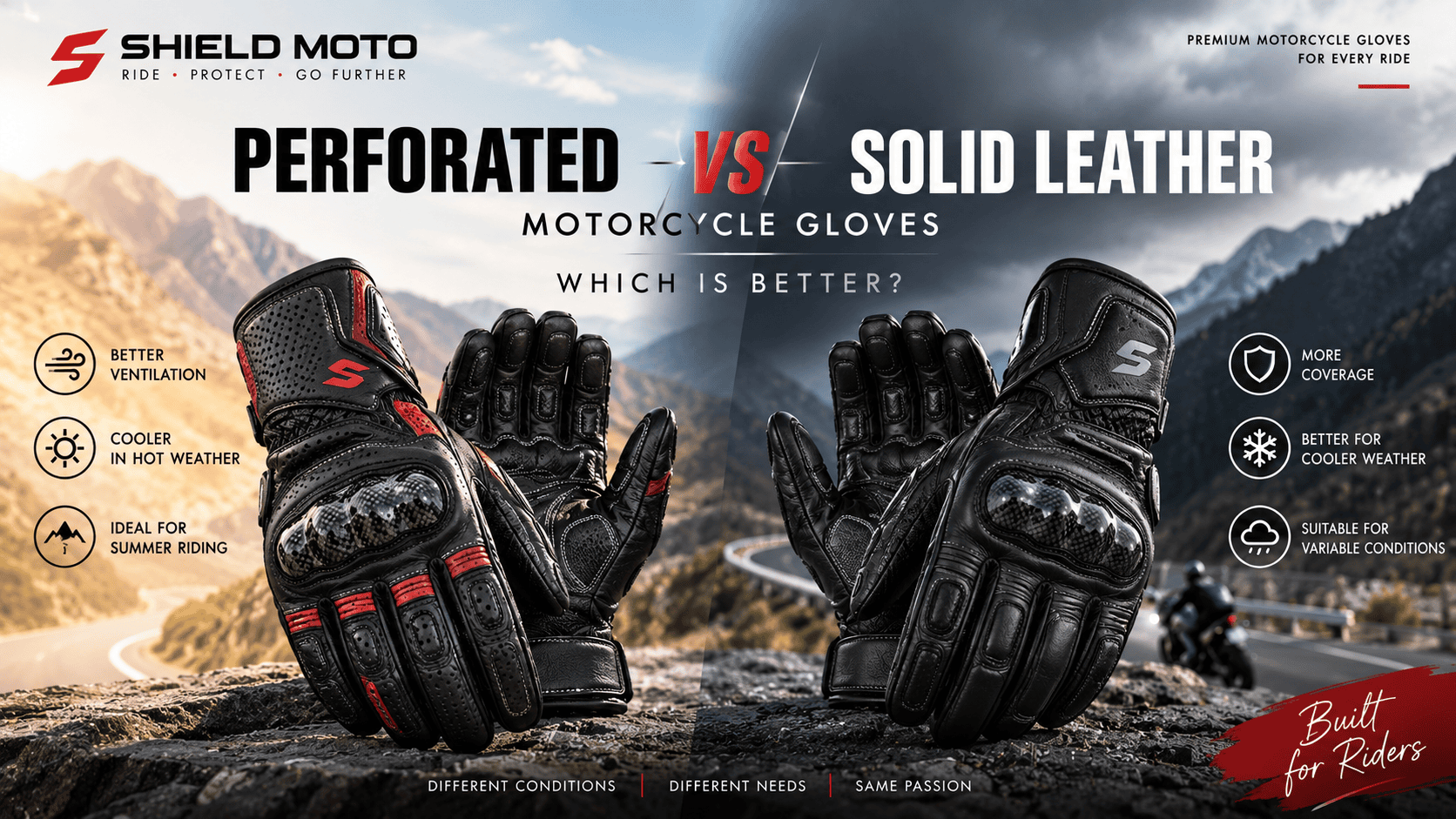
Perforated and solid leather motorcycle gloves are designed for different riding conditions. Perforated leather gloves prioritize airflow and ventilation, while solid leather gloves generally provide a more closed construction that can be better suited to cooler, variable, or weather-exposed conditions.
Neither construction is automatically better for every rider. The right choice depends on climate, riding duration, riding style, glove construction, protection requirements, and how much ventilation you need.
For motorcycle brands and glove buyers, the same principle applies: the leather construction should be selected according to the intended use of the finished glove rather than treated as a universal performance ranking.
The primary difference is the presence of small ventilation perforations in the leather.
Perforated leather contains controlled holes or openings across selected panels to allow more air to move through the glove. Solid leather does not use these ventilation holes and creates a more continuous leather surface.
| Feature | Perforated Leather Gloves | Solid Leather Gloves |
|---|---|---|
| Airflow | Higher potential airflow | Lower natural airflow |
| Hot-weather comfort | Generally better suited | Can feel warmer |
| Cooler conditions | Less suitable in some conditions | Generally more suitable |
| Weather exposure | Requires consideration of openings | More closed construction |
| Ventilation | Main advantage | Depends more on glove design |
| Leather appearance | Distinct perforated appearance | Continuous leather surface |
| Typical use | Warm-weather riding | Cooler, variable or general riding |
| Protection | Depends on complete glove construction | Depends on complete glove construction |
The table describes construction characteristics, not a safety ranking. The protective performance of a motorcycle glove depends on the complete product, including materials, seams, reinforcement and protective components.
Perforated motorcycle gloves use small openings in selected leather panels to increase airflow.
This construction is particularly relevant when riders regularly deal with hot temperatures or long periods of riding in warm conditions.
The biggest reason to choose perforated leather is airflow.
Air can pass through the perforated sections while the motorcycle is moving, potentially making the glove feel less enclosed than a comparable solid-leather construction.
This can be useful for:
However, ventilation depends on more than perforation alone. The location and size of the perforations, leather construction, lining, palm design, cuffs and other materials all influence the final airflow characteristics.
Not every perforated glove has the same ventilation performance.
Manufacturers can place perforations on areas such as:
The palm requires particular consideration because it interacts directly with the motorcycle controls and may require additional reinforcement or grip materials.
A glove with perforated backhand panels may therefore provide a different airflow experience from a glove with extensive perforation across several panels.
Solid leather gloves use a continuous leather construction without ventilation perforations in the relevant panels.
They are often considered when the rider wants a more enclosed glove construction.
Solid leather can be appropriate for:
Solid leather does not mean that the glove cannot have ventilation. A manufacturer can incorporate other ventilation methods or breathable materials into the design.
The important distinction is that the leather itself does not rely on perforation to create airflow.
For hot-weather riding, perforated leather is generally the more logical starting point because its construction is specifically intended to increase airflow through the leather.
This does not mean every perforated glove will feel cool in every situation.
Comfort also depends on:
For riders in consistently hot climates, ventilation should therefore be evaluated as part of the entire glove design rather than by looking at the word “perforated” alone.
For cooler riding, solid leather may be the more practical option because it does not intentionally introduce the same type of airflow openings into the leather.
A solid construction can also be combined with:
For cold or wet riding, however, the complete glove specification matters much more than whether the outer leather is perforated or solid.
A winter motorcycle glove, for example, is designed around a different set of requirements from a lightweight summer riding glove.
Perforation by itself does not establish whether a motorcycle glove is safe or unsafe.
Protection depends on the complete glove design and, where applicable, the testing and certification of the finished product.
Important elements include:
A perforated leather glove should therefore not be described as automatically less protective simply because it contains ventilation holes.
Likewise, a solid leather glove should not automatically be described as more protective merely because its leather surface is continuous.
The correct question is:
How was the complete glove engineered and tested for its intended application?
Racing gloves require a broader evaluation than simply choosing between perforated and solid leather.
Track-focused riders may want:
Perforated leather can be incorporated into racing gloves when ventilation is important.
Solid leather can also be appropriate when the product specification prioritizes a more enclosed construction.
Shield Moto currently offers long and short racing glove categories, demonstrating that glove design can be developed around different riding applications rather than relying on a single leather configuration.
Touring riders often face changing temperatures and weather conditions.
For long-distance riding, consider:
Best considered when:
Worth considering when:
For touring, there may not be a single correct answer. A rider travelling through multiple climates may prioritize versatility over maximum ventilation.
For commuting, climate should be one of the first considerations.
A rider commuting in a hot city may prefer perforated leather because airflow can make a noticeable difference during warm rides.
A commuter riding in cooler weather may prefer solid leather.
The best choice can also change seasonally. Some riders may benefit from having separate summer and cooler-weather motorcycle gloves rather than expecting one glove to perform optimally in every condition.
Fit matters for both perforated and solid leather gloves.
A glove that is excessively tight can create pressure points and reduce comfort. A glove that is too loose can reduce control and allow unwanted movement.
A properly designed motorcycle glove should balance:
Perforation cannot compensate for poor fit.
Likewise, solid leather does not automatically provide a better riding experience if the glove is poorly fitted.
When comparing two motorcycle gloves, look beyond the backhand.
The palm is one of the most important areas to inspect because it directly interacts with the motorcycle controls.
Look for:
A manufacturer may combine different materials across the glove rather than using identical leather construction throughout.
For example, Shield Moto’s Long Racing Gloves model SH-07-7001 uses goat skin leather on the backhand and palm together with Chamude leather reinforcement and additional protective components.
This illustrates why material selection needs to be evaluated as part of the entire glove architecture.
| If Your Priority Is… | Consider |
|---|---|
| Maximum ventilation in hot weather | Perforated leather |
| Warm-weather commuting | Perforated leather |
| Summer riding | Perforated leather |
| Cooler-weather riding | Solid leather |
| More enclosed construction | Solid leather |
| Variable temperatures | Solid leather or application-specific design |
| Racing in hot conditions | Perforated racing design may be appropriate |
| Touring across changing climates | Evaluate the complete glove system |
| Custom brand development | Select based on target market and product specification |
This is a starting point rather than a universal rule.
Perforated leather is generally the better choice when ventilation is the priority. Solid leather is generally the better starting point when the rider wants a more enclosed construction for cooler or variable conditions.
For motorcycle brands, the decision should begin with the target market.
A brand selling summer riding gear in a hot climate may want perforated leather options.
A brand targeting touring, cooler-weather or more versatile riding may prefer solid leather or a combination of materials.
The correct specification depends on the final product’s intended use.
For OEM, private-label or custom motorcycle glove programs, perforation should be treated as a product-development decision, not simply a visual feature.
Before production, define:
Will the glove be sold primarily in:
Identify whether the glove is intended for:
Determine:
Define the required:
Any required certification or testing should be specified and verified for the finished glove.
Custom glove programs can incorporate elements such as:
Shield Moto states that its OEM and private-label manufacturing services support customization involving material selection, design, packaging and branding.
A sample should be reviewed before bulk production.
Evaluate:
Shield Moto’s custom biker glove program states that pre-production samples can be provided for approval of fit, material and branding before bulk production.
Shield Moto is a Pakistan-based motorcycle glove manufacturer and the in-house brand of Solehre Brothers Industries, whose history on the company website dates back to 2002. The company provides OEM and private-label motorcycle glove manufacturing and identifies R&D, cutting, printing, stitching and quality assurance among its capabilities.
Its product range includes:
For brands developing a motorcycle glove collection, the appropriate construction can therefore be selected around the target rider, climate, product positioning and functional requirements rather than using one construction for every product.
Generally, yes. Perforated leather is specifically designed to allow more airflow than an equivalent solid leather construction, making it a logical choice for warm-weather riding.
Solid leather can be more suitable for cooler conditions because it does not intentionally introduce the same ventilation openings. However, winter performance depends on the complete glove, including insulation, lining and weather-resistant construction.
Not necessarily. Perforation alone does not determine the protective performance of a motorcycle glove. The complete construction and any applicable testing or certification should be evaluated.
Yes. Perforated leather can be incorporated into racing glove designs when ventilation is appropriate for the intended riding environment. The complete racing glove specification remains important.
Yes. A glove can use different material constructions across different panels. This allows manufacturers to balance ventilation, reinforcement, grip, flexibility and other design requirements.
That depends on the product design. The palm interacts directly with the motorcycle controls and may require reinforcement or specialized grip materials, so perforation should be evaluated as part of the complete palm construction.
Custom glove development can include material and design decisions where supported by the manufacturer’s capabilities. Shield Moto provides OEM and private-label manufacturing and states that material selection, design, branding and packaging can be customized.
Ask about leather specification, perforation placement, palm construction, reinforcement, protective components, sizing, sampling, branding, testing requirements, packaging and quality-control procedures.
The choice between perforated and solid leather motorcycle gloves comes down primarily to ventilation versus a more enclosed construction.
Choose perforated leather when warm-weather airflow is a major priority. Consider solid leather when cooler conditions, variable weather or a more enclosed construction are more important.
For motorcycle brands, the decision should go further. Climate, riding style, protection requirements, palm construction, materials, branding and target market should all be defined before production.
The strongest motorcycle glove specification is not simply the one with more perforations or thicker leather. It is the one that matches the actual rider, environment and intended use.