Need help? Ask an expert your product and motorbike gloves questions
Need help? Ask an expert your product and motorbike gloves questions
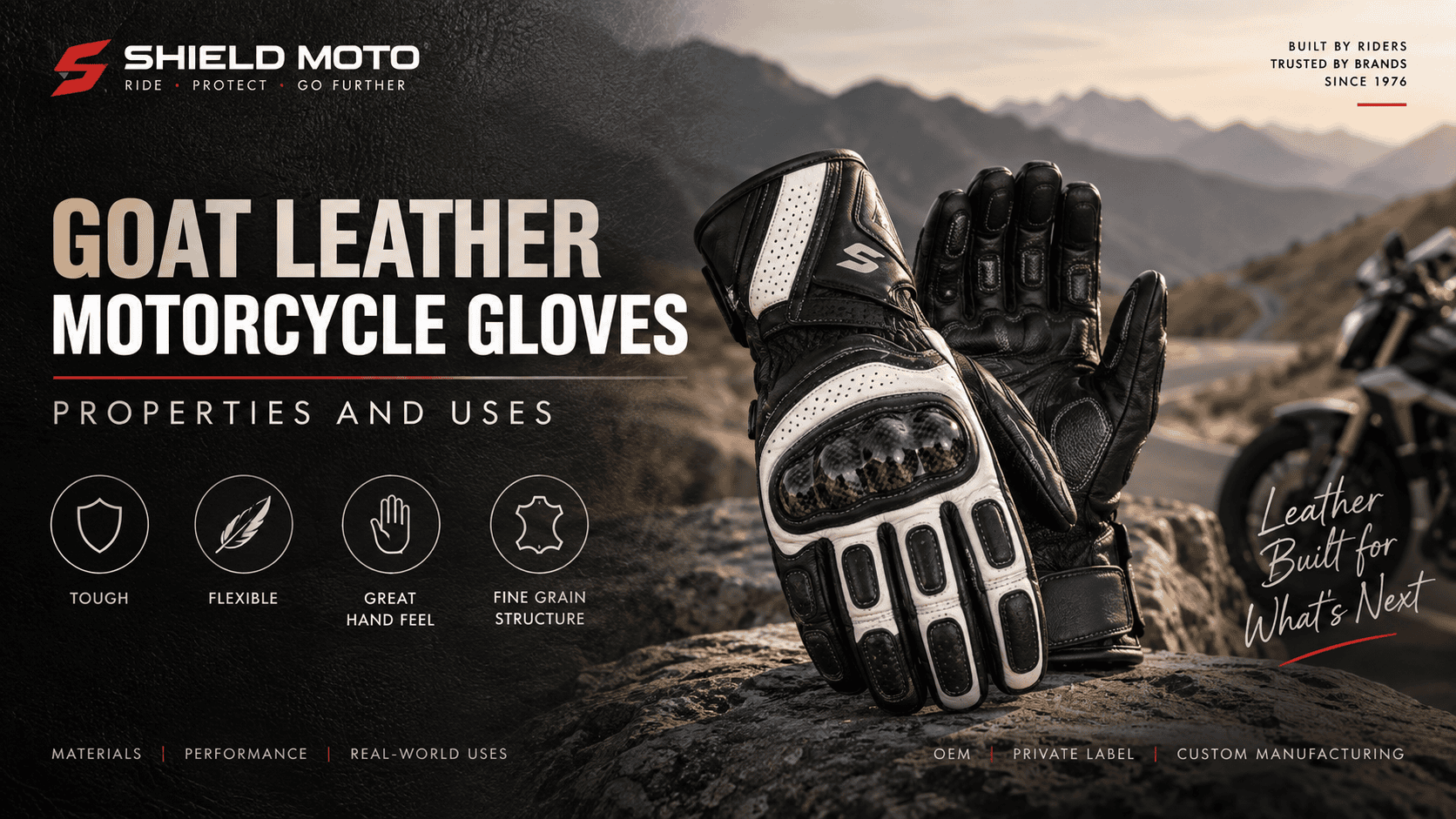
Goat leather is a practical leather choice for motorcycle gloves when a design needs a combination of toughness, a fine grain structure, flexibility, and good hand feel. The Leather Working Group describes goat skin as having a particularly tough and fine grain layer with a relatively dense corium structure.
For motorcycle glove design, those material characteristics can be useful where dexterity, palm feel, comfort, and controlled movement matter. However, the leather itself is only one part of a glove’s performance. Pattern design, thickness, stitching, reinforcement, protective components, closures, lining, and fit all influence the finished glove.
This guide explains what goat leather offers, where it fits into motorcycle glove construction, and what riders and motorcycle brands should consider when selecting or sourcing goat leather gloves.
Goat leather motorcycle gloves are riding gloves made partly or primarily from leather produced from goat skin.
Goat skin has a distinctive fine grain structure and is recognized for a tough grain layer and dense underlying structure.
In motorcycle gloves, goat leather may be used for areas such as:
The exact construction depends on the intended riding application and the manufacturer’s pattern and material specification.
Important: Goat leather should not automatically be treated as equivalent to a certified motorcycle protective glove. Protection depends on the complete glove design and, where applicable, verified testing and certification for the finished model.
Goat skin has a characteristically fine and well-defined grain. The Leather Working Group notes that the grain layer is particularly tough and fine and that goat skin has a denser corium structure than bovine leather.
For glove construction, a fine grain can contribute to a refined leather surface and a comfortable hand feel.
Goat leather is not simply selected for appearance. Its natural structure can provide useful toughness for leather goods.
The Leather Working Group describes goat skin as a tough material suited to wear and tear in small leather goods.
For motorcycle gloves, however, material toughness should not be confused with a specific abrasion, impact, tear, or burst-strength rating. Those characteristics must be evaluated on the finished glove and verified through appropriate testing where required.
Motorcycle gloves need to allow the rider to operate controls while maintaining a secure fit.
Goat leather can be considered when the design prioritizes a flexible leather feel and hand movement. This can be particularly relevant around:
The final result depends heavily on leather selection, thickness, pattern engineering, seams, and construction.
Goat leather has a recognizable natural grain pattern. This can be useful for brands looking for a leather glove with a distinctive natural appearance rather than a completely uniform synthetic surface.
For private-label and custom glove programs, the final appearance can also be influenced by:
There is no single leather that is automatically best for every motorcycle glove.
The appropriate material depends on the intended use, glove construction, target price, required hand feel, protection design, and production specification.
| Consideration | Goat Leather | Cowhide | Kangaroo Leather |
|---|---|---|---|
| Grain character | Fine, distinctive grain | Generally broader/heavier leather character | Fine, premium leather commonly used in performance applications |
| Typical design consideration | Dexterity and leather hand feel | Durability and robust construction | Lightweight performance and flexibility |
| Potential motorcycle use | Riding, racing and custom glove designs depending on construction | Racing, touring and general protective glove designs depending on construction | Performance-focused glove designs |
| Important qualification | Final performance depends on glove construction | Leather alone does not establish protection | Finished glove must be assessed as a complete product |
The comparison should be treated as a material-selection guide rather than a safety ranking. Leather species alone does not determine whether a motorcycle glove is suitable for a particular riding environment.
Goat leather can be incorporated into several parts of a motorcycle glove.
The backhand is highly visible and often requires a balance between structure and movement.
A goat leather backhand can provide a natural leather construction while allowing the pattern to incorporate flex zones and protective components.
The palm has different requirements because it interacts directly with the motorcycle’s controls.
Depending on the glove design, manufacturers may combine goat leather with additional grip or reinforcement materials.
Finger construction requires careful patterning because excessive bulk can interfere with dexterity.
Goat leather can be used in finger panels where the design calls for a leather construction with a relatively refined grain and flexible hand feel.
The thumb and finger joints experience significant movement during riding.
Material selection in these areas should therefore be considered together with:
It can be, depending on the complete glove design and the requirements of the intended application.
Goat leather is currently used in Shield Moto racing glove models. For example, Shield Moto’s Long Racing Gloves model SH-07-7001 specifies goat skin leather for the backhand and palm, with additional reinforcement and protective components in the glove construction.
Shield Moto’s current long-racing category also includes products identified as Camo Racing Gloves – Goat Leather and Chamude Grip Long Racing Gloves – Goat Leather.
This illustrates an important point: the leather material and the protective construction should be evaluated together.
A racing glove may incorporate goat leather while also using components such as:
The exact protection package must be assessed for the specific model.
A motorcycle glove’s protective performance cannot be determined simply by saying it is made from goat leather.
When evaluating a protective glove, look at the complete construction.
The palm is a major contact area and may require additional reinforcement depending on the intended design.
A glove designed for more protective riding may incorporate dedicated knuckle protection.
Long-cuff gloves can provide more coverage around the wrist and lower forearm than short-cuff designs.
Finger protection, seams, reinforcement and articulation all influence the final design.
If a supplier states that a glove is certified or compliant with a motorcycle glove standard, request documentation for the specific finished model.
Do not treat the leather type itself as evidence of certification.
The choice of leather and the choice of glove length are separate decisions.
| Feature | Short Motorcycle Gloves | Long Motorcycle Gloves |
|---|---|---|
| Cuff | Shorter | Extended |
| Wrist coverage | Less | More |
| Convenience | Generally easier for everyday use | More coverage but more substantial cuff |
| Common applications | Commuting, warm-weather riding, everyday riding | Racing, track riding, aggressive riding and applications requiring extended coverage |
| Goat leather possible? | Yes, depending on model | Yes, depending on model |
Shield Moto currently offers both short racing and long racing glove categories, including goat leather models.
Goat leather may be worth considering when the glove specification prioritizes:
It may be particularly relevant for brands developing a leather motorcycle glove collection where material feel and construction need to work together.
It is less useful to ask “Is goat leather the best?” than to ask:
“Is goat leather appropriate for this glove’s intended use, construction, protection requirements and target customer?”
That is the more useful material-selection question.
For a motorcycle brand, retailer, distributor or motorcycle club, material selection should happen before bulk production.
Ask the manufacturer about:
Confirm:
Ask how the leather will be combined with:
A physical sample is important before committing to a larger production run.
A sample allows a buyer to evaluate:
Shield Moto states that it provides pre-production samples for custom glove programs, allowing buyers to review fit, material and branding before bulk production.
For private-label motorcycle gloves, clarify how the brand will be applied.
Possible customization areas may include:
Shield Moto states that its OEM and private-label programs can accommodate material selection, design, packaging and branding customization
Ask how the manufacturer controls quality throughout production.
Relevant production stages can include:
Shield Moto identifies R&D, cutting, printing, stitching, quality assurance and packing among its production activities.
For a motorcycle brand developing its own glove collection, goat leather can be evaluated as part of the product-development specification rather than selected simply as a marketing term.
An OEM or private-label project can define:
Shield Moto is a Pakistan-based motorcycle glove manufacturer whose parent company, Solehre Brothers Industries, dates to 2002. Its website states that the company provides OEM and private-label manufacturing and has dedicated R&D, cutting, printing, stitching and quality-assurance capabilities.
Its current manufacturing site also states production infrastructure including 600+ stitching machines, automatic palm-stitching equipment, 50+ cutting presses, 15+ CNC machines, 15 production halls and a stated capacity exceeding 6 million gloves annually.
For a B2B buyer, those capabilities are relevant to production scalability, but the appropriate glove specification still needs to be established through product development and sampling.
For a B2B buyer, those capabilities are relevant to production scalability, but the appropriate glove specification still needs to be established through product development and sampling.
Goat leather is not merely a theoretical material option in Shield Moto’s range. The company currently lists goat leather motorcycle gloves in both its long-racing and short-racing collections.
Its Long Racing Gloves range includes goat leather models, while its Short Racing Gloves range includes an All-Goat Leather Wet-Grip Short Racing Gloves model and a Camo Anti-Twist Racing Gloves – Goat Leather model.
This makes goat leather particularly relevant for brands and distributors evaluating different leather constructions within a motorcycle glove collection.
Explore Shield Moto Long Racing Gloves
Explore Shield Moto Short Racing Gloves
Explore Shield Moto Custom Biker Gloves
Goat skin has a particularly tough and fine grain layer and a relatively dense corium structure, according to the Leather Working Group. However, the durability of a motorcycle glove depends on the leather specification and complete construction, including seams, reinforcement and protective components.
They can be suitable for racing designs when the complete glove is engineered for the intended application. Shield Moto, for example, currently offers long and short racing gloves using goat leather.
Not universally. Goat leather and cowhide have different characteristics, and the appropriate choice depends on the desired hand feel, construction, riding application, cost target and protection requirements.
Goat leather itself should not automatically be described as waterproof. Water resistance depends on the leather treatment and complete glove construction. If waterproof performance is required, verify the specification of the finished glove.
Yes, custom goat leather glove designs can be developed where the manufacturer offers the required customization. Shield Moto states that its OEM/private-label programs support customization involving materials, design, branding and packaging.
Yes. Shield Moto’s current product ecosystem includes goat leather models and wholesale/OEM manufacturing options for motorcycle businesses, retailers, distributors and private-label brands.
Check the leather specification, fit, stitching, palm construction, knuckle and finger protection, wrist closure, intended riding application and any applicable certification documentation for the exact model.
Shield Moto states that pre-production samples are available for custom glove programs so buyers can evaluate fit, material and branding before bulk production. Shield Moto
Goat leather can be a strong material option for motorcycle gloves when a product requires a fine-grain leather construction, toughness, hand feel and controlled flexibility. But material choice should never be considered separately from the rest of the glove.
For riders, the key considerations are fit, intended riding environment, construction and verified protection features.
For motorcycle brands and B2B buyers, the decision should go further: define the leather specification, glove architecture, protection components, branding, sizing, samples and compliance requirements before production.
Shield Moto offers goat leather models within its current racing glove range and provides OEM, ODM and private-label motorcycle glove manufacturing for brands and other B2B buyers.