Need help? Ask an expert your product and motorbike gloves questions
Need help? Ask an expert your product and motorbike gloves questions
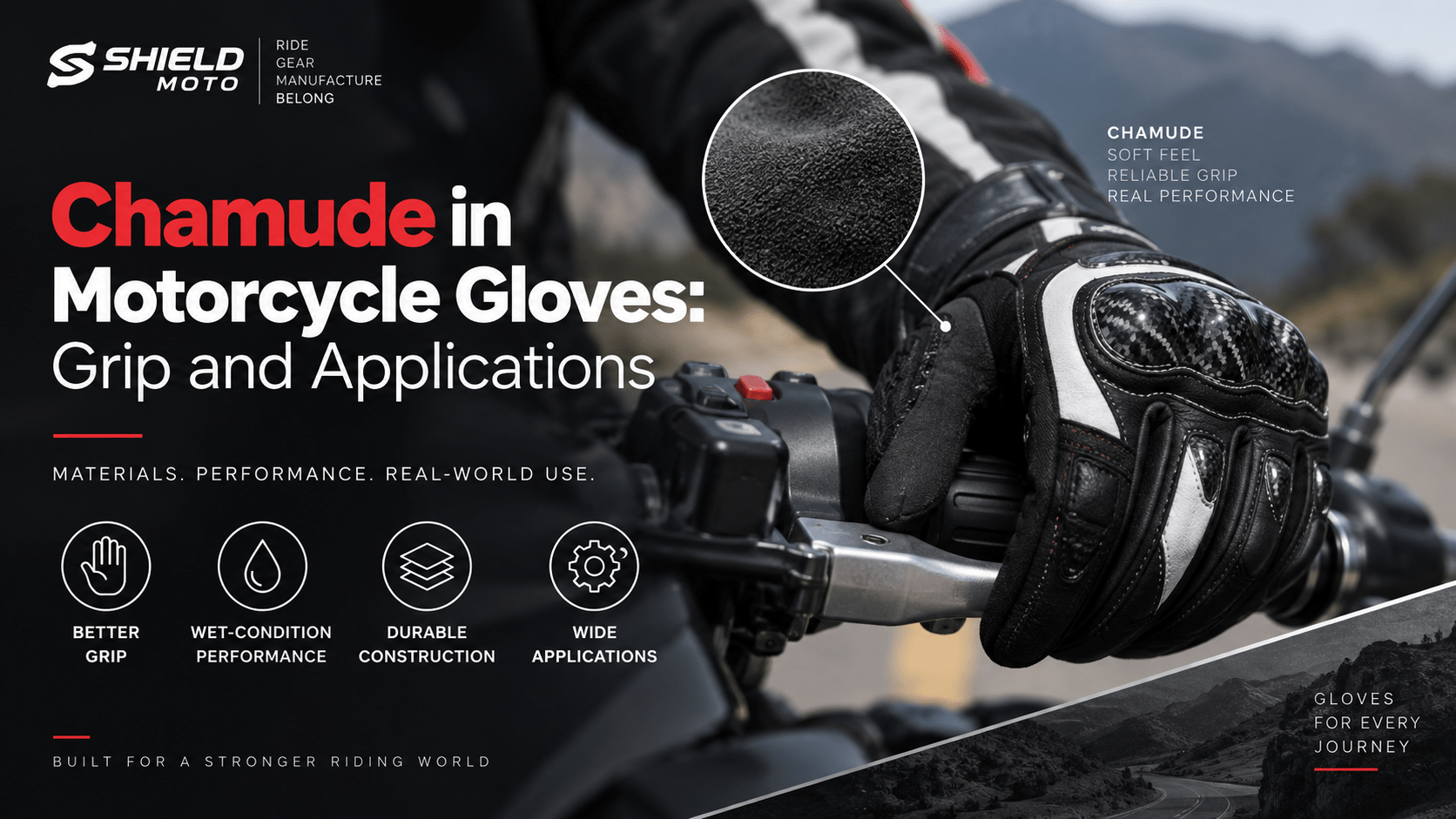
Chamude is a synthetic leather material used in motorcycle gloves where grip, flexibility, and a soft hand feel are important. It is particularly useful as a palm or reinforcement material because its surface can provide reliable friction between the glove and motorcycle controls, including the handlebar and throttle.
For motorcycle glove manufacturers, brands, and riders, Chamude is best understood as a functional grip material rather than a universal replacement for every glove material. Its suitability depends on where it is used, the glove’s overall construction, weather conditions, protection features, and the intended riding application.
Chamude is a synthetic leather material commonly associated with soft-touch applications and grip-focused glove construction. In motorcycle equipment, it may be used on the palm, fingers, or other areas where tactile control is important.
Chamude is also known by the broader material category of synthetic suede. One motorcycle-equipment manufacturer describes Amara/Chamude as a synthetic leather made from polyamide and polyurethane, with a soft feel and strong grip characteristics.
Its main value in motorcycle gloves comes from combining a relatively soft surface with useful friction and flexibility.
The exact composition and performance can vary by material specification and supplier, so glove manufacturers should verify the material specification before making product-level performance claims.
The palm of a motorcycle glove has an important job: it needs to maintain controlled contact with the motorcycle while allowing the rider to move the hand naturally.
A material used in this area therefore needs to balance grip, flexibility, comfort, durability, and construction requirements.
Chamude can be useful when a glove design requires a soft synthetic surface with grip-oriented characteristics.
Rather than using Chamude throughout an entire glove, manufacturers may combine it with leather, textile materials, reinforcements, protective components, and different lining systems.
This allows each material to perform a specific function.
Grip is one of the main reasons Chamude appears in motorcycle glove construction.
A motorcycle rider continuously interacts with the handlebars and controls. Excessive material stiffness can interfere with dexterity, while an unsuitable palm surface may reduce the desired tactile feel.
Chamude can provide a surface designed to maintain friction between the glove and the motorcycle controls.
This is particularly relevant for:
However, grip is not determined by the material alone.
The final grip characteristics of a motorcycle glove also depend on the pattern, thickness, stitching, palm construction, fit, surface treatment, and the conditions in which the glove is used.
Chamude can be particularly interesting for motorcycle gloves intended for conditions where maintaining hand-to-control contact is important.
Shield Moto’s Long Racing Gloves model SH-07-7001 specifically lists Chamude® leather reinforcement for optimal grip in wet conditions. The same model combines Chamude with goat skin leather in the palm and uses additional protective and reinforcement components.
This illustrates an important principle in motorcycle glove design: Chamude can function as a targeted grip reinforcement rather than being the sole material responsible for glove performance.
Wet-weather performance should still be evaluated at the complete-glove level. A manufacturer should not assume that using Chamude automatically makes an entire glove waterproof or suitable for severe rain.
Chamude and natural leather can serve different purposes in motorcycle glove construction.
| Feature | Chamude | Natural Leather |
|---|---|---|
| Material type | Synthetic leather | Animal hide |
| Surface feel | Soft, suede-like | Depends on leather type and finish |
| Grip application | Strong candidate for grip-focused areas | Can provide good grip depending on finish |
| Flexibility | Generally suitable for flexible glove zones | Depends on hide and construction |
| Palm use | Commonly used for grip/reinforcement | Widely used in motorcycle gloves |
| Weather performance | Depends on specification and construction | Depends on leather type, treatment, and construction |
| Best approach | Targeted functional application | Structural and protective applications depending on leather |
Neither material should automatically be considered better.
For a motorcycle glove manufacturer, the more useful question is:
Where does each material perform the required function most effectively?
A glove may combine leather and Chamude so that the construction benefits from the characteristics of both.
Racing gloves place particular emphasis on control, dexterity, fit, and protective construction.
Chamude can be used in racing gloves as a palm or grip reinforcement where tactile contact is important.
For example, Shield Moto’s SH-07-7001 Long Racing Gloves combine:
The example demonstrates how Chamude can be incorporated into a larger multi-material construction rather than treated as a standalone protection system.
Motocross is another application where grip-oriented palm construction is particularly relevant.
Off-road riders need consistent contact with the controls while moving across changing terrain. Glove manufacturers therefore often pay close attention to palm materials, finger construction, flexibility, and tactile control.
Chamude’s combination of a soft surface and grip-oriented characteristics makes it a material worth considering for motocross glove palms and reinforcement areas.
The final design still needs to account for the specific requirements of the glove, including abrasion exposure, ventilation, stitching, reinforcement, fit, and protection.
Not by itself.
A material’s presence in a glove should not automatically be interpreted as evidence that the complete glove meets a particular motorcycle protective standard.
Protection depends on the complete glove design, construction, protective components, material selection, seams, impact protection, and applicable testing.
For example, EN 13594 is a European standard covering protective gloves for motorcycle riders. It addresses areas including sizing, ergonomics, mechanical properties, impact protection, marking, and user information.
Therefore, brands should distinguish between:
A Chamude palm may contribute to the functional design of a glove, but it should not be presented as proof of protective certification without appropriate evidence.
The most logical location is often an area where grip and tactile contact are important.
The palm is one of the most obvious applications because it directly contacts the motorcycle controls.
Chamude can be incorporated as a complete palm panel, partial palm panel, or reinforcement section depending on the glove design.
Chamude may also be considered for finger areas where flexibility and tactile contact are important.
The exact application depends on the glove pattern and construction.
The thumb is heavily involved in control operation and hand movement. A flexible grip-oriented material can therefore be useful in selected thumb-panel designs.
Chamude can also be incorporated alongside other materials to reinforce specific areas without making the entire glove from one material.
For brands developing motorcycle gloves, material selection should begin with the intended application rather than the material name.
Consider these factors:
A racing glove, motocross glove, touring glove, and casual riding glove can have very different construction requirements.
Determine which areas need enhanced tactile contact and whether Chamude is appropriate for those locations.
Chamude may work best when combined with leather, textiles, reinforcements, and protective components rather than used independently.
Consider whether the glove will be marketed for dry, wet, hot, cold, or mixed conditions.
The material and pattern should allow the rider to operate controls without unnecessary restriction.
Evaluate the material together with stitching, panel design, reinforcement, and expected wear areas.
If the finished glove is intended to be marketed as protective motorcycle PPE, the manufacturer should identify the applicable standards and arrange the appropriate testing rather than relying on individual material properties.
For motorcycle brands developing their own glove collections, Chamude can be considered as part of the product-development process.
The key question is not simply:
“Can you manufacture a Chamude glove?”
A better question is:
“Where should Chamude be used within our glove design to achieve the required grip, feel, flexibility, and appearance?”
An OEM or private-label manufacturer can work with the brand to determine the appropriate combination of materials and construction features.
Depending on the project, customization may involve:
The exact capabilities and specifications should be confirmed for each production project.
Two gloves can use the same material but perform differently.
The reason is simple: construction matters.
A manufacturer’s pattern engineering determines:
This is why evaluating a motorcycle glove requires looking beyond the material label.
There is no single material that is ideal for every motorcycle glove.
| Material | Common Design Role | Key Consideration |
|---|---|---|
| Chamude | Grip and reinforcement | Useful where soft feel and friction are desired |
| Goat leather | Palm or backhand construction | Flexible leather option used in motorcycle gloves |
| Cowhide | Structural/protective applications | Often selected where robust leather construction is required |
| Textile | Lightweight or breathable construction | Performance depends heavily on fabric specification |
| Synthetic reinforcement | Targeted functional areas | Should be selected according to required performance |
The right combination depends on the intended product.
For example, a premium racing glove may combine leather with Chamude and protective components, while a lightweight riding glove may use a different material architecture.
The glove should fit securely without creating excessive pressure points.
A suitable motorcycle glove fit should allow:
The material alone cannot compensate for a poor pattern or incorrect sizing.
For manufacturers, fit should therefore be evaluated during sampling before bulk production.
Yes, when developing a custom motorcycle glove, a pre-production sample is valuable because it allows the buyer to evaluate the actual design before committing to bulk production.
The sample can be reviewed for:
Shield Moto’s custom biker glove offering states that pre-production samples can be provided so customers can review fit, material, and branding before bulk production.
Brands sourcing motorcycle gloves should look beyond the ability to supply a particular material.
Ask the manufacturer:
These questions help separate material sourcing from actual glove engineering.
Chamude is useful in motorcycle glove design primarily because of its soft synthetic-leather construction and grip-oriented surface characteristics.
Its strongest applications can include palm construction, reinforcement, finger areas, racing gloves, and selected motocross or wet-condition designs.
However, Chamude should not be treated as a guarantee of protection, waterproofing, or durability. Those characteristics depend on the complete glove construction, material specification, manufacturing process, and—where applicable—independent testing or certification.
For motorcycle brands, the most effective approach is to treat Chamude as one component of a complete glove-development system.
Chamude is a synthetic leather material commonly used in motorcycle gloves for grip-focused applications. It has a soft, suede-like feel and can be incorporated into palm, finger, or reinforcement areas depending on the glove design.
Chamude can be a suitable palm material when a design requires a soft surface with grip-oriented characteristics. The final performance depends on the material specification and complete glove construction.
Chamude can be used in glove designs intended to provide grip in wet conditions. Shield Moto’s SH-07-7001 Long Racing Gloves specifically use Chamude reinforcement for grip in wet conditions. However, this should not be interpreted as a guarantee of complete glove waterproofing or performance in every wet environment.
No. Chamude is a synthetic leather material rather than animal leather. It is generally used as a functional synthetic alternative in applications where its surface characteristics are useful.
Yes. Shield Moto’s SH-07-7001 Long Racing Gloves use goat skin leather together with Chamude in the palm, demonstrating how the two materials can be incorporated into the same glove construction.
It can be. Chamude may be used in racing gloves where grip and tactile contact are important. The suitability of the finished glove depends on its complete construction, protective components, fit, and intended use.
Chamude can be considered as part of a custom glove material specification. Brands should confirm the exact material, placement, construction, sampling process, and available customization options with the manufacturer before production.
No. The use of Chamude alone does not establish certification. Protective motorcycle gloves need to be evaluated against the applicable requirements and testing standards for the intended market and product.
Chamude has a practical role in motorcycle glove construction because it can combine a soft synthetic feel with useful grip characteristics. Its application is particularly relevant to palm and reinforcement areas where rider-control contact matters.
For brands and manufacturers, the best results come from selecting Chamude according to the glove’s intended riding discipline, climate, grip requirements, fit, protection architecture, and overall material combination.
For motorcycle brands developing a custom collection, Shield Moto’s OEM, private-label, and custom biker glove capabilities provide a relevant starting point for discussing material selection, glove construction, branding, sampling, and production requirements.