Need help? Ask an expert your product and motorbike gloves questions
Need help? Ask an expert your product and motorbike gloves questions
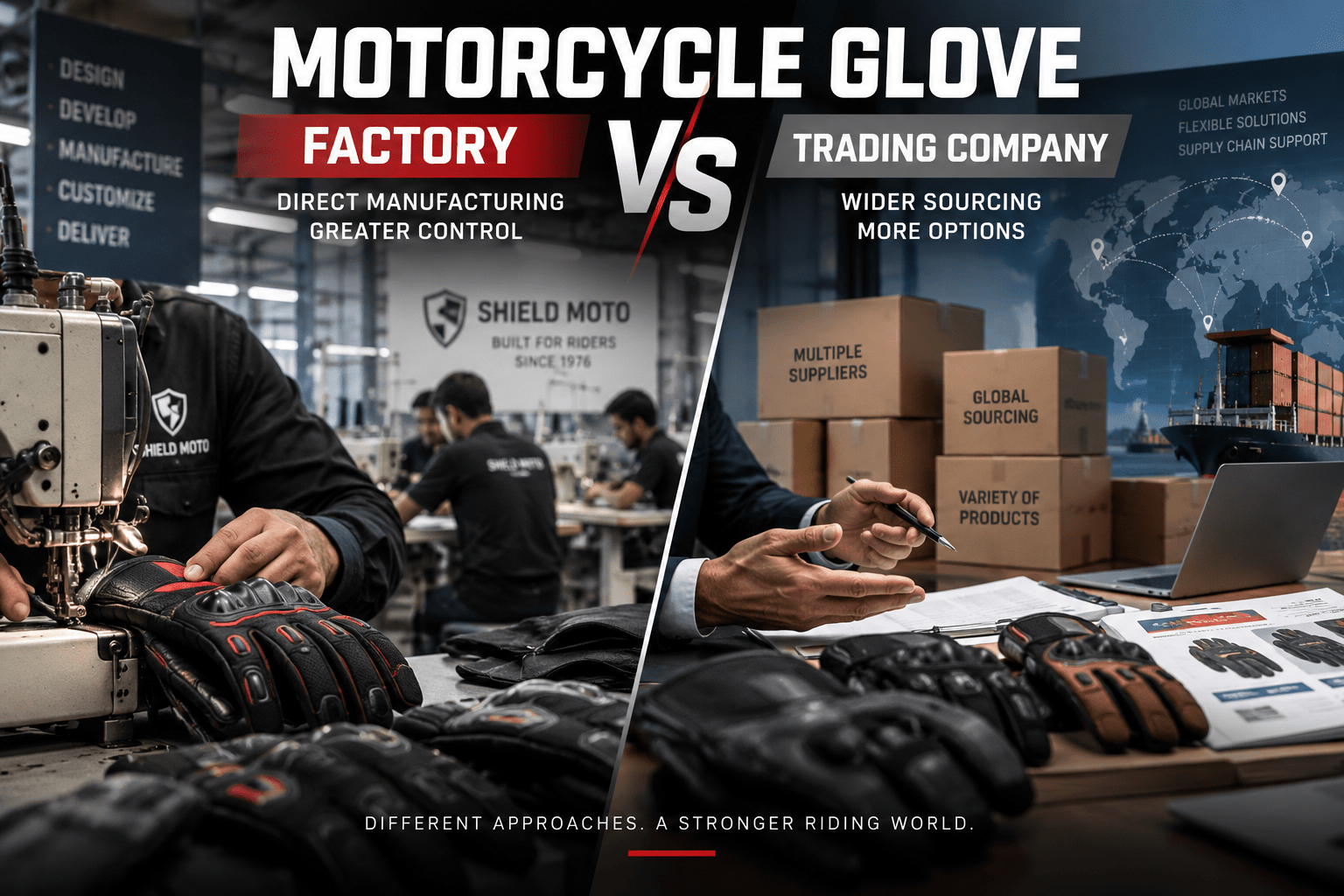
If you are sourcing motorcycle gloves for a brand, retailer, distributor, or motorcycle club, choosing between a motorcycle glove factory and a trading company can affect customization, communication, quality control, pricing structure, and your ability to develop products over time.
The main difference is simple: a factory manufactures the gloves, while a trading company typically purchases products from manufacturers and sells or supplies them to buyers. However, the better option depends on what you need.
For standard, ready-made products, a trading company may be convenient. For custom motorcycle gloves, OEM production, private-label collections, product development, or direct manufacturing communication, working with a factory can provide greater control over the process.
A motorcycle glove factory is generally the more direct sourcing option when you need customized products, private labeling, product development, production visibility, or an ongoing manufacturing relationship.
A trading company can be useful when you want to source different products or suppliers through one intermediary and do not require extensive control over manufacturing.
| Factor | Motorcycle Glove Factory | Trading Company |
|---|---|---|
| Manufacturing | Direct manufacturer | Usually sources from manufacturers |
| Product customization | Typically greater control | Depends on supplier |
| OEM/private label | Often available | May be arranged through factories |
| Factory communication | Direct | Through intermediary |
| Product development | Usually easier to coordinate | May involve additional communication |
| Branding | Can be integrated into production | Depends on manufacturing partner |
| Quality control | Direct factory oversight | Trading company coordinates with supplier |
| Product range | Focused on manufacturing capabilities | May offer products from multiple suppliers |
| Sourcing flexibility | Strong for specific products | Strong for multiple product categories |
| Long-term product development | Well suited | Depends on trading company’s supplier relationships |
The important point is that neither model is automatically better for every buyer. The right choice depends on the complexity of your order and how much control you need.
A motorcycle glove factory is a manufacturing operation that produces motorcycle or motorbike gloves through its own production processes and equipment.
Depending on the factory, those processes can include areas such as:
For a brand developing its own motorcycle glove collection, this direct manufacturing relationship can be particularly valuable.
Shield Moto, for example, describes itself as a Pakistan-based motorcycle glove manufacturer specializing in OEM and private-label manufacturing. Its website identifies R&D, cutting, printing, stitching, and quality assurance among its manufacturing-related capabilities.
A motorcycle glove trading company generally acts as an intermediary between buyers and manufacturers.
Instead of manufacturing the gloves itself, a trading company may source products from one or more factories and then supply those products to:
This model can be useful when a buyer wants access to multiple product types or suppliers without directly managing factory relationships.
However, the buyer should understand who actually manufactures the gloves.
A trading company may have strong supplier relationships and valuable sourcing expertise, but the actual manufacturing capabilities, materials, production controls, and customization options ultimately depend on the factories producing the products.
The biggest difference is the relationship with production.
When you work directly with a motorcycle glove factory, communication can take place closer to the people responsible for product development and manufacturing.
This can be useful when discussing:
With a trading company, these requests may need to pass through the trading company’s supplier network.
That does not necessarily make the process worse, but it can add another layer between the buyer and manufacturer.
A factory is generally the more natural choice when customization is an important part of the project.
For example, a motorcycle brand may want to develop gloves with its own:
Shield Moto states that its OEM and private-label solutions can include customization involving material selection, design, packaging, and branding.
Its custom biker glove category also describes customization involving logos, colorways, embroidery, sublimation printing, and material selection.
For a buyer developing a unique collection rather than simply reselling an existing model, this distinction matters.
When comparing suppliers, do not simply ask whether a company claims to offer “high quality.”
Ask where quality control takes place and who is responsible for it.
Questions worth asking include:
A direct factory relationship can make these questions easier to address because the buyer is communicating with the manufacturing organization itself.
Shield Moto states that its quality process covers material selection through final inspection and identifies quality assurance as part of its production facilities.
Product development is another important distinction.
If you simply need an existing motorcycle glove model, you may not need extensive factory involvement.
But if you are creating a new glove collection, development may involve several stages:
A manufacturer with an established R&D function can be particularly relevant to this type of project.
Shield Moto states that its R&D process combines material innovation, ergonomic design, and technology for motorbike glove development.
Communication becomes increasingly important as product complexity increases.
For a basic wholesale order, a trading company may be sufficient.
For a technical custom glove, however, the buyer may need to discuss details such as:
Direct communication with the manufacturer can reduce the distance between the product specification and the production team.
A trading company can have one significant advantage: supplier breadth.
Because a trading company may work with multiple factories, it may be able to source different types of products from different manufacturers.
This can be useful if your business needs several unrelated product categories.
A specialized motorcycle glove factory, on the other hand, may provide deeper expertise in motorcycle gloves and related production processes.
The best option therefore depends on whether your priority is supplier breadth or manufacturing specialization.
For a one-time purchase, the difference may be relatively small.
For an ongoing motorcycle glove brand, it can become much more important.
A direct factory relationship may make it easier to maintain consistency across future production runs because the manufacturer has a direct understanding of the approved product specifications.
This is particularly relevant when a brand develops several models or seasonal collections.
A direct factory is usually worth considering when you need:
For example, a motorcycle brand launching its first glove collection may benefit from working directly with a manufacturer because product development and branding are central to the project.
A trading company can be appropriate when:
A trading company can effectively act as a sourcing partner, particularly when the buyer does not want to manage multiple factory relationships.
The key is to understand exactly what the trading company handles and what is handled by its manufacturing suppliers.
Whether you are speaking with a factory or trading company, ask specific questions before placing a bulk order.
Do not assume that every factory offers the same MOQ, lead time, materials, customization, or testing. Ask the supplier to confirm these details for your specific project.
For custom motorcycle gloves, a direct manufacturer is generally the more logical starting point because customization requires closer coordination between product requirements and production.
A brand may need to control the design, materials, colors, branding, construction, and packaging. A direct manufacturer can potentially manage these requirements within its own manufacturing workflow, depending on its capabilities.
Shield Moto specifically positions its business around OEM, ODM, private-label, and custom motorcycle glove manufacturing. Its website also lists custom biker gloves as a dedicated product category.
| Buyer | Usually More Suitable | Why |
|---|---|---|
| Motorcycle brand launching custom gloves | Factory | Greater focus on product development and customization |
| Established glove brand | Factory | Better suited to an ongoing manufacturing relationship |
| Motorcycle retailer buying standard models | Either | Depends on product range and sourcing requirements |
| Distributor sourcing multiple products | Trading company or factory | Depends on breadth and customization needs |
| Motorcycle club ordering branded gloves | Factory or specialized supplier | Custom branding may require direct production coordination |
| Buyer testing standard products | Either | Product requirements may be relatively simple |
| Private-label motorcycle brand | Factory | Branding and product specifications are central |
This table is a starting point rather than a universal rule. Supplier capabilities should always be verified before ordering.
OEM and private-label projects require more than simply purchasing finished gloves.
A brand may need to define:
The closer the relationship is to the actual manufacturing process, the easier it can be to discuss these requirements with the organization responsible for production.
Shield Moto states that it provides OEM and private-label manufacturing and works with customized requirements related to brand identity and performance needs.
Shield Moto is based in Sialkot, Pakistan, and operates under its parent company, Solehre Brothers Industries, which the company states was established in 2002.
The company identifies itself as a motorcycle glove manufacturer and lists product categories including:
Its website currently states production capacity of more than 6 million pairs annually and lists more than 600 stitching machines, alongside automatic palm-stitching equipment.
For businesses looking for a direct manufacturing relationship rather than simply sourcing finished products through an intermediary, these capabilities make Shield Moto relevant to an OEM, private-label, wholesale, or custom motorcycle glove project.
Do not choose a factory or trading company based only on a website, catalog, or quoted price.
A better sourcing process is:
This approach helps you compare suppliers on more than price.
Not in every situation. A factory is generally more suitable when you need direct manufacturing, customization, OEM/private-label production, or product development. A trading company may be useful when you need broader sourcing options or a single intermediary for multiple products.
The main advantage is a more direct relationship with the organization responsible for manufacturing. This can be particularly useful for custom designs, product development, branding, quality requirements, and ongoing production.
Potentially, yes. A trading company may arrange customization through one of its manufacturing partners. However, you should confirm which factory will produce the gloves and exactly which customization capabilities are available.
For a custom or private-label project, a pre-production sample can be useful for reviewing fit, materials, construction, branding, and other specifications before bulk production. Shield Moto’s custom glove category states that sampling is available.
OEM motorcycle glove manufacturing involves a manufacturer producing gloves according to the buyer’s product requirements and specifications. The exact scope of OEM services varies between manufacturers, so the buyer should confirm design, materials, branding, packaging, and production responsibilities.
Private-label manufacturing means motorcycle gloves are produced for sale under the customer’s brand. The precise customization available depends on the manufacturer’s capabilities and the agreed product specifications.
Ask about actual manufacturing location, materials, product development, customization, sampling, quality control, MOQ, lead time, packaging, branding, and any applicable testing or compliance requirements. Always request confirmation for project-specific details.
Start with your requirements. If you need standard products and broad sourcing, a trading company may be suitable. If you need custom motorcycle gloves, OEM/private-label production, product development, or a long-term manufacturing relationship, compare direct factories first.
The choice between a motorcycle glove factory and a trading company comes down to the level of control and manufacturing involvement your business needs.
For straightforward sourcing, a trading company can provide convenience and access to multiple suppliers.
For custom motorcycle gloves, OEM, private label, product development, branding, and long-term production, a direct factory relationship is often the more appropriate route.
If you are developing a motorcycle glove collection, Shield Moto provides motorcycle glove manufacturing, OEM, private-label, and custom manufacturing services from its Sialkot, Pakistan operation.
The next step is to define your product requirements and ask the manufacturer to confirm the capabilities, materials, MOQ, sampling process, lead time, and commercial terms applicable to your specific project.