Need help? Ask an expert your product and motorbike gloves questions
Need help? Ask an expert your product and motorbike gloves questions
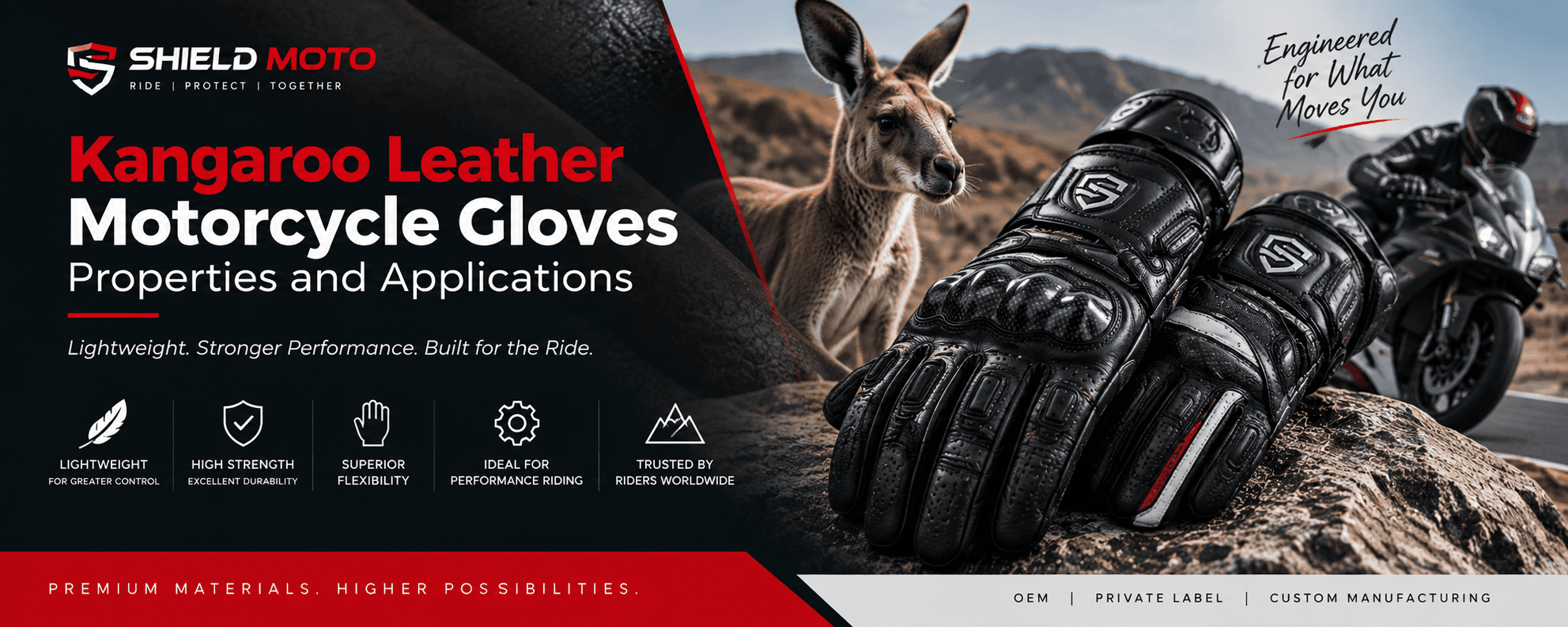
Kangaroo leather is valued in motorcycle gear because it can combine low weight, flexibility, and strong mechanical performance in a relatively thin leather. For motorcycle gloves, that combination can be particularly useful when a rider wants close hand feel and dexterity without relying on a bulky construction.
However, kangaroo leather is not automatically the right choice for every motorcycle glove. The final performance of a glove depends on more than the animal hide. Leather thickness, tanning, panel selection, stitching, reinforcement, protectors, palm construction, cuff design, and overall pattern all affect the finished product.
For riders and motorcycle brands considering kangaroo leather gloves, the better question is not simply whether kangaroo leather is “better.” The practical question is where its material properties provide an advantage and how the complete glove is engineered around them.
Kangaroo leather is leather produced from kangaroo hide. It is known for a relatively fine structure and is used in applications where manufacturers want a combination of strength, flexibility, and reduced material weight.
Unlike judging a glove only by leather thickness, buyers should consider the complete construction. A thinner leather can improve flexibility and hand feel, but thickness alone does not determine the protection or durability of a finished motorcycle glove.
For motorcycle applications, kangaroo leather is particularly associated with performance-oriented equipment where maintaining dexterity and reducing bulk are important.
The main attraction is the relationship between strength, thickness, weight, and flexibility.
A motorcycle glove has to allow the rider to operate the controls while maintaining a secure fit around the hand. Excess material or stiffness can interfere with dexterity, especially when the rider repeatedly operates a clutch, brake, throttle, or other controls.
Kangaroo leather can be useful when the product design calls for:
These characteristics make kangaroo leather particularly relevant to racing and performance motorcycle equipment, although the suitability of the material depends on the complete glove design.
One of the most important reasons kangaroo leather attracts attention in technical motorcycle equipment is its strength-to-weight relationship.
A manufacturer can potentially design a glove using comparatively thin leather while maintaining useful mechanical properties.
This can help reduce unnecessary bulk around the fingers and palm.
However, the strength of the finished glove is not determined by leather species alone. Leather quality, hide selection, tanning, thickness, cutting direction, stitching, seams, and reinforcement all matter.
Weight matters more than many buyers realize.
A motorcycle glove is worn continuously during a ride, and heavier construction can contribute to hand fatigue over long periods.
Kangaroo leather can support lightweight product development because it can provide useful mechanical performance without requiring the same material bulk as some heavier leather constructions.
For racing-oriented gloves, reducing unnecessary weight can also help maintain a more direct connection between the rider’s hands and the motorcycle controls.
Motorcycle gloves need to move with the hand.
The fingers repeatedly bend around the handlebars, while the palm changes shape during braking, acceleration, and clutch operation.
A flexible leather construction can therefore contribute to:
Kangaroo leather can be particularly attractive for gloves where dexterity is a priority.
The pattern and construction still matter. Poorly designed finger panels or excessive reinforcement can reduce the flexibility advantages of the leather.
Thin leather does not automatically mean weak leather.
For technical motorcycle applications, the objective can be to achieve the required material performance without unnecessary thickness.
This can produce a glove that feels less bulky and conforms more closely to the hand.
There is, however, an important trade-off: leather thickness, reinforcement and protective components must be considered together. A glove cannot be evaluated purely from the leather thickness printed in a specification sheet.
Riders who prioritize control feel often prefer gloves that fit closely without excessive loose material.
Kangaroo leather can be useful in this type of construction because its flexibility allows the glove to follow hand movement closely.
This is particularly relevant to performance riding, where precise operation of motorcycle controls is important.
Kangaroo leather and cowhide can both be used in motorcycle gear, but they offer different design possibilities.
| Feature | Kangaroo Leather | Cowhide |
|---|---|---|
| Weight | Typically associated with lightweight construction | Can be heavier depending on thickness |
| Flexibility | Excellent potential for flexible construction | Depends strongly on leather type and finishing |
| Dexterity | Well suited to close-fitting designs | Can provide good dexterity when properly selected and patterned |
| Thickness | Can provide useful performance at relatively low thickness | Available across a wide range of thicknesses |
| Durability | Strong mechanical properties are a major attraction | Well established for durable motorcycle equipment |
| Premium performance use | Commonly associated with performance applications | Widely used across motorcycle gear |
| Cost consideration | Usually a more specialized material | Generally more accessible for broader product ranges |
| Best design approach | Lightweight, close-fitting, performance-focused gloves | Versatile designs ranging from everyday to heavy-duty motorcycle gloves |
There is no universal winner.
A high-quality cowhide glove with appropriate thickness, reinforcement and construction may be a better choice for a particular application than a poorly engineered kangaroo leather glove.
Likewise, kangaroo leather can be attractive when low weight, flexibility and tactile feel are priorities.
Racing is one of the applications where kangaroo leather makes the most sense.
Track-focused riders generally place significant importance on:
Kangaroo leather can support the first several requirements, but the leather itself should not be treated as the complete protective system.
A racing glove may also incorporate protective knuckle components, palm reinforcement, finger protection, additional leather layers, reinforced seams and secure cuff closures.
The final product should therefore be evaluated as a complete glove rather than by material name alone.
Kangaroo leather can also be considered for non-racing motorcycle gloves, but the application changes the priorities.
A touring or commuting glove may need features such as:
In these applications, the best material choice depends on the environment and product objectives.
For cold or wet riding, a manufacturer may need to combine leather with suitable membranes, insulation or other materials. The leather itself does not provide every property required for all-weather riding.
Material selection can vary across the glove.
A manufacturer may consider kangaroo leather for areas where flexibility and tactile response are especially important, while using other materials or reinforcement in specific high-wear or protective areas.
Important areas to evaluate include:
The palm experiences continuous contact with the motorcycle controls and can experience significant wear.
Material selection should therefore consider grip, abrasion exposure, flexibility and reinforcement requirements.
Finger panels require careful balancing of durability and dexterity.
Excessive thickness can make control operation uncomfortable, while insufficient construction may not meet the intended product requirements.
The backhand provides an opportunity to combine leather with protective components and flexible construction.
Knuckle protection is generally a separate design consideration from the leather itself.
A glove may combine leather with a dedicated protective component depending on the intended design and applicable requirements.
The cuff affects how securely the glove stays positioned on the hand.
A well-designed closure system can contribute to fit and stability regardless of whether the primary leather is kangaroo, cowhide or another material.
This is one of the most important points for buyers.
Choosing kangaroo leather does not automatically make a motorcycle glove suitable for racing or crash protection.
A complete motorcycle glove should be evaluated according to its:
Material is one component of the engineering process.
For safety-related products, buyers should distinguish between a material’s inherent properties and the performance of the finished glove. A material description should never be treated as proof of compliance with a motorcycle glove safety standard.
A performance glove should fit securely without creating excessive pressure points.
An excessively loose glove can reduce control and tactile feel. An excessively tight glove can restrict movement and create discomfort.
Check the following when evaluating fit:
For brands developing gloves, fit should be evaluated during sampling rather than relying only on a digital specification.
Kangaroo leather is particularly relevant to buyers who prioritize a combination of:
Light weight + flexibility + dexterity + performance-oriented construction
Potential applications include:
For everyday commuter or touring gloves, other leather types or mixed-material constructions may be more appropriate depending on weather, price position and intended use.
For a motorcycle brand, material selection is only the beginning.
Before placing an OEM or private-label project, define the complete product specification.
Specify whether the glove is designed for:
The application affects construction and feature requirements.
Do not simply request “kangaroo leather.”
Define the material requirements that matter to the product, including the intended leather quality, thickness range, finish and areas where the material will be used.
Define the protective components and construction requirements separately from the leather specification.
This prevents the product brief from treating the leather as the entire protection system.
Establish the target size range and fit profile.
Samples should be reviewed for finger movement, palm fit, cuff security and overall control feel.
A private-label glove may require:
The appropriate method depends on the glove design and material.
Sampling allows the buyer to evaluate the actual product rather than relying only on specifications.
Check the sample for:
For a commercial motorcycle glove program, clarify material specifications, product requirements, applicable testing or certification requirements, packaging specifications and production expectations before approving bulk production.
Kangaroo leather can be considered as part of a broader OEM motorcycle glove development process.
The manufacturer and buyer should first define the product’s intended market and performance requirements. Material selection can then be matched to the construction, fit, protection components and commercial positioning.
For brands that want their own glove collection, private-label manufacturing can provide greater control over branding, product direction, colors, labeling and packaging than simply purchasing finished wholesale products.
Shield Moto states that its private-label program supports product development around requirements such as glove type, materials, colors, branding, sizes and packaging. Sampling is also part of its stated product-development process.
For a kangaroo leather project specifically, the material availability, product construction, sample specifications and production requirements should be confirmed directly with the manufacturer before proceeding.
Shield Moto’s current public product ecosystem includes motorcycle glove categories such as long racing gloves, short racing gloves, winter gloves, vintage gloves, custom biker gloves, half-finger gloves and motocross gloves.
Its custom biker glove range currently lists several cowhide, goatskin and buffalo leather products.
Kangaroo leather should therefore be treated as a project-specific material requirement rather than assumed to be a standard Shield Moto catalog material.
For a brand specifically requesting kangaroo leather, the appropriate approach is to contact Shield Moto with the intended glove type, target market, material requirement, design, sizing, branding and other product specifications and ask the manufacturing team to confirm feasibility.
A private-label motorcycle glove should be developed around the product rather than simply adding a logo to an existing glove.
A complete product brief can include:
| Specification | What the Buyer Should Define |
|---|---|
| Glove Type | Racing, touring, commuter, motocross or other |
| Primary Leather | Kangaroo or another selected material |
| Construction | Panel layout, seams and reinforcement |
| Protection | Knuckle, palm, finger and wrist requirements |
| Fit | Target fit and size range |
| Colors | Brand-specific color direction |
| Branding | Logo, labels, printing or embroidery |
| Packaging | Retail presentation requirements |
| Market | Target customer and geographic market |
| Compliance | Applicable requirements for the intended market |
The clearer the product brief, the easier it is for a manufacturer to evaluate the project.
Kangaroo leather is attractive for motorcycle gloves because it can support lightweight, flexible and close-fitting construction while maintaining strong mechanical properties.
Its greatest value is not simply that it is a different type of leather. Its value comes from the design possibilities it offers when weight, dexterity and material performance are important.
For racing and performance-oriented gloves, kangaroo leather can be a strong material option. For touring, commuting and other applications, cowhide, goatskin, textiles or mixed-material constructions may make more sense depending on the product requirements.
For motorcycle brands, the correct approach is to evaluate the complete glove specification, not the leather name alone.
If you are developing a custom motorcycle glove collection, define the riding application, material, construction, protection requirements, fit, branding and packaging before requesting production samples.
Kangaroo leather can be an excellent option for motorcycle gloves where low weight, flexibility and dexterity are important. The final suitability still depends on the glove’s complete construction, reinforcement and protective components.
Kangaroo leather is commonly selected for lightweight motorcycle equipment because it can provide useful mechanical performance at relatively low material thickness. Actual glove weight depends on the leather thickness, pattern, reinforcements, protectors and other components.
It is not accurate to declare one universally stronger without defining the leather specification and test method. Kangaroo leather is valued for its strength-to-weight characteristics, while cowhide is widely used because of its durability and versatility.
Kangaroo leather is well suited to performance-oriented motorcycle equipment because lightweight construction and flexibility can be valuable for racing. However, racing suitability depends on the complete glove design and applicable protective requirements, not simply the leather type.
Shield Moto’s currently listed custom glove range includes cowhide, goatskin and buffalo leather products. Kangaroo leather is not presented as a standard material across the current public catalog, so brands should contact Shield Moto to confirm whether a specific kangaroo leather project can be developed.
A private-label project can be developed around specified product requirements when the manufacturer’s capabilities support them. Shield Moto states that its private-label program supports requirements including materials, colors, branding, sizing and packaging. Kangaroo leather availability should be confirmed for the specific project.
Ask about the available leather specification, construction, reinforcement, protective components, sizing, sample process, branding options, packaging, applicable testing or certification requirements and production specifications. Request confirmation of any requirement that is important to your target market.
Kangaroo leather motorcycle gloves occupy a specialized position in motorcycle gear. Their appeal comes from the possibility of combining lightweight construction, flexibility and strong material performance in a glove designed for precise hand movement.
For riders, the right choice depends on riding style, environment, fit and glove construction. For motorcycle brands, the decision should begin with the product specification and end with sample evaluation.
If your goal is to develop a branded motorcycle glove collection using a specific leather or construction, Shield Moto’s OEM and private-label manufacturing services can be considered as a potential sourcing route. The exact material and product requirements should be confirmed directly before development.