Need help? Ask an expert your product and motorbike gloves questions
Need help? Ask an expert your product and motorbike gloves questions
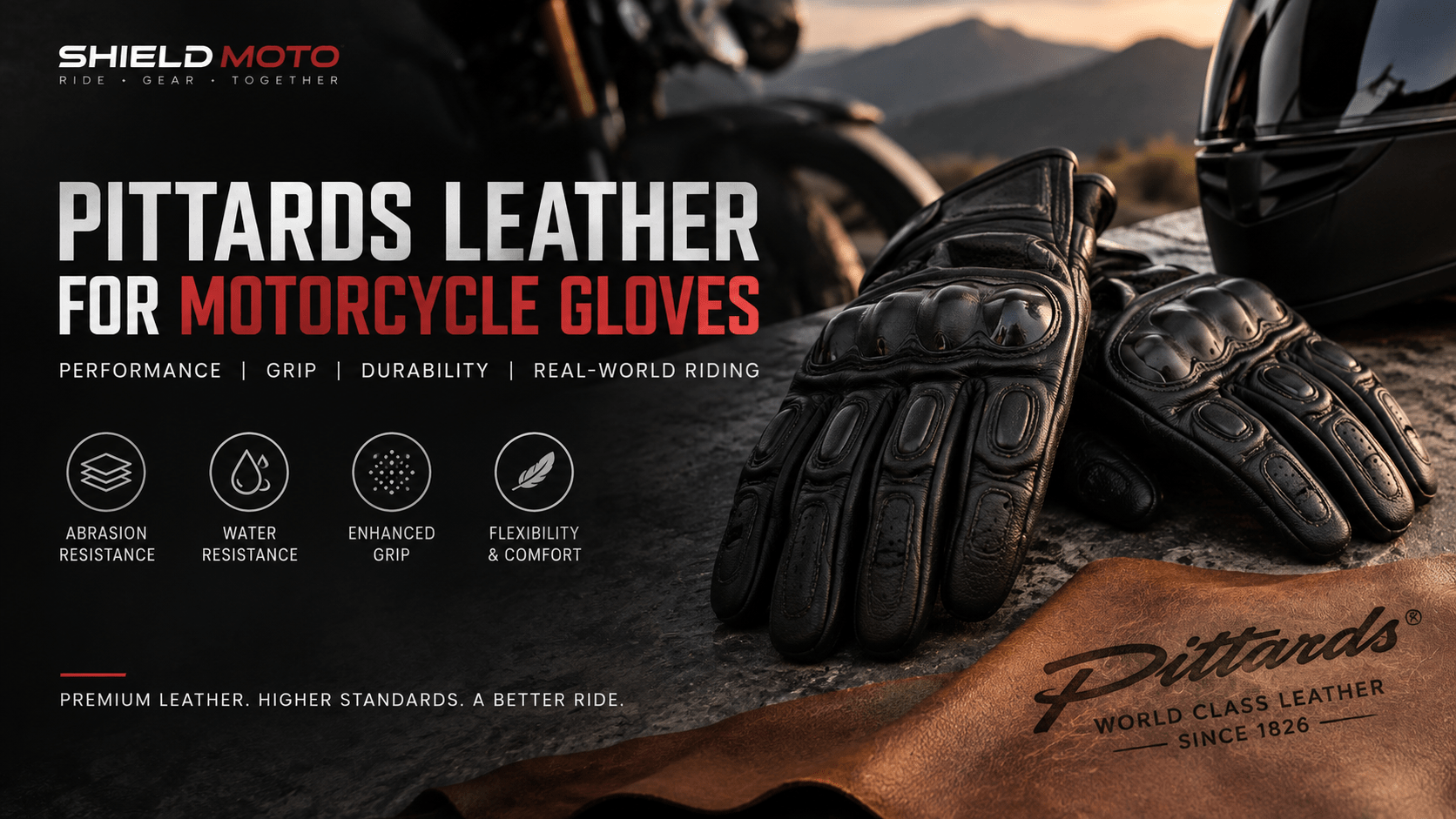
Pittards leather is used in motorcycle gloves when manufacturers need a combination of leather feel, flexibility, grip, water or perspiration resistance, and enhanced wear performance. Pittards develops several performance-leather technologies specifically suited to motorcycling, including options designed for racing, touring, motocross, and other demanding applications.
For motorcycle glove manufacturers and brands, the important point is that “Pittards leather” is not one single leather specification. Pittards offers different leather technologies and treatments, so the appropriate choice depends on the glove’s intended use, construction, climate, grip requirements, and desired durability.
Pittards is a leather company with a history dating to 1826 and a focus on engineered performance leathers. Its technical leather range includes technologies for properties such as abrasion resistance, grip enhancement, water resistance, and other specialized performance requirements.
For motorcycle gloves, this matters because the leather has to work as part of a complete glove construction. A suitable motorcycle glove leather must balance:
Pittards specifically identifies motorcycling as one of the sectors for its performance leathers. The company describes applications ranging from lightweight race gloves to harder-wearing touring and motocross leathers.
The main reason is the ability to engineer different leather characteristics for different glove applications.
A motorcycle glove needs more than a soft leather surface. The leather may need to provide good hand movement while also handling repeated flexing, contact with motorcycle controls, moisture, and wear.
Pittards’ motorcycling materials can combine different technologies with textured finishes, grip enhancement, and perforated leather. This allows glove designers to select a material configuration according to the intended riding environment and product design.
| Performance Requirement | Why It Matters in Motorcycle Gloves |
|---|---|
| Flexibility | Helps fingers and hands move naturally around controls |
| Grip | Supports secure contact with handlebars and controls |
| Abrasion Resistance | Helps the leather withstand wear at exposed areas |
| Water Resistance | Useful when riding in wet conditions |
| Perspiration Resistance | Can help manage moisture during extended use |
| Tactile Feel | Important when riders need control sensitivity |
| Breathability | Supports comfort during longer rides |
| Durability | Important for repeated use and high-wear areas |
These characteristics should be considered together rather than treating any single property as a guarantee of overall glove performance.
Pittards offers several technologies that can be relevant to motorcycle glove development.
Keratan is a Pittards treatment designed to increase the abrasion protection and durability of its performance goatskin leathers.
Pittards states that Keratan is water resistant and suitable for applications including motorcycle gloves and motorcycle clothing. Its etched-diamond surface treatment is bonded to the leather structure and is designed to retain flexibility while increasing abrasion resistance.
This makes Keratan particularly relevant when a motorcycle glove design requires a balance between:
For a glove manufacturer, however, the leather treatment should be evaluated together with the glove’s complete protective construction rather than considered independently.
Pittards Armor-Tan is another performance technology developed to increase abrasion resistance and durability.
According to Pittards, the technology uses microscopic ceramic structures within the leather’s fibril structure to improve resistance to abrasion and wear. It can also be combined with other technologies, including WR100X for water and perspiration resistance.
Armor-Tan is identified by Pittards as suitable for motorcycling as well as outdoor performance and sports applications.
Grip is especially important in motorcycle gloves because the rider needs controlled contact with the handlebars and controls.
Pittards Gripster is designed to enhance grip while retaining the softness and natural feel of leather. Pittards explains that the technology incorporates a grip-enhancing material into the leather surface and is designed to maintain grip performance as the hand becomes perspired.
For motorcycle glove development, this type of technology can be particularly relevant to palm or other contact areas where grip characteristics are important.
WR100X is Pittards’ water-resistant technology.
Pittards states that the treatment is incorporated into the leather rather than functioning simply as a surface coating. It is designed to provide water and perspiration resistance while maintaining breathability, softness, and flexibility.
For motorcycle gloves, this can be useful for products intended for variable weather conditions, touring, or other applications where moisture management is important.
Racing gloves place particular demands on material selection.
Pittards specifically describes its motorcycling leather range as including lightweight leathers for race gloves.
A racing glove development program may therefore prioritize:
The leather itself is only one part of the final product. Knuckle protection, palm reinforcement, finger construction, cuff design, closure systems, stitching, and other protective components also influence the final glove.
Touring gloves often have different priorities from race gloves.
Long-distance riders may place greater emphasis on:
Pittards states that harder-wearing leathers can be used for touring and motocross applications, while water- and perspiration-resistant technologies can be incorporated according to the intended product requirements.
This illustrates why leather selection should begin with the intended use rather than simply choosing a material because it has a premium name.
Motocross gloves operate in a different environment from road or track gloves.
They may encounter:
Pittards identifies motocross among the applications for its motorcycling leather range and specifically notes harder-wearing leathers for this type of use.
For a motocross glove, material selection should therefore be considered alongside the glove’s overall construction and intended riding conditions.
The useful comparison is not simply “Pittards versus ordinary leather.”
The more important question is whether the selected leather specification provides the characteristics required by the glove design.
| Consideration | Performance Leather Approach | Conventional Leather Approach |
|---|---|---|
| Material Engineering | Can incorporate specialized treatments | Depends heavily on base leather and finish |
| Grip Options | Specialized grip technologies may be available | Usually depends on leather surface and construction |
| Water Resistance | Technologies such as WR100X are available | Depends on leather treatment |
| Abrasion Performance | Technologies such as Keratan and Armor-Tan are available | Depends on leather type, thickness and construction |
| Flexibility | Can be engineered alongside performance properties | Depends on leather selection and construction |
| Application Selection | Different technologies can target different uses | Often selected primarily by base leather characteristics |
This does not mean a performance leather is automatically the right choice for every motorcycle glove. Product requirements should determine the specification.
Not by itself.
A leather technology can contribute characteristics such as abrasion resistance, grip, flexibility, or water resistance, but the protection of a complete motorcycle glove depends on the entire glove design.
Important considerations can include:
Pittards’ own motorcycling information discusses material performance characteristics, while motorcycle glove protection should be evaluated at the finished-product level.
Therefore, manufacturers should avoid treating a particular leather name as equivalent to a complete safety rating.
For a brand developing a motorcycle glove collection, material selection should start with the product brief.
Determine whether the glove is intended for:
The application determines the performance priorities.
Consider where the glove will experience the most contact and movement.
The palm, thumb, fingers, sidewalls, and other exposed areas may require different construction approaches.
If handlebar feel and grip are major priorities, a leather technology such as Gripster may be worth evaluating. Pittards specifically identifies Gripster as an enhanced-grip technology for functional and sporting gloves and lists motorcycling as a suitable sector.
For products intended for wet or variable conditions, water- and perspiration-resistant leather technologies may be relevant.
WR100X is specifically designed around these properties.
A motorcycle glove cannot be evaluated only by material toughness.
The designer must also consider:
The objective is to create a complete glove system appropriate to its intended use.
Yes, the material-selection stage can be part of a custom motorcycle glove development process, but the exact availability and specification should be confirmed for the project.
For a motorcycle brand, customization may involve:
Shield Moto specializes in OEM and private-label motorcycle glove manufacturing and states that its customization process can include material selection, design, packaging, and branding.
When a brand specifically requests Pittards leather, the manufacturer should confirm the required leather technology, availability, intended application, construction compatibility, and any applicable testing requirements before production.
For an OEM or private-label motorcycle glove project, the material specification should be established before finalizing the production sample.
A practical development process can include:
Shield Moto provides OEM and private-label motorcycle glove manufacturing and has facilities covering R&D, cutting, printing, stitching, and quality assurance. Its website also states production capacity exceeding 6 million gloves annually.
For a brand considering Pittards leather, the important step is to discuss the exact material requirement with the manufacturer rather than assuming that every Pittards technology is suitable for every glove model.
Pittards leather is particularly relevant to motorcycle glove development because Pittards offers performance technologies designed for properties such as abrasion resistance, grip, water resistance, flexibility, and moisture-related performance.
The most appropriate leather depends on the glove’s intended application.
The final performance of a motorcycle glove still depends on its complete construction, protective components, fit, and applicable testing.
For motorcycle brands developing a custom glove collection, the best approach is to specify the required performance first and then select the leather technology that supports that product brief.
Yes. Pittards specifically identifies motorcycling as a sector for its performance leathers, with applications including race gloves, touring gloves, and motocross products. Different Pittards technologies are designed for different performance requirements.
There is no single Pittards leather for all motorcycle gloves. Pittards offers multiple performance technologies, including Keratan, Armor-Tan, Gripster and WR100X, which can address different requirements.
It can be suitable for racing applications. Pittards states that lightweight performance leathers can be used for race gloves. The final suitability depends on the complete glove design and its intended requirements.
Some Pittards technologies are specifically designed to enhance grip. Gripster is engineered to improve grip while maintaining the natural feel of leather and is identified as suitable for motorcycling.
Some Pittards leather technologies are water resistant rather than universally waterproof. WR100X is designed to provide water and perspiration resistance while retaining breathability and flexibility.
Certain Pittards technologies are specifically designed to improve abrasion resistance. Keratan is designed to increase abrasion protection and durability in Pittards performance goatskin, while Armor-Tan is engineered for abrasion and wear resistance.
A brand can discuss a specific Pittards material requirement with its motorcycle glove manufacturer. The manufacturer should confirm material availability, technical specification, compatibility with the glove design, and any testing requirements before production.
Shield Moto states that it provides OEM and private-label motorcycle glove manufacturing and offers customization involving areas such as material selection, design, branding and packaging. Its current website also lists R&D, cutting, printing, stitching and quality-assurance capabilities.
Choosing the right motorcycle glove leather should begin with the riding application and required performance characteristics—not simply the material name.
If your brand is developing custom, OEM, or private-label motorcycle gloves, Shield Moto can discuss the material and construction requirements for your project and help determine an appropriate glove-development route.
Request a custom motorcycle glove discussion with Shield Moto