Need help? Ask an expert your product and motorbike gloves questions
Need help? Ask an expert your product and motorbike gloves questions
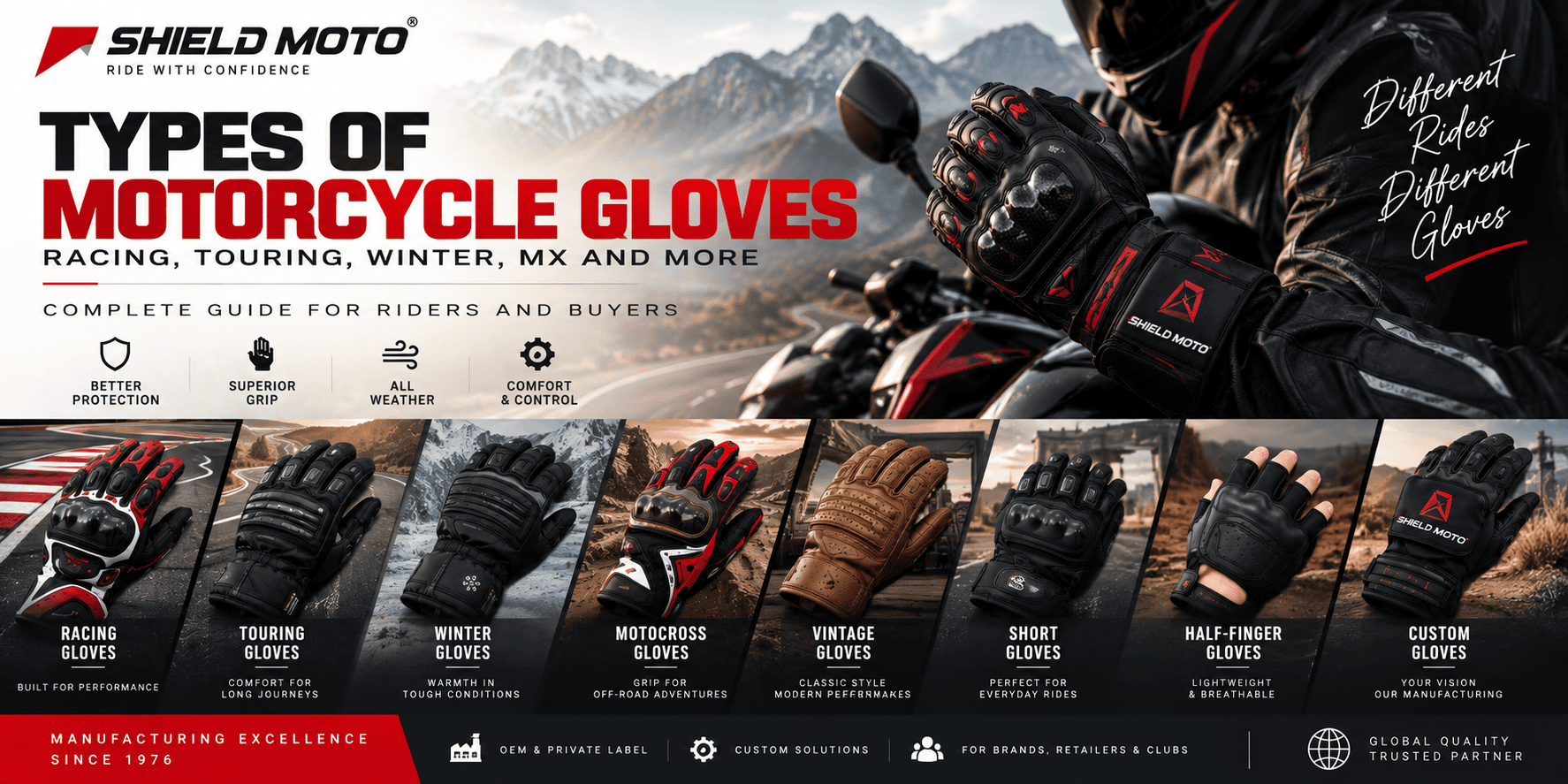
There is no single type of motorcycle glove that works equally well for every rider. Racing, touring, winter, motocross, vintage, short-cuff, long-cuff, half-finger, and custom motorcycle gloves are designed around different riding conditions and priorities.
The right choice depends on how you ride, the weather you encounter, the level of wrist and hand coverage you want, and the balance between protection-related construction, comfort, grip, and dexterity.
For motorcycle brands and B2B buyers, the decision also includes materials, construction, customization, branding, sampling, quality requirements, and manufacturing capabilities.
The main types include:
Some categories overlap. For example, a long racing glove can also be a leather motorcycle glove, while a touring glove may be designed specifically for cold or wet conditions.
The most useful way to choose between them is to start with your riding application, rather than the appearance of the glove.
Racing gloves are designed for performance-oriented riding, particularly track and sport riding.
They commonly use a longer cuff and more structured construction than casual riding gloves. Depending on the specific model, features can include reinforced palms, knuckle protection, finger reinforcement, wrist adjustment systems, and flexible areas designed to preserve hand movement.
Racing gloves are particularly relevant to:
Long racing gloves extend farther over the wrist than short-cuff gloves.
This additional coverage can be useful for riders who want a race-oriented design with more wrist coverage.
A Shield Moto long racing model, for example, lists a dual wrist closure, adjustable cuff, elasticated wrist, flexible leather sections, Chamude® reinforcement, TPU carbon knuckle protection, SuperFabric® reinforcement, and palm/thenar reinforcement. These are specific features of that model rather than characteristics that should automatically be attributed to every racing glove.
Short racing gloves use a shorter cuff and can be more convenient for riders who prefer a compact wrist design.
They may be appropriate where ease of use and freedom around the wrist are important, but the exact construction and protection-related features depend on the individual glove.
Touring gloves are designed around longer-distance riding rather than short, performance-focused sessions.
A touring rider may spend several hours on the motorcycle, making comfort, fit, grip, weather suitability, and durability important considerations.
Depending on the intended environment, touring gloves may incorporate:
Touring gloves should be selected according to the climate and route. A lightweight touring glove may be appropriate for warm-weather riding, while a heavily insulated design may be more suitable for colder conditions.
Winter motorcycle gloves are designed for colder riding conditions.
The major difference between winter gloves and lightweight riding gloves is the emphasis on insulation, weather resistance, warmth, and maintaining usable dexterity in cold conditions.
Shield Moto currently lists a dedicated Winter Gloves category. Its website describes this range as insulated and waterproof.
Important features to consider include:
A winter glove should not simply be judged by how thick it feels. Excessive bulk can affect the rider’s ability to operate motorcycle controls comfortably.
Motocross gloves are designed for off-road riding and should be evaluated differently from road-racing gloves.
Off-road riding can involve dirt, vibration, frequent hand movement, changing terrain, and extended exposure to the elements.
Important considerations include:
Shield Moto identifies Motocross Gloves as one of its current motorcycle glove categories.
For motocross riders, a glove that balances flexibility and control may be more appropriate than simply selecting the most heavily constructed road-racing glove.
Vintage motorcycle gloves emphasize classic styling while still being intended for motorcycle use.
They can be particularly relevant to:
Shield Moto lists Vintage Gloves as a dedicated category and describes them as suitable for cruiser and touring riders looking for old-school styling.
The important point is that vintage styling does not by itself determine performance. Buyers should still evaluate the glove’s actual materials, fit, construction, closure system, and intended application.
Short motorcycle gloves have a compact cuff that generally ends around the wrist rather than extending significantly up the forearm.
Their main appeal is convenience.
They can be useful for:
Short gloves can also be designed for racing or performance applications, so “short” describes the cuff design rather than the complete performance specification.
Half-finger gloves leave portions of the fingers uncovered.
Their design can prioritize:
Shield Moto lists Half Finger Gloves among its current categories and describes them as lightweight and breathable short-finger gloves designed for grip and control.
However, riders should consider whether reduced finger coverage is appropriate for their intended environment.
Custom motorcycle gloves are different from simply choosing an existing glove model.
They are developed around a particular buyer’s requirements, which can include:
Custom gloves can be relevant to motorcycle brands, retailers, distributors, motorcycle clubs, and organizations that need a product developed around their own requirements.
Shield Moto currently offers a Custom Biker Gloves category and states that its custom manufacturing services can include branding, material selection, design, packaging, embroidery, and sublimation printing.
| Glove Type | Typical Use | Main Priorities |
|---|---|---|
| Racing | Track and performance riding | Coverage, grip, construction, dexterity |
| Touring | Long-distance road riding | Comfort, weather suitability, durability |
| Winter | Cold-weather riding | Insulation, warmth, weather resistance |
| Motocross | Off-road riding | Grip, flexibility, breathability |
| Vintage | Cruiser and classic riding | Traditional styling, comfort, construction |
| Short | Commuting and everyday riding | Convenience, flexibility, compact cuff |
| Half-Finger | Lightweight riding applications | Breathability, finger freedom, grip |
| Custom | Brands, clubs, retailers, distributors | Design, materials, branding, customization |
No category is automatically the best choice for every rider.
The primary difference is wrist coverage.
| Feature | Long Gloves | Short Gloves |
|---|---|---|
| Wrist coverage | Extended | Compact |
| Cuff | Longer | Shorter |
| Typical applications | Racing, performance, some touring | Commuting, everyday riding |
| Convenience | More material around wrist | Easier to put on/remove |
| Weather suitability | Can provide additional coverage | Depends on construction |
| Fit considerations | Cuff and wrist adjustment are important | Wrist fit remains important |
For riders who prioritize extended wrist coverage, long gloves may be more suitable. Riders who prioritize convenience may prefer a short cuff.
Material selection can significantly influence the characteristics of a motorcycle glove.
Leather is commonly selected for motorcycle gloves because it can provide a combination of durability, structure, flexibility, and a traditional motorcycle appearance.
The specific leather matters.
Different leather types can produce different characteristics in terms of:
Shield Moto’s current product range includes gloves using materials such as goat leather, cowhide, and buffalo leather across different products.
Textile construction can be useful when designers prioritize factors such as:
The correct choice depends on the intended glove and riding conditions.
There is no universal rule that leather is always better than textile or vice versa.
The palm directly interacts with motorcycle controls, making grip and material selection important.
Look for:
Knuckle protectors are designed to provide additional coverage around the knuckle area.
The construction varies between glove models, so buyers should check the specific product specification.
Finger sections need to balance coverage with dexterity.
A rider should be able to operate controls without excessive restriction.
A secure wrist closure helps keep the glove correctly positioned.
Common systems include:
Warm-weather gloves may benefit from perforated or breathable construction.
Ventilation should be evaluated alongside durability, weather resistance, and the intended riding environment.
Cold-weather gloves may use insulation to help retain warmth.
The challenge is maintaining useful hand movement while adding sufficient insulation for the intended temperature range.
Start with these five questions:
Road, track, city, touring routes, and off-road environments create different requirements.
Hot, cold, wet, and variable conditions can require different glove construction.
Choose between short and long cuff designs according to your riding preferences and requirements.
If you frequently operate controls, comfort and finger movement should be evaluated carefully.
Do not select a glove based only on appearance.
Compare:
Long racing gloves are generally the most relevant category for riders looking for race-oriented construction and extended wrist coverage.
Short motorcycle gloves can be convenient for everyday urban riding, particularly in warmer conditions.
Touring-oriented gloves should prioritize comfort, fit, weather suitability, grip, and durability for longer periods on the road.
Dedicated winter gloves are more appropriate when insulation and weather resistance are major requirements.
Motocross gloves should prioritize grip, flexibility, breathability, and construction appropriate for off-road riding.
Vintage motorcycle gloves can complement classic and cruiser motorcycles where traditional styling is important.
For a motorcycle brand, selecting gloves is not simply a product-shopping decision.
A brand developing its own glove collection should establish the specification before choosing a manufacturer.
Define:
Define:
A sample should be evaluated before bulk production.
Check:
Agree on quality requirements before production begins.
These can include material specifications, construction tolerances, inspection requirements, packaging standards, and applicable compliance documentation.
These manufacturing models can overlap, so buyers should focus on the actual scope of the supplier relationship.
OEM manufacturing generally involves producing gloves according to the buyer’s defined requirements.
This can be appropriate for brands that have a detailed product specification and need a manufacturing partner.
Private-label manufacturing involves products being produced for sale under the buyer’s brand.
Depending on the supplier, the project can include branding, packaging, materials, and other product customization.
Custom manufacturing goes further when the buyer needs a tailored design or construction.
The project may involve:
The exact process depends on the manufacturer and project requirements.
A motorcycle glove is a relatively complex product made from multiple components and production processes.
Shield Moto states that it provides OEM and private-label manufacturing and operates R&D, cutting, printing, stitching, and quality-assurance capabilities.
The company also states that its production infrastructure includes 600+ stitching machines, automatic palm stitching machines, 50+ cutting presses, 15+ CNC machines, sublimation machines, heat-transfer printers, and 15 production halls. Shield Moto currently states production capacity exceeding 6 million gloves annually.
For a B2B buyer, these capabilities can be relevant when evaluating whether a manufacturer is equipped to support product development and scaled production.
However, factory infrastructure should not replace product sampling, specification approval, quality checks, and verification of applicable standards.
Before choosing a supplier, ask:
The answers should be confirmed for the specific project rather than assumed from general company information.
Shield Moto’s current product ecosystem includes:
This allows the website to serve multiple riding applications without treating every glove as the same product type.
For individual riders, the most useful approach is to start with the riding application and then compare the relevant glove category.
For brands, retailers, distributors, and motorcycle clubs, the relevant route may instead be custom, OEM, private-label, or wholesale manufacturing.
The main types include racing, touring, winter, motocross, vintage, short-cuff, half-finger, and custom motorcycle gloves. The best option depends on riding style, weather, desired coverage, fit, and construction requirements.
Long racing gloves are generally the most relevant option for track-focused riding because they can provide extended wrist coverage and race-oriented construction. The exact features and applicable certifications should be checked for the individual glove.
Yes. Racing gloves are generally designed around performance-oriented riding, while touring gloves prioritize longer-duration comfort, weather suitability, grip, and versatility. Some glove designs can serve more than one application.
Some winter motorcycle gloves are designed with waterproof or weather-resistant construction, but this should always be confirmed for the specific model. Shield Moto describes its Winter Gloves category as insulated and waterproof.
Motocross gloves are designed for off-road riding. Grip, flexibility, breathability, fit, and lightweight construction can be particularly important for motocross applications.
Short gloves can be a practical option for commuting because their compact cuffs can make them convenient for everyday use. The appropriate glove still depends on weather, riding conditions, fit, and desired features.
Yes. Custom motorcycle gloves can be developed around requirements such as design, materials, colors, branding, printing, construction, and packaging when supported by the manufacturer.
Ask about materials, product development, sampling, customization, branding, quality control, applicable certifications, MOQ, lead time, packaging, and technical documentation. Confirm each requirement for your specific project.
The right motorcycle glove starts with the riding application.
Racing gloves suit performance-oriented riding, touring gloves focus on longer-distance use, winter gloves address cold conditions, motocross gloves target off-road riding, vintage gloves emphasize classic styling, short gloves prioritize a compact cuff, and half-finger gloves provide a lightweight alternative.
For motorcycle brands and B2B buyers, the decision goes beyond glove type. Materials, construction, branding, sampling, quality requirements, customization, and manufacturing capabilities all need to be considered.
Shield Moto provides multiple motorcycle glove categories and OEM/private-label manufacturing services, making the company relevant to both individual product exploration and brands developing their own motorcycle glove programs.