Need help? Ask an expert your product and motorbike gloves questions
Need help? Ask an expert your product and motorbike gloves questions
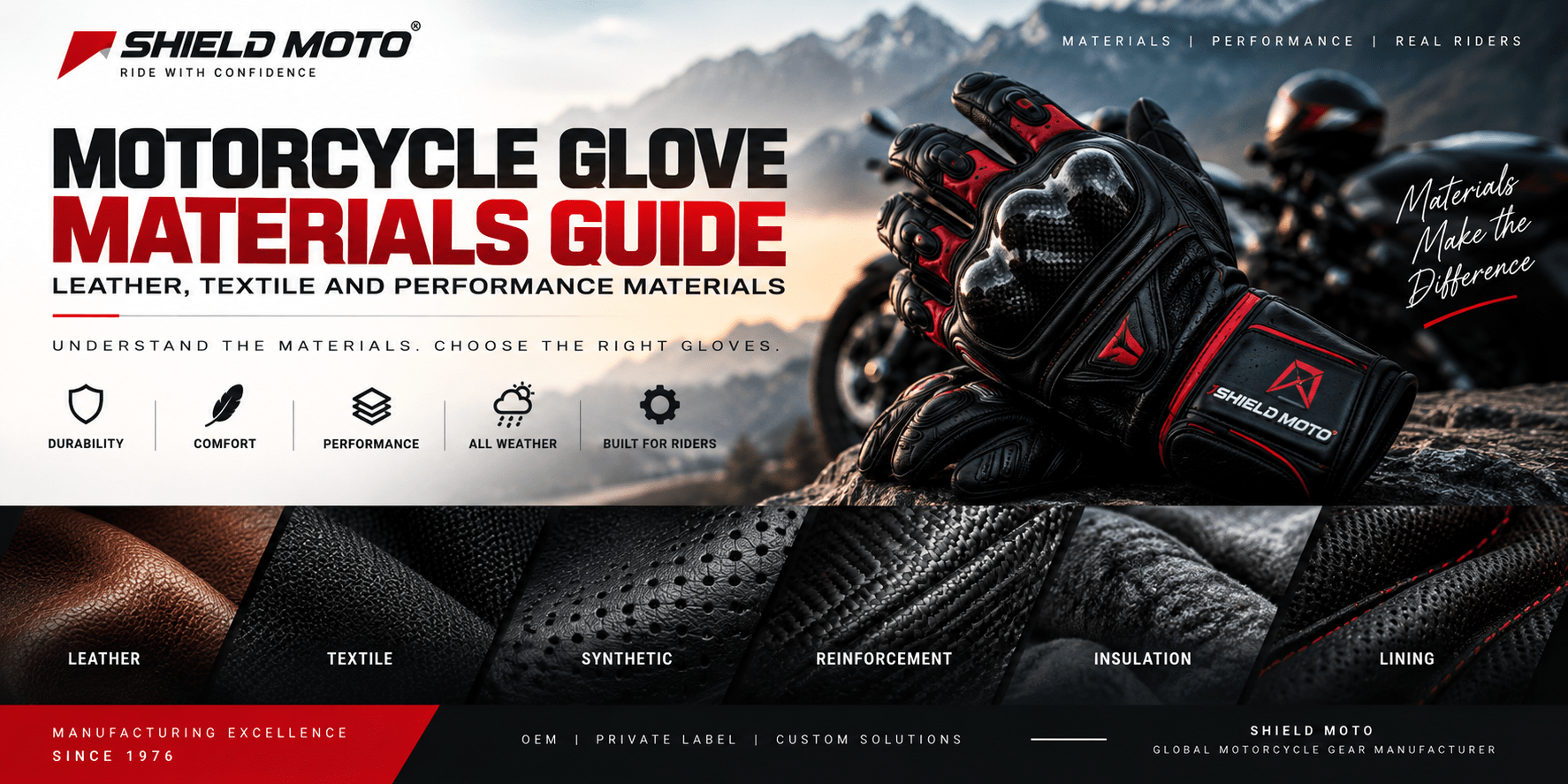
Choosing motorcycle gloves is not only about style or color. The material used in the palm, backhand, fingers, reinforcements, lining, and protective components can affect durability, flexibility, grip, breathability, weather resistance, comfort, and overall glove construction.
The most common material approaches include leather, textile fabrics, synthetic materials, and combinations of several materials. There is no single material that is automatically best for every rider. The right choice depends on riding style, weather, glove design, intended use, fit, and the features built around the material.
For motorcycle brands and retailers, material selection is equally important because it affects product positioning, target market, manufacturing requirements, branding, and the final riding experience.
Motorcycle gloves can use several materials within the same product rather than relying on one material throughout.
A typical glove may combine:
This combination allows manufacturers to balance different requirements such as flexibility, abrasion resistance, comfort, grip, ventilation, and weather protection.
The important question is therefore not simply “Which material is best?” but “Which material and construction are appropriate for this glove’s intended use?”
Leather remains one of the most established material choices for motorcycle gloves.
Depending on the leather type and construction, leather can provide a combination of durability, flexibility, tactile feel, and abrasion resistance. Leather gloves are commonly associated with racing, street riding, cruising, vintage styles, and premium motorcycle gear.
Motorcycle gloves may be produced using different leather types, including:
Each leather type can have different characteristics, so buyers should evaluate the actual specification rather than assuming all leather gloves perform identically.
Cowhide is widely used in motorcycle gear because it can provide a strong and durable material platform.
It can be suitable for motorcycle gloves where durability and robust construction are important considerations.
Cowhide can also be useful for commercial glove collections where brands need a balance between material performance, product positioning, and manufacturing cost.
Goat leather can offer a useful combination of softness, flexibility, and durability.
It may be particularly appropriate where the glove needs a comfortable hand feel without sacrificing the robust characteristics expected from motorcycle gear.
Shield Moto’s current racing glove range includes models identified with goat leather, demonstrating that leather selection can vary between glove constructions and product specifications.
Kangaroo leather is often selected for applications where lightweight construction and flexibility are important.
It is particularly associated with premium racing glove applications.
However, material selection should always be evaluated together with thickness, panel construction, reinforcement, stitching, and the complete glove design rather than judging performance from the leather type alone.
Textile gloves use woven or engineered fabrics as part of their main construction.
Textile materials can provide design flexibility and can be useful when manufacturers need to combine ventilation, flexibility, insulation, weather resistance, or lightweight construction.
Textile motorcycle gloves are commonly associated with:
A textile glove does not necessarily mean a simple or lightweight construction. Advanced motorcycle gloves can combine several textile materials with reinforcement and protective components.
Textile construction can make sense when a product needs specific characteristics that may be difficult to achieve using leather alone.
For example, a manufacturer may design different panels for:
This makes textile construction particularly useful for gloves designed around specific weather or riding conditions.
Leather and textile are not competing materials in every application. They are different construction approaches with different strengths.
| Feature | Leather | Textile |
|---|---|---|
| Durability | Generally strong, depending on leather and construction | Depends heavily on fabric type and construction |
| Flexibility | Can be highly flexible after proper construction and use | Often allows flexible panel design |
| Breathability | Depends on perforation and construction | Can be designed for ventilation |
| Weather use | Depends on treatment and construction | Can be engineered for specific weather conditions |
| Feel | Natural material feel | Depends on textile type |
| Style | Strong association with classic and racing gear | Broad range of modern designs |
| Customization | Suitable for many premium constructions | Flexible for multi-panel designs |
| Typical applications | Racing, street, cruiser, vintage | Touring, commuting, winter, adventure and mixed-use |
The better option depends on the glove’s intended purpose.
Modern motorcycle gloves may also incorporate engineered synthetic materials.
These materials can be used to introduce specific characteristics into individual areas of the glove rather than replacing the main shell material entirely.
Examples can include materials designed for:
Some Shield Moto product listings, for example, identify materials and technologies such as Chamude®, Pittards® leather, SuperFabric®, and aramid stitching on specific racing glove models.
The important distinction is that a material appearing on one model should not automatically be assumed to be used across every Shield Moto glove.
The palm is one of the most important areas to examine when comparing motorcycle glove construction.
The palm needs to balance:
A glove can use a different material or reinforcement in the palm than on the back of the hand.
For example, a motorcycle glove may combine leather on the main shell with a specialized grip material in the palm.
This type of multi-material construction allows the manufacturer to assign different materials to different functional areas.
Additional palm reinforcement can be used in areas exposed to higher wear.
For buyers, it is worth checking:
The back of the hand and finger areas can use a combination of shell materials and protective components.
Knuckle protection may be constructed separately from the glove’s primary leather or textile shell.
Finger construction can also include:
These components need to work together without unnecessarily restricting finger movement.
A glove designed for track riding may prioritize different construction characteristics from a glove designed for everyday commuting.
The inside of a motorcycle glove is just as important as the outside.
The lining can influence:
Summer-oriented gloves may prioritize lighter and more breathable construction.
Winter gloves typically require additional insulation and weather-oriented construction.
This is why the same shell material can produce very different riding experiences depending on the internal construction.
Winter motorcycle gloves require a different material strategy from warm-weather gloves.
The goal is not simply to add a thick outer material. Manufacturers need to consider the relationship between:
Too much bulk can make controls more difficult to operate, while insufficient insulation may not provide the desired cold-weather comfort.
Shield Moto has a dedicated Winter Gloves category, making winter-specific construction a separate product segment rather than simply treating winter gloves as thicker versions of standard riding gloves.
Perforation is another important construction consideration.
Small perforations can increase airflow through leather panels and can be useful for warm-weather riding.
However, perforation also changes how a glove interacts with wind and weather.
For hot-weather motorcycle gloves, buyers may want to consider:
A current Shield Moto short racing glove listing, for example, identifies perforated leather panels as part of its warm-weather construction.
Grip is not determined by one material alone.
It can depend on:
Specialized grip materials can be integrated into the palm or finger areas to improve the intended feel and control characteristics of a particular glove.
When sourcing motorcycle gloves, brands should evaluate grip materials together with the complete hand construction rather than selecting a material based only on its name.
Different riders can have different priorities.
| Riding Style | Material Priorities |
|---|---|
| Track / Racing | Lightweight construction, flexibility, grip, reinforcement, protective design |
| Street Riding | Balance of durability, comfort, grip and versatility |
| Touring | Comfort, weather suitability, durability and long-duration wear |
| Commuting | Convenience, flexibility, weather suitability and everyday durability |
| Winter Riding | Insulation, weather resistance, warmth and dexterity |
| Motocross | Lightweight construction, flexibility, grip and rugged-use suitability |
| Vintage / Cruiser | Leather feel, styling, comfort and appropriate reinforcement |
These are general selection considerations rather than guarantees of performance.
For a motorcycle brand developing a glove collection, material selection should begin with the product’s intended customer and use case.
Before choosing a material, define:
Is the glove intended for:
The answer will influence the material strategy.
Premium materials may support a different product positioning from standard materials.
Brands should consider material cost together with:
A premium motorcycle glove should not be evaluated only by external appearance.
Consider:
Protection-related requirements should be defined before selecting the final materials.
Material selection should work together with the required protective components and applicable standards.
Do not assume that a particular leather, textile, or synthetic material automatically makes a glove compliant with a safety standard.
For private-label motorcycle gloves, brands should also determine:
The manufacturer should then confirm which options are technically suitable for the selected glove construction.
Material selection becomes more important when developing gloves for a motorcycle brand.
OEM and private-label buyers should discuss the following with a manufacturer:
A manufacturer should be able to explain how the selected materials work with the proposed construction.
Shield Moto states that its OEM and private-label services can include material selection, design, packaging, and branding customization.
For a brand developing a new motorcycle glove collection, this type of manufacturing relationship can be more useful than simply selecting an off-the-shelf product.
Before placing a production order, ask specific questions rather than simply asking whether the factory produces “high-quality gloves.”
Useful questions include:
The answers should be specific to the actual product rather than generic factory promises.
For riders, the decision can be simplified by starting with the riding environment.
Choose leather when: you want a traditional motorcycle glove construction and the characteristics of leather suit your intended riding application.
Consider textile when: ventilation, flexibility, weather-specific construction, or multi-material design are important priorities.
Consider specialty performance materials when: a specific part of the glove requires additional grip, reinforcement, flexibility, or another targeted characteristic.
For winter gloves: evaluate the complete insulation, lining, weather-resistance, and dexterity system rather than focusing only on the outer shell.
For racing gloves: examine the complete construction, including leather selection, palm reinforcement, knuckle and finger protection, wrist coverage, stitching, and fit.
The best motorcycle glove is not simply the one with the most expensive material. It is the one whose materials and construction are appropriate for the intended use.
Shield Moto is a Pakistan-based motorcycle glove manufacturer offering motorcycle glove categories including long racing gloves, short racing gloves, winter gloves, vintage gloves, custom biker gloves, half-finger gloves, and motocross gloves.
The company also states that it provides OEM and private-label manufacturing for brands, retailers, distributors, and motorcycle-related businesses.
Its manufacturing information includes R&D, cutting, printing, stitching, quality assurance, and packing, alongside dedicated production infrastructure.
For brands developing a motorcycle glove collection, material selection can therefore be considered as part of the wider product-development process rather than as an isolated purchasing decision.
Explore the relevant Shield Moto glove category or discuss your requirements with the manufacturing team when you have defined your riding application, target market, materials, construction, branding, and product specifications.
There is no single best material for every motorcycle glove. Leather can be appropriate for many racing, street, cruiser, and vintage applications, while textile and engineered materials can be useful for ventilation, weather-specific designs, touring, commuting, and multi-material construction.
Not universally. Leather and textile have different characteristics and can be used for different riding applications. The complete construction, reinforcement, fit, weather suitability, and intended use are more important than choosing one material based only on its category.
Motorcycle gloves can use several leather types, including cowhide, goat leather, and kangaroo leather. The appropriate option depends on the glove design, intended use, desired hand feel, flexibility, durability requirements, and product positioning.
Winter gloves require more than a particular outer material. The overall system—including shell, insulation, lining, weather resistance, closure, and dexterity—should be considered together.
The palm interacts directly with the motorcycle controls, so its material and construction can influence grip, tactile feel, durability, flexibility, and comfort. Reinforcement may also be added to areas exposed to greater wear.
Yes. Multi-material construction is common because different areas of a glove can have different functional requirements. A glove may combine leather, textile, stretch material, grip material, lining, and protective components.
Brands should define the riding application, target market, price position, climate, desired hand feel, protection requirements, branding requirements, and manufacturing specifications before finalizing materials.
Yes, depending on the manufacturer’s capabilities. Customization may include materials, colors, branding, construction details, printing or embroidery, labels, and packaging. These options should be confirmed during product development and sampling.
Motorcycle glove materials should be selected according to the riding application, construction requirements, climate, fit, durability expectations, and product positioning.
Leather remains an important choice for many motorcycle gloves, while textile and engineered materials provide additional options for ventilation, weather-specific construction, flexibility, and specialized applications.
For motorcycle brands and retailers, the material decision should be made together with the manufacturer. Reviewing samples, construction details, fit, reinforcement, branding, and applicable requirements before production can help ensure that the finished glove matches the intended product specification.