Need help? Ask an expert your product and motorbike gloves questions
Need help? Ask an expert your product and motorbike gloves questions
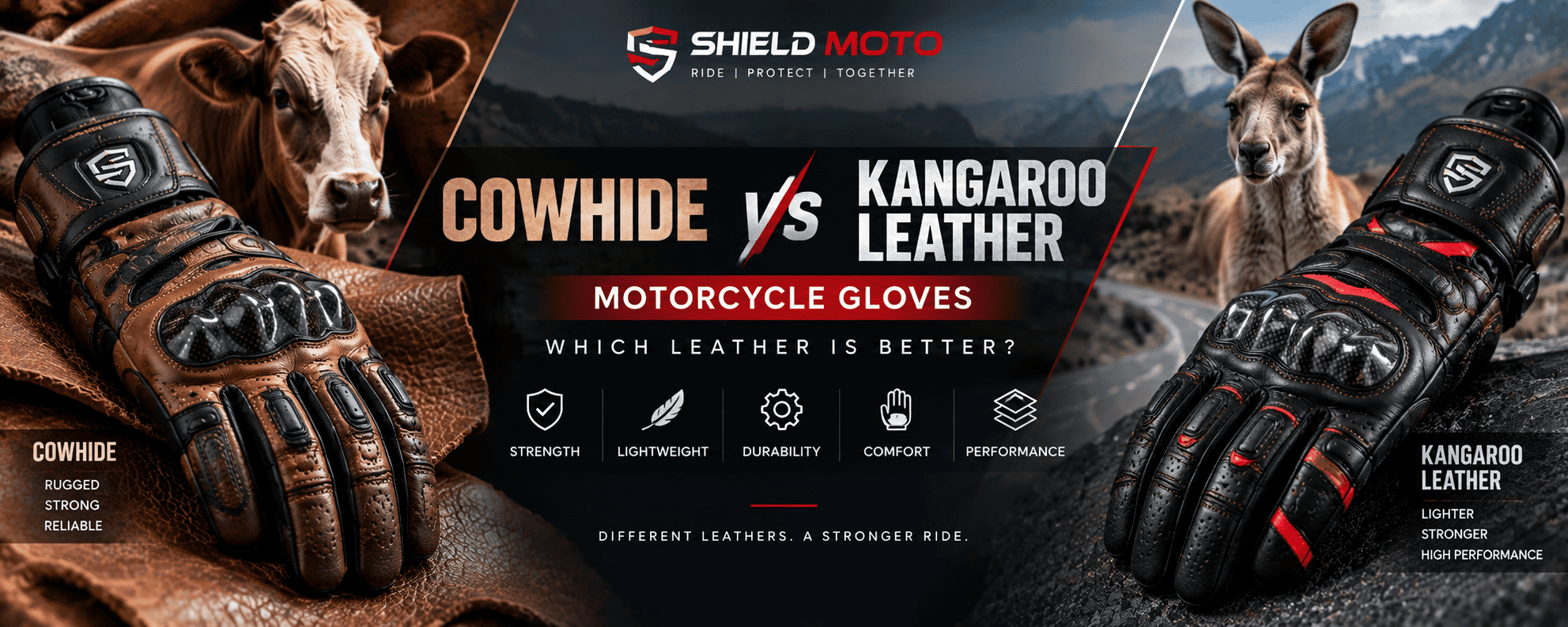
For motorcycle gloves, cowhide and kangaroo leather can both be effective materials, but they serve different design priorities. Kangaroo leather is particularly attractive for performance-oriented motorcycle gear because it can provide high mechanical strength at relatively low thickness and weight. Cowhide remains a widely used option for motorcycle apparel and can provide strong abrasion, tear, and tensile performance when properly selected and constructed.
The better choice depends on the glove’s intended use, leather specification, thickness, construction, reinforcement, fit, and required performance—not simply the animal species.
| Feature | Cowhide | Kangaroo Leather |
|---|---|---|
| General construction | Substantial and versatile | Lightweight and performance-oriented |
| Strength-to-weight potential | Strong | Particularly high |
| Typical thickness | Can be used in thicker constructions | Can provide high performance at lower thickness |
| Weight | Generally heavier at comparable thickness | Generally lighter for comparable applications |
| Flexibility | Depends on leather and construction | Well suited to lightweight flexible designs |
| Abrasion performance | Can be excellent | Can be excellent |
| Tear resistance | Can be excellent | Can be excellent |
| Racing applications | Widely used | Particularly associated with high-performance racing gear |
| Cost consideration | Generally more accessible | Usually a premium material |
| Best starting point | Versatile motorcycle glove designs | Lightweight, performance-focused designs |
These are general material characteristics. The actual performance of a motorcycle glove depends on the specific leather, processing, thickness, pattern, stitching, reinforcement, and protective construction.
Cowhide is leather made from cattle hide and is widely used in motorcycle apparel and protective equipment.
For motorcycle gloves, cowhide can provide a substantial material base for designs requiring durability and abrasion resistance. However, “cowhide” by itself does not define the performance of the finished glove.
Important variables include:
Research on cattle-hide leather used for gloves shows that processing conditions can influence physical and mechanical properties such as tensile strength, elongation, thickness, and rub fastness.
That means a buyer should evaluate the specific leather specification, rather than assuming every cowhide motorcycle glove will perform identically.
Kangaroo leather is produced from kangaroo hide and has become associated with lightweight motorcycle racing equipment.
Research recorded by Australia’s CSIRO includes dedicated studies into the tensile strength of leather from kangaroo skins, reflecting the material’s technical importance in leather research.
Kangaroo leather is particularly interesting for motorcycle applications because its fiber structure can support high mechanical performance without requiring the same thickness as some conventional motorcycle leathers.
Ducati’s technical motorcycle apparel information, for example, describes kangaroo leather as offering a strong mechanical-resistance-to-lightness ratio and uses a thinner kangaroo construction compared with the cowhide used in its motorcycle sport applications.
There is no useful universal answer based only on the names “kangaroo” and “cowhide.”
Leather strength depends on factors including:
Research has shown that collagen-fiber orientation is an important factor affecting leather tear strength across different mammalian species.
However, kangaroo leather is well known in technical motorcycle apparel for achieving strong mechanical properties at relatively low weight.
Ducati’s motorcycle apparel documentation describes kangaroo leather as having excellent tear and abrasion resistance and a favorable mechanical-resistance-to-lightness ratio.
So the more useful comparison is:
Kangaroo leather can offer exceptional performance where low weight and high mechanical performance are priorities, while cowhide can provide strong performance with a broader range of thicknesses, constructions, and applications.
Kangaroo leather generally has an advantage when low weight is a major design requirement.
For motorcycle sport applications, Ducati specifies a kangaroo leather construction at approximately 0.9 mm and describes it as 25% thinner than the cowhide used for its motorcycle sport application. The company also states that one square meter of that kangaroo leather weighs approximately 600 grams.
The important point is not that every kangaroo leather is lighter than every cowhide.
Instead, kangaroo leather can allow manufacturers to pursue a lighter construction without automatically sacrificing the mechanical performance required by the product specification.
That can be particularly valuable for racing gloves.
For performance-oriented racing gloves, kangaroo leather deserves serious consideration when weight, flexibility, and mechanical performance are priorities.
However, the leather is only one component of a racing glove.
A complete racing glove may also involve:
Shield Moto’s current long racing glove range demonstrates this principle. One listed racing model uses goatskin leather together with Chamude reinforcement, TPU carbon knuckle protection, SuperFabric® protection, palm protection, and other reinforcement features.
This is why the question should not simply be “Which leather is strongest?”
The better question is:
Which leather and construction provide the right balance of weight, flexibility, durability, protection features, fit, and riding purpose?
For everyday riding, cowhide can be a practical starting point when the rider wants a substantial leather glove with a conventional motorcycle-glove feel.
Kangaroo leather may make more sense when the rider prioritizes:
For commuting, touring, cruising, and general road use, however, the best material depends on the complete glove design and intended environment.
A heavy leather glove is not automatically better, and a lightweight glove is not automatically less protective.
Track riding places different demands on motorcycle gloves.
Riders may prioritize:
Kangaroo leather’s strength-to-weight characteristics can make it particularly attractive for this type of application. Ducati specifically positions kangaroo leather within its performance motorcycle apparel range because of its combination of mechanical performance and reduced weight.
Cowhide can also be engineered into high-performance motorcycle gear. The specific grade, thickness, processing, and construction matter considerably.
Not necessarily.
Leather thickness can influence resistance characteristics, but increasing thickness can also affect:
Ducati’s technical material guidance explains that leather thickness affects perceived softness and resistance to tearing and abrasion, with thinner leather generally being more comfortable and thicker leather generally being more rigid.
Therefore, motorcycle glove manufacturers need to balance material thickness against the complete product specification.
One of the strongest arguments for kangaroo leather is not simply “strength.”
It is the combination of mechanical performance and low weight.
This matters because motorcycle gloves must allow riders to operate controls while maintaining a secure fit and sufficient dexterity.
Reducing unnecessary material weight can be valuable for riders who spend long periods riding or who prioritize track performance.
The material should still be evaluated in the finished glove because pattern design, stitching, reinforcement, and protective components all influence the final result.
Cowhide offers manufacturers a broad material platform for motorcycle glove development.
It can be selected in different specifications and incorporated into different constructions depending on the product.
Cowhide is used across motorcycle apparel, and technical motorcycle equipment manufacturers offer multiple cowhide constructions with different thicknesses, finishes, and performance characteristics.
For brands developing motorcycle gloves, that versatility can be useful when creating products for:
Comfort cannot be determined by leather species alone.
A motorcycle glove’s comfort depends on:
A very strong leather can become uncomfortable if the pattern is poorly designed.
Likewise, a lightweight leather can still produce an uncomfortable glove if the fit or construction is wrong.
For motorcycle gloves, material selection and pattern engineering need to work together.
For a motorcycle brand developing a new glove, the decision should begin with the product brief.
Before selecting the leather, define:
Then compare the appropriate leather samples.
This is more reliable than choosing kangaroo or cowhide simply because one material has a stronger reputation.
If you are developing a custom motorcycle glove, ask the manufacturer to produce samples using the proposed leather.
Compare the samples for:
Shield Moto’s custom biker glove range states that sampling is available before bulk production, allowing buyers to evaluate fit, material, and branding before committing to production.
For retailers, motorcycle brands, distributors, and private-label buyers, material selection also affects the commercial positioning of the product.
| Buyer Priority | Material Worth Evaluating |
|---|---|
| Lightweight premium racing glove | Kangaroo leather |
| Performance-focused track product | Kangaroo leather |
| General leather riding glove | Cowhide |
| Substantial leather construction | Cowhide |
| Premium lightweight positioning | Kangaroo leather |
| Broad product-range development | Cowhide |
| Custom performance glove | Compare both through sampling |
These are starting points rather than absolute rules.
The manufacturer’s sample and technical specification should determine the final decision.
When sourcing cowhide or kangaroo leather gloves, ask the manufacturer for clear information about:
Do not accept a generic statement such as “premium leather.”
A professional specification should tell you what material is being used, where it is being used, and what construction it is part of.
Shield Moto is a Pakistan-based motorcycle glove manufacturer that provides OEM and private-label manufacturing for motorcycle brands and other B2B buyers. Its website describes capabilities including material selection, product development, R&D, cutting, printing, stitching, quality assurance, and packaging.
Shield Moto’s current product range includes multiple leather motorcycle glove constructions. Its custom biker glove category currently lists cowhide and goat-leather products, while its long racing glove range includes a goat-skin construction.
For a brand specifically interested in kangaroo leather, the appropriate approach is to discuss the required material specification directly with the manufacturer and confirm whether that material is available for the intended product.
Choose kangaroo leather when the product prioritizes lightweight construction and high mechanical performance relative to weight, particularly for performance-oriented motorcycle gear.
Choose cowhide when you want a versatile leather platform for a substantial motorcycle glove construction and the material specification fits the intended application.
For either material, the final glove should be evaluated as a complete product.
The best motorcycle glove is not determined by leather species alone. It is determined by how the material is selected, engineered, and incorporated into the complete glove.
Not in every application. Kangaroo leather is particularly attractive when low weight and high mechanical performance are priorities. Cowhide offers a versatile material option that can also provide strong abrasion, tear, and tensile performance when appropriately selected and constructed.
Kangaroo leather can provide a lower-weight construction than cowhide at comparable motorcycle-sport applications. Ducati, for example, describes a 0.9 mm kangaroo construction as thinner and lighter than its motorcycle-sport cowhide application.
Yes, kangaroo leather is used in performance-oriented motorcycle equipment and is valued for its mechanical performance-to-weight characteristics. However, the overall glove construction—not leather alone—determines suitability.
Cowhide can provide strong mechanical performance for motorcycle equipment, but durability depends on leather quality, processing, thickness, construction, and reinforcement. Different cowhide specifications can have substantially different properties.
Not automatically. A thinner leather can have strong mechanical properties depending on its structure and processing. Kangaroo leather is one example where relatively thin material can provide strong mechanical performance. The complete product construction and applicable testing should be evaluated rather than thickness alone.
Kangaroo leather is generally positioned as a premium material in high-performance motorcycle equipment, but actual pricing depends on leather quality, sourcing, thickness, processing, product construction, and order requirements. Buyers should request project-specific quotations rather than assuming a fixed price difference.
Shield Moto provides custom, OEM, and private-label motorcycle glove manufacturing and states that material selection can be incorporated into custom product development. Specific material availability—including kangaroo leather—should be confirmed for the individual project.
The complete glove specification is more important than the leather name alone. Fit, construction, thickness, stitching, reinforcement, protective components, intended riding application, and verified testing requirements should all be considered before production.