Need help? Ask an expert your product and motorbike gloves questions
Need help? Ask an expert your product and motorbike gloves questions
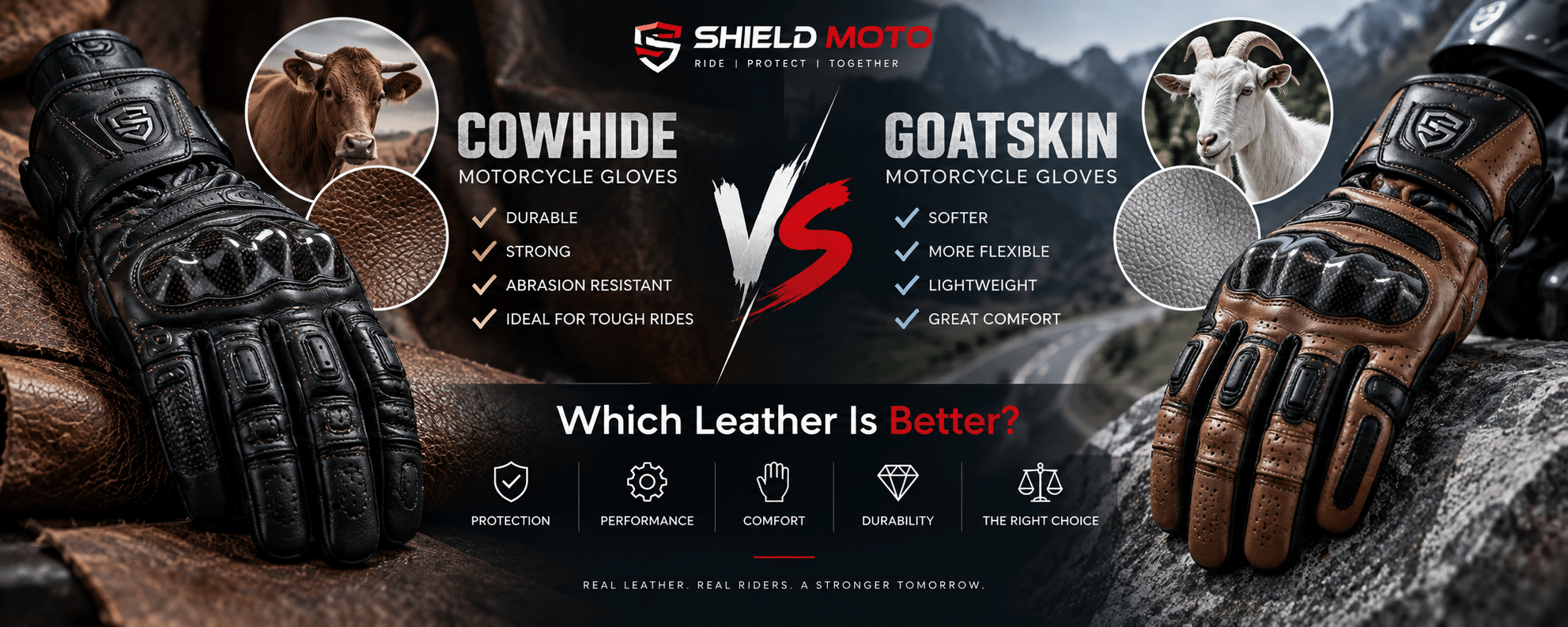
When comparing cowhide vs goatskin motorcycle gloves, there is no single winner for every rider or application. Cowhide is often chosen when a substantial, durable leather construction is desired, while goatskin is valued for its flexibility, softness, and suitability for gloves that need comfortable hand movement.
For motorcycle gloves, however, the leather itself is only one part of the equation. Thickness, tanning, grain structure, stitching, reinforcement, palm construction, protective components, and glove design can have as much influence on the finished product as the animal hide.
| Feature | Cowhide Motorcycle Gloves | Goatskin Motorcycle Gloves |
|---|---|---|
| General feel | Substantial and structured | Soft and flexible |
| Flexibility | Generally moderate | Generally high |
| Hand mobility | Depends strongly on construction | Often well suited to flexible glove designs |
| Durability | Commonly selected for robust leather goods | Can provide strong mechanical properties when properly processed |
| Weight | Can feel heavier depending on thickness | Often suitable for lighter constructions |
| Grain | Typically more substantial | Characteristic fine grain |
| Best suited to | Robust riding and work-oriented designs | Flexible riding and comfort-focused designs |
| Key consideration | Thickness and construction | Leather quality and processing |
| Is one universally better? | No | No |
The table provides a general material comparison, not a guarantee of performance. Leather properties vary according to hide quality, animal characteristics, tanning, finishing, thickness, and manufacturing process. Research on goat leather, for example, shows that physical properties can vary with factors such as age, sex, thickness, and processing.
Cowhide is leather made from cattle hide. It is widely used for footwear, apparel, motorcycle equipment, workwear, and other leather products.
For motorcycle gloves, cowhide can be appropriate when the product specification calls for a more substantial leather construction.
Important characteristics to evaluate include:
A thicker cowhide is not automatically a better motorcycle glove material. Excessive thickness can affect dexterity and comfort, while a well-designed glove needs an appropriate balance between material structure and hand movement.
Goatskin is leather produced from goat hide. It is commonly used in gloves and other applications where flexibility and hand movement are important.
Goatskin has a distinctive grain structure and can provide a soft, flexible feel when appropriately processed.
Research into goatskin leather has demonstrated that its physical and mechanical properties depend on characteristics of the original skin and the leather-processing conditions.
For motorcycle gloves, this makes goatskin particularly interesting for designs where the manufacturer needs to balance:
It is too simplistic to say that cowhide is always more durable than goatskin.
Leather durability depends on much more than the species of animal. Thickness, fiber structure, tanning, finishing, construction, stitching, and the location of the leather within the glove all influence the finished product.
Laboratory research on goat leather demonstrates that properties such as tensile strength and tear strength can vary significantly depending on the characteristics of the hide and how the leather is processed.
For motorcycle gloves, therefore, ask the manufacturer for the actual leather specification rather than choosing based solely on the word “cowhide” or “goatskin.”
Goatskin is generally a strong choice when flexibility is an important design objective.
A recent study of goat and sheep garment leather describes these leathers in terms of softness, flexibility, lightweight characteristics, and mechanical performance, although the study concerns garment leather rather than motorcycle gloves specifically.
Cowhide can also be flexible when appropriately selected and processed. The final glove construction matters considerably.
For motorcycle gloves, flexibility is important because the rider needs to operate controls while maintaining comfortable hand movement.
A glove should therefore not be evaluated by leather type alone.
For racing gloves, construction should be evaluated before leather species.
A racing glove may incorporate features such as:
Shield Moto’s current long racing glove range provides a useful example of this principle. One listed model uses goat skin leather on the backhand and palm while combining that leather with other reinforcement and protective components.
This demonstrates why simply asking whether cowhide or goatskin is “better” can produce an incomplete answer. A motorcycle glove’s performance depends on the complete construction.
For everyday motorcycle riding, either leather can be suitable depending on the glove design.
The correct choice should ultimately come from the complete product specification.
For motorcycle brands and retailers, the comparison becomes more technical.
A manufacturer should be able to explain why a particular leather is being recommended for the intended glove.
For example, a manufacturer developing a custom glove should consider:
This approach is more reliable than telling a factory, “I want the strongest leather.”
The actual objective should be to specify the desired finished-glove characteristics.
The palm deserves particular attention because it interacts directly with the motorcycle controls.
A manufacturer should evaluate:
A reinforced palm can add material to a high-wear area, but the reinforcement should not unnecessarily restrict hand movement.
This is why material selection and pattern development need to work together.
No.
Thickness is only one characteristic of leather.
A thicker material may provide a more substantial construction, but it can also affect flexibility, weight, dexterity, and comfort.
A thinner material can provide greater flexibility, but that does not automatically mean it is appropriate for every riding application.
The correct specification depends on the complete glove design.
For B2B buyers, the better question is:
What leather specification provides the required balance of flexibility, durability, comfort, construction, and intended use for this glove?
A motorcycle brand should choose based on the product it is trying to develop.
| Product Goal | Potential Starting Point |
|---|---|
| Substantial leather riding glove | Cowhide may be worth evaluating |
| Flexible glove construction | Goatskin may be worth evaluating |
| Comfort-focused design | Goatskin may be worth evaluating |
| Structured leather construction | Cowhide may be worth evaluating |
| Racing glove | Evaluate complete construction first |
| Custom/private-label glove | Compare both through sampling |
| Premium product | Select based on leather specification and finished construction |
These are starting points, not universal rules.
A professional manufacturer should be able to provide samples so the buyer can compare the actual materials rather than making a decision based only on descriptions.
If you are developing motorcycle gloves for your own brand, request samples in the proposed leather before approving bulk production.
Compare:
A physical sample can reveal differences that cannot be identified from a product photograph.
Shield Moto’s custom biker glove range currently includes both cowhide and goatskin models, making material comparison particularly relevant for brands evaluating custom glove development.
Choose cowhide when the product specification calls for a substantial leather construction and the material characteristics fit the intended riding application.
Choose goatskin when flexibility, hand movement, and a softer leather feel are important parts of the product specification.
For a custom motorcycle glove, the best approach is not to choose the hide first and design the glove around it. Instead, define the riding application and required performance characteristics, then evaluate the most appropriate leather through samples.
Shield Moto provides motorcycle glove manufacturing for brands and B2B buyers, including custom, OEM, and private-label development.
Its current website lists both cowhide and goatskin motorcycle glove products within its custom biker glove range. The company also describes capabilities covering material selection, design, branding, packaging, R&D, cutting, stitching, printing, and quality assurance.
For a brand deciding between cowhide and goatskin, the practical next step is to define the glove’s intended riding application and request the appropriate material samples before finalizing the production specification.
Neither leather is universally better.
Cowhide can be a strong candidate for substantial motorcycle glove constructions, while goatskin can be an excellent option when flexibility and comfortable hand movement are important.
The better choice depends on:
For motorcycle brands, retailers, and distributors, the most reliable method is to compare actual samples built to the same design and evaluate the complete glove rather than judging the leather in isolation.
Not universally. Cowhide and goatskin have different characteristics, and the best choice depends on the glove’s construction, intended use, leather specification, reinforcement, fit, and required performance.
Goatskin can provide suitable mechanical properties for leather products, but durability depends on hide quality, processing, thickness, construction, and use. Research shows that goatskin properties vary with characteristics of the original skin and processing conditions.
Leather type alone does not establish a glove’s protection level. Protection depends on the complete design, including protective components, reinforcement, construction, and any applicable verified testing or certification.
Goatskin is commonly associated with a softer and more flexible feel, but actual softness varies according to leather processing, finishing, thickness, and product construction.
Neither should automatically be selected based only on leather species. Racing gloves should be evaluated as a complete construction, including coverage, closures, reinforcement, protective components, flexibility, and fit.
Yes, some manufacturers offer both materials. Shield Moto’s current custom biker glove range includes cowhide and goatskin products.
Yes. For a custom or private-label product, comparing physical samples is one of the best ways to evaluate leather feel, flexibility, construction, fit, stitching, reinforcement, and overall finishing before bulk production.
Shield Moto’s website currently lists custom biker glove products using both cowhide and goatskin and describes OEM/private-label manufacturing and customization capabilities. Specific leather availability, construction, and project requirements should be confirmed with Shield Moto for the individual order.