Need help? Ask an expert your product and motorbike gloves questions
Need help? Ask an expert your product and motorbike gloves questions
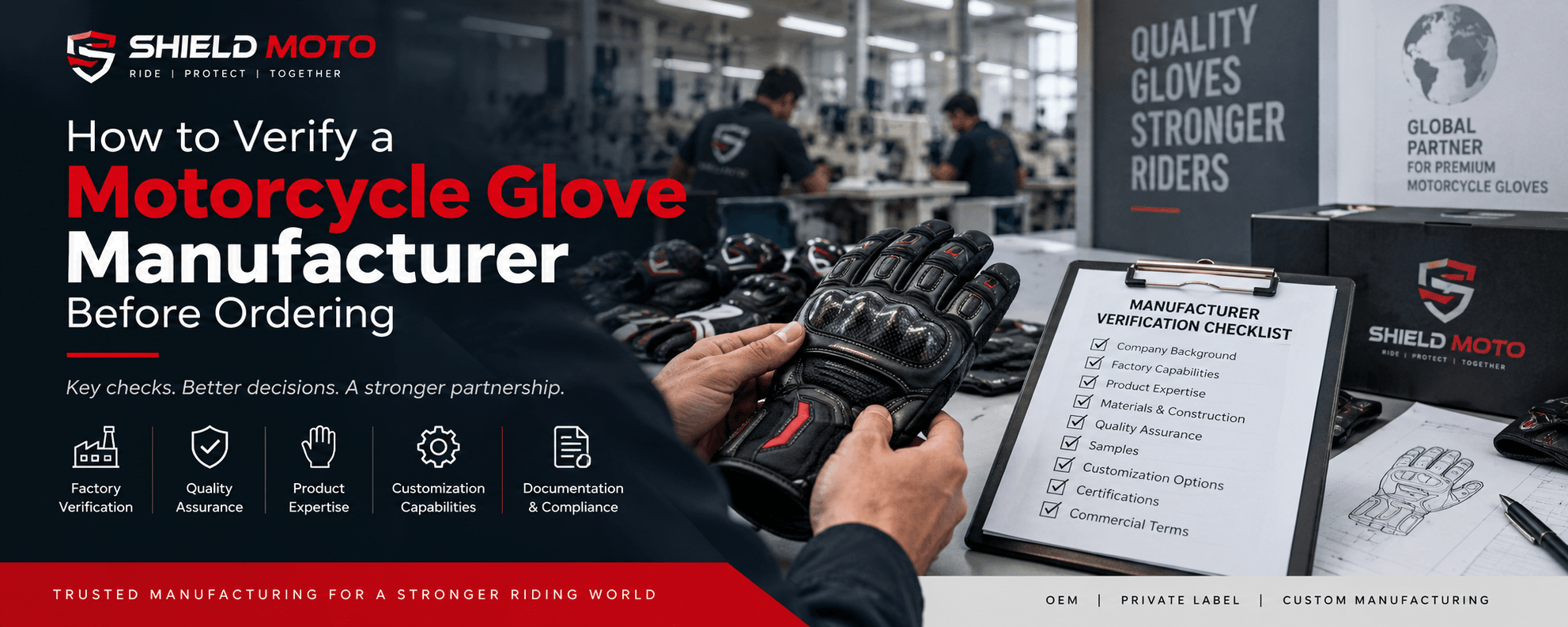
Choosing a motorcycle glove manufacturer is more than comparing prices. Before placing an order, you should verify that the supplier is a genuine manufacturer, understands motorcycle glove construction, can produce the specifications you need, has a documented quality process, and can provide samples before bulk production.
For brands, retailers, distributors, and motorcycle businesses, the safest approach is to verify the manufacturer in several stages: company identity, factory capability, product expertise, materials, quality assurance, samples, customization, documentation, and production requirements.
Before committing to a motorcycle glove supplier, verify these eight areas:
A supplier that cannot provide clear answers to basic manufacturing questions deserves additional scrutiny.
The first step is to establish what the company actually does.
Some businesses manufacture products themselves, while others operate as trading companies, sourcing products from third-party factories. Neither model is automatically wrong, but you should know which type of supplier you are dealing with before ordering.
Ask:
A manufacturer should be able to explain its production process in practical terms rather than only describing itself as a “factory.”
For example, Shield Moto identifies itself as a Pakistan-based motorcycle glove manufacturer operating under Solehre Brothers Industries in Sialkot, Pakistan. Its website identifies R&D, cutting, stitching, printing, quality assurance, and packing among its production-related capabilities.
This distinction matters because your sourcing requirements may be different if you are working directly with a factory versus a trading intermediary.
A general leather-goods factory is not necessarily an experienced motorcycle glove manufacturer.
Motorcycle gloves require product-specific knowledge involving areas such as:
Ask the manufacturer whether it regularly produces the type of glove you need.
For example, a supplier producing racing gloves should be able to discuss the construction requirements of racing-oriented products differently from winter, touring, motocross, or casual riding gloves.
Shield Moto’s current product ecosystem includes long racing gloves, short racing gloves, winter gloves, vintage gloves, custom biker gloves, half-finger gloves, and motocross gloves.
The goal is not simply to find a factory that can sew gloves. You want a manufacturing partner that understands why the glove is being designed a particular way.
Do not accept vague descriptions such as “premium leather” without asking what that means for your particular product.
Depending on the glove, ask about:
Material choice should be connected to the intended application.
A racing glove, for example, may have different priorities from a winter glove or a vintage-style riding glove. Durability, flexibility, weight, feel, weather resistance, and construction requirements can all influence material selection.
Shield Moto’s OEM information states that its custom biker glove range includes materials such as buffalo leather, cowhide, and goatskin, while specific material characteristics should be confirmed for the individual product or project.
Do not judge a manufacturer’s material capability from a photograph alone.
Request written specifications or samples when the material is important to your product.
A manufacturer’s machinery and production infrastructure can provide useful evidence that it has genuine manufacturing operations.
However, large numbers alone do not prove product quality.
Instead, look for a connection between the claimed infrastructure and the product you are ordering.
Shield Moto currently identifies production infrastructure including:
| Production Capability | Why It Matters |
|---|---|
| Stitching machines | Supports glove assembly |
| Automatic palm stitching | Relevant to palm construction |
| Cutting presses | Supports pattern and material cutting |
| CNC machines | Supports certain manufacturing operations |
| Sublimation equipment | Relevant to applicable printed designs |
| Heat-transfer printers | Supports applicable branding/graphics |
| R&D | Supports product development |
| Quality assurance | Supports production inspection |
| Packing | Supports finished-product preparation |
Shield Moto’s website currently states 600+ stitching machines, 50+ cutting presses, 15+ CNC machines, 15 production halls, and production capacity exceeding 6 million gloves annually.
If a manufacturer provides capacity figures, ask whether the stated capacity represents theoretical capacity, current production, or capacity available for your particular project.
“Quality checked” is not enough information.
Ask the manufacturer when and how quality is checked.
Useful questions include:
A reliable manufacturing conversation should move from general claims toward specific processes.
Shield Moto identifies quality assurance as one of its manufacturing capabilities and describes quality inspection as part of its production approach.
For your own sourcing process, ask the manufacturer to explain its quality checkpoints for your specific glove specification.
A sample is one of the most useful ways to evaluate a motorcycle glove manufacturer.
Photos can show appearance, but they cannot fully demonstrate:
For a custom or OEM project, the sample should be evaluated against the agreed product specification.
Before approving bulk production, inspect:
Construction
Materials
Fit
Branding
Finishing
Shield Moto’s OEM process specifically includes sample development before approved specifications move into production.
This is especially important when sourcing motorcycle gloves.
A manufacturer may describe features such as:
But a design feature is not automatically proof of a certified performance level.
Ask the supplier to distinguish between:
If a supplier claims that a glove complies with a specific safety standard, request the relevant documentation and verify that the documentation applies to the specific product or configuration you are ordering.
Do not assume that a certificate for one glove automatically covers every glove produced by the factory.
For brands ordering custom motorcycle gloves, clarify exactly what can be customized.
Potential areas include:
However, customization depends on the glove design, material, and production requirements.
Shield Moto states that its private-label manufacturing can include branding, labels, packaging, custom colors, embroidery, and sublimation printing where appropriate to the project.
Before production, create a written specification covering every approved customization element.
This prevents a common sourcing problem: the buyer and manufacturer having different interpretations of the final product.
Not every buyer needs the same manufacturing model.
| Supply Model | Best For | Main Focus |
|---|---|---|
| OEM | Brands developing products around defined specifications | Product development and manufacturing |
| Private Label | Brands selling gloves under their own identity | Branding, labeling, packaging and product presentation |
| Custom Manufacturing | Buyers requiring specific product changes | Materials, colors, design and construction |
| Wholesale | Businesses seeking ready products | Existing product selection and resale |
For example, a brand developing a completely new motorcycle glove specification may need an OEM development process.
A retailer wanting to sell gloves under its own brand may be better suited to private-label manufacturing.
Shield Moto describes these supply models separately and provides OEM and private-label manufacturing services for B2B buyers.
Before production begins, put the product requirements into writing.
A motorcycle glove specification can include:
This is especially important for OEM and private-label orders.
A clear specification gives both sides a reference point when reviewing the sample and bulk production.
Shield Moto’s OEM guidance similarly recommends defining the glove type, riding application, materials, colors, sizes, construction, branding, packaging, samples, and applicable certification requirements before production.
A legitimate manufacturer should be able to provide clear commercial information for your project.
Confirm:
Do not compare suppliers only on unit price.
A lower quoted price can become expensive if the supplier cannot maintain the required specification, sample quality, sizing, packaging, or production consistency.
The correct question is:
Which supplier can reliably produce the required product at an acceptable total cost and commercial risk?
International buyers should also verify whether the supplier understands their intended market.
Tell the manufacturer:
The manufacturer does not need to be located in your target market.
What matters is whether it can clearly communicate the production requirements and provide the documentation needed for your project.
Shield Moto identifies itself as a Pakistan-based manufacturer in Sialkot serving international buyers.
Before placing a significant order, use this checklist:
| Verification Area | What to Check |
|---|---|
| Company identity | Legal/company information and manufacturing role |
| Factory | Location and genuine production capability |
| Experience | Motorcycle glove-specific manufacturing experience |
| Materials | Clearly identified materials and specifications |
| Production | Cutting, stitching, printing and other relevant processes |
| Quality | Documented inspection and QA process |
| Samples | Pre-production sample availability |
| Fit | Size, pattern and ergonomic requirements |
| Customization | Branding, colors, materials and packaging |
| Protection | Features and applicable verified standards |
| Documentation | Certificates or test documentation where applicable |
| Commercial terms | Quantity, pricing, production and shipping terms |
| Communication | Clear technical and commercial responses |
| Final approval | Written specification and approved sample |
If a supplier cannot answer important questions clearly, investigate further before making a large commitment.
Before ordering, send the manufacturer a structured questionnaire.
The quality of the manufacturer’s answers can tell you a great deal about how prepared the company is to handle a serious B2B order.
If you are comparing two factories, create a simple scorecard rather than choosing the lowest quotation.
| Factor | Manufacturer A | Manufacturer B |
|---|---|---|
| Verified manufacturing facility | ✓ / ✕ | ✓ / ✕ |
| Motorcycle glove experience | ✓ / ✕ | ✓ / ✕ |
| Relevant product categories | ✓ / ✕ | ✓ / ✕ |
| Material options | ✓ / ✕ | ✓ / ✕ |
| Custom development | ✓ / ✕ | ✓ / ✕ |
| Sample available | ✓ / ✕ | ✓ / ✕ |
| QA process explained | ✓ / ✕ | ✓ / ✕ |
| Certification documentation | ✓ / ✕ | ✓ / ✕ |
| Branding capability | ✓ / ✕ | ✓ / ✕ |
| Packaging capability | ✓ / ✕ | ✓ / ✕ |
| Communication quality | ✓ / ✕ | ✓ / ✕ |
| Commercial terms | ✓ / ✕ | ✓ / ✕ |
This approach helps you compare manufacturing capability and sourcing risk, rather than price alone.
Shield Moto is a Pakistan-based motorcycle glove manufacturer operating under Solehre Brothers Industries, whose parent company states that it was established in 2002. Shield Moto’s current manufacturing information identifies R&D, cutting, stitching, printing, quality assurance, production, and packaging capabilities.
For buyers developing their own products, Shield Moto provides dedicated OEM motorcycle glove manufacturing, including product development, material selection, pattern and fit development, sampling, production, and quality assurance.
For brands that want their own commercial identity, its private-label offering covers areas such as branding, colors, labels, packaging, embroidery, and applicable printing options.
The appropriate route depends on your project. A buyer should still provide a clear specification, review samples, confirm applicable requirements, and approve the final production details before placing a bulk order.
The best way to verify a motorcycle glove manufacturer is to look beyond the company’s website and advertising claims.
Verify the factory. Verify the product expertise. Verify the materials. Verify the quality process. Verify the sample. Verify the documentation. Then verify the commercial terms.
For a B2B buyer, a trustworthy manufacturing relationship should be based on clear specifications and evidence rather than promises alone.
If you are developing motorcycle gloves for your own brand, start with a detailed product brief covering the intended riding application, materials, construction, sizing, branding, packaging, and applicable requirements. Then request a sample and evaluate it against the agreed specification before moving to bulk production.
Shield Moto provides OEM motorcycle glove manufacturing and private-label motorcycle glove manufacturing for buyers developing motorcycle glove products around their own requirements.