Need help? Ask an expert your product and motorbike gloves questions
Need help? Ask an expert your product and motorbike gloves questions
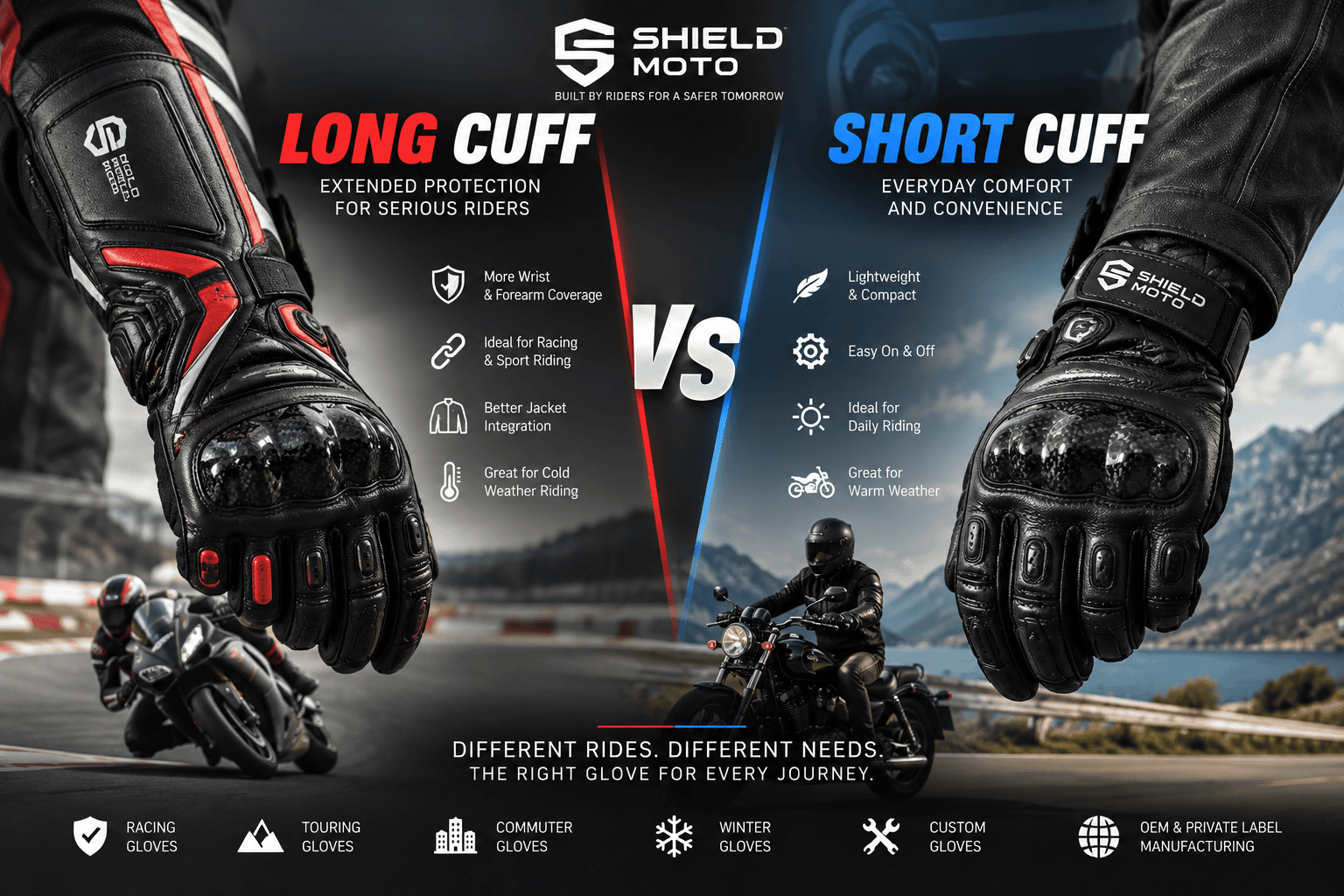
Long cuff and short cuff motorcycle gloves serve different riding needs. Long cuff gloves extend farther over the wrist and lower forearm, while short cuff gloves generally finish closer to the wrist. The right choice depends on riding style, weather, desired coverage, convenience, and the overall construction of the glove.
For riders who prioritize extended wrist coverage and a race-oriented design, long cuff gloves can be a practical choice. Short cuff gloves may be more convenient for commuting, casual riding, and situations where easier on-and-off use is important.
| Feature | Long Cuff Motorcycle Gloves | Short Cuff Motorcycle Gloves |
|---|---|---|
| Wrist coverage | Extended coverage over the wrist and lower forearm | Coverage generally ends closer to the wrist |
| Cuff length | Longer | Shorter |
| Typical riding use | Racing, sport riding, touring, track-oriented use | Commuting, cruising, everyday riding |
| Jacket integration | Can overlap more with a riding jacket sleeve | Easier to wear under or around shorter sleeves |
| Weather suitability | More coverage can be useful in cooler or exposed conditions | Convenient for warmer-weather everyday riding |
| On/off convenience | Generally requires more adjustment | Usually quicker to put on and remove |
| Wrist closure | Often includes more extensive cuff adjustment | Usually simpler and more compact |
| Mobility | Depends on construction and fit | Often feels less restrictive around the wrist |
| Storage/packing | Takes more space | Easier to pack |
| Best choice | Riders wanting extended coverage | Riders prioritizing convenience and everyday use |
The cuff length itself does not determine the protection performance of a motorcycle glove. The complete glove construction, fit, materials, protective components, closures, and applicable testing requirements all need to be considered.
A long cuff motorcycle glove extends beyond the wrist toward the lower forearm.
The additional material creates a larger covered area between the glove and the rider’s jacket sleeve. Long cuff designs are particularly common in racing and sport-oriented motorcycle gloves.
A long cuff may incorporate:
Shield Moto’s long racing glove, for example, uses a dual wrist closure system and an adjustable cuff with a TPR Velcro tab. Its construction also includes an elasticated wrist with strap tightening.
A short cuff motorcycle glove has a more compact wrist construction and generally finishes closer to the wrist joint.
This design can be useful for riders who prioritize:
Short cuff does not necessarily mean less attention to construction or protective features. A short glove can still incorporate reinforced palms, protective knuckle components, finger protection, secure closures, and other design features depending on the model.
The biggest physical difference is how far the glove extends beyond the hand and wrist.
Long cuff gloves cover more of the lower wrist and forearm area. This can create a larger overlap with a motorcycle jacket sleeve.
Short cuff gloves provide less forearm coverage and leave more of the jacket sleeve responsible for covering the transition between the glove and jacket.
For riders who regularly use a dedicated motorcycle jacket, the interaction between the glove cuff and jacket sleeve is therefore an important consideration.
A longer cuff may be useful when you want:
A shorter cuff may be useful when you want:
For track-focused or race-oriented riding, long cuff motorcycle gloves are generally the more relevant design because they provide extended wrist coverage and are commonly integrated with racing-oriented construction.
Shield Moto categorizes long racing gloves separately from short racing gloves, reflecting the different glove formats available for motorcycle riders.
However, cuff length alone should not be used to determine whether a glove is suitable for a particular type of riding.
For protective motorcycle gloves, EN 13594 specifies requirements and test methods covering areas such as sizing, ergonomic characteristics, mechanical properties, impact protection, labeling, and user information. The standard also recognizes that rider needs can vary according to motorcycle discipline, weather, and how the gloves are used.
Always check the actual specifications and applicable documentation for the particular glove.
For everyday commuting and casual riding, short cuff motorcycle gloves can be more convenient because of their compact design and easier on/off characteristics.
They may work particularly well for riders who:
Long cuff gloves can also be used for everyday riding, particularly when the rider values additional wrist coverage or wears a motorcycle jacket regularly.
The decision ultimately depends on how the glove fits into the rider’s normal routine.
Cuff length can influence how a glove interacts with the rider’s clothing and the surrounding environment.
A long cuff can provide more material around the wrist and lower forearm, which may be useful when wearing a jacket with sleeves designed to overlap the glove.
Short cuffs leave more of the wrist-to-sleeve transition exposed to the jacket construction.
However, cuff length should not be confused with waterproofing or insulation.
A glove does not become waterproof simply because it has a long cuff. Weather performance depends on the complete glove construction, including its materials, lining, membrane or barrier system where applicable, seams, closures, and cuff design.
A motorcycle glove needs to provide protection-related features without unnecessarily interfering with the rider’s ability to operate motorcycle controls.
EN 13594 specifically addresses ergonomic characteristics and the need to preserve the dexterity required to operate motorcycle controls and switches.
Longer cuffs introduce additional material around the wrist and forearm, so the cuff design needs to allow natural wrist movement.
Important construction considerations include:
Short cuffs can feel less substantial around the wrist, but the actual comfort depends on the glove’s fit and construction rather than length alone.
Cuff length is only one element of motorcycle glove design.
Other important features include:
Knuckle protectors are designed to provide protective coverage over the knuckle area. Their material, shape, positioning, and attachment all matter.
Palm reinforcement adds material or protective construction to an area that can experience significant wear.
Finger materials and reinforcement influence durability, dexterity, and the overall glove design.
A secure closure helps the glove remain correctly positioned during use.
The cuff should work with the glove’s wrist construction and the rider’s jacket or clothing system.
The relevant standard and testing requirements should always be considered for gloves marketed as protective motorcycle equipment. EN 13594 covers mechanical and impact-related requirements for protective motorcycle gloves.
| Riding Style | Long Cuff | Short Cuff |
|---|---|---|
| Track riding | Well suited to race-oriented designs | Possible depending on product specification |
| Sport riding | Strong fit for extended-coverage designs | Suitable for riders prioritizing compactness |
| Touring | Useful when extended wrist coverage is desired | Convenient for everyday touring |
| Commuting | Suitable but potentially more substantial | Convenient for frequent use |
| Cruising | Depends on clothing and preference | Compact and practical |
| Warm-weather casual riding | May feel more substantial | Often convenient |
| Cold-weather riding | Can work with suitable insulated construction | Depends heavily on overall glove design |
This table describes design suitability, not a safety ranking.
One of the most overlooked considerations is how the glove works with the rider’s jacket.
A long cuff can overlap with a jacket sleeve and create a more integrated connection between the glove and jacket.
When selecting gloves, check:
A glove that fits well by itself can still feel uncomfortable if the cuff and jacket sleeve compete for space.
Short cuff gloves have a practical advantage when riders frequently need to remove their gloves.
This can matter during:
The compact cuff can also make the glove easier to store in a motorcycle bag or other small compartment.
For riders who spend long periods on the road without removing their gloves, the convenience difference may be less important.
Regardless of cuff length, fit is critical.
A motorcycle glove should allow the rider to operate motorcycle controls without excessive pressure points or unwanted movement.
Pay attention to:
A glove that is too loose may move around the hand, while a glove that is too tight can create discomfort and restrict movement.
Cuff length should therefore be evaluated together with the entire glove fit.
For motorcycle brands developing a glove collection, the choice between long and short cuffs should be based on the intended customer and riding application.
A brand targeting track and sport riders may want a long cuff racing glove as part of its collection.
A brand targeting commuters, cruisers, or casual riders may want a compact short cuff option.
A broader motorcycle glove collection can include both designs, allowing the brand to address different rider preferences.
Shield Moto provides OEM and private-label motorcycle glove manufacturing, with its website describing customization around areas such as material selection, design, packaging, and branding.
For OEM or private-label development, a product specification should go beyond simply stating “long cuff.”
Consider specifying:
This gives the manufacturer a clearer technical brief and makes sample evaluation more useful.
A short cuff specification should similarly define:
For both glove formats, the manufacturer should confirm which materials, construction methods, and testing options are actually available for the intended design.
Choose a long cuff motorcycle glove if your priorities include:
Choose a short cuff motorcycle glove if your priorities include:
There is no universal choice for every rider. The best format depends on the riding environment, clothing system, glove construction, fit, and personal preference.
Shield Moto’s product ecosystem includes Long Racing Gloves, Short Racing Gloves, Winter Gloves, Vintage Gloves, Custom Biker Gloves, Half Finger Gloves, and Motocross Gloves.
Its long racing glove model SH-07-7001 provides a useful example of a long-cuff construction, incorporating a dual wrist closure system, adjustable cuff with TPR Velcro tab, elasticated wrist, leather construction, and several protective components.
For brands developing their own motorcycle glove collection, Shield Moto also offers OEM and private-label manufacturing services.
Cuff length alone does not establish the protection level of a motorcycle glove. Protection depends on the complete glove construction, protective components, materials, fit, and applicable testing. EN 13594 establishes requirements and test methods for protective motorcycle gloves.
The primary difference is coverage. Long cuff gloves extend farther over the wrist and lower forearm, while short cuff gloves generally finish closer to the wrist.
Long cuff gloves are commonly associated with racing and sport-oriented designs because they provide extended wrist coverage and can integrate with racing jackets. The suitability of a particular glove should still be assessed from its complete specifications and applicable testing.
Short cuff gloves can be convenient for commuting because their compact cuff makes them easy to put on and remove. The appropriate choice depends on the rider’s clothing, weather, riding conditions, and glove requirements.
Yes. Long cuff designs can be used with motorcycle jackets, and the extended cuff can overlap with the jacket sleeve. The exact interaction depends on the cuff and jacket construction.
Not necessarily. Properly designed long cuff gloves can incorporate flexible materials and articulated construction to accommodate wrist movement. Fit and cuff design are important factors.
Yes. A motorcycle glove manufacturer can develop different glove formats as separate products, subject to its manufacturing capabilities and the brand’s specifications. Shield Moto’s current product ecosystem includes both long and short racing glove categories.
Ask about available materials, cuff construction, protective components, closure systems, customization, samples, testing requirements, packaging, and the manufacturer’s ability to produce the exact specification required for your target market.
Long cuff and short cuff motorcycle gloves are designed around different priorities. Long cuffs provide extended wrist and lower-forearm coverage and are commonly associated with racing and sport-oriented glove designs. Short cuffs provide a more compact format that can be convenient for commuting and everyday riding.
For riders, the decision should consider riding style, weather, jacket compatibility, fit, comfort, and the glove’s complete construction.
For motorcycle brands and B2B buyers, cuff length should be treated as one part of a broader product specification covering materials, protection features, construction, branding, testing, and intended use.
For custom motorcycle glove development, Shield Moto provides OEM and private-label manufacturing services that can be considered when developing long cuff, short cuff, or other motorcycle glove formats.