Need help? Ask an expert your product and motorbike gloves questions
Need help? Ask an expert your product and motorbike gloves questions
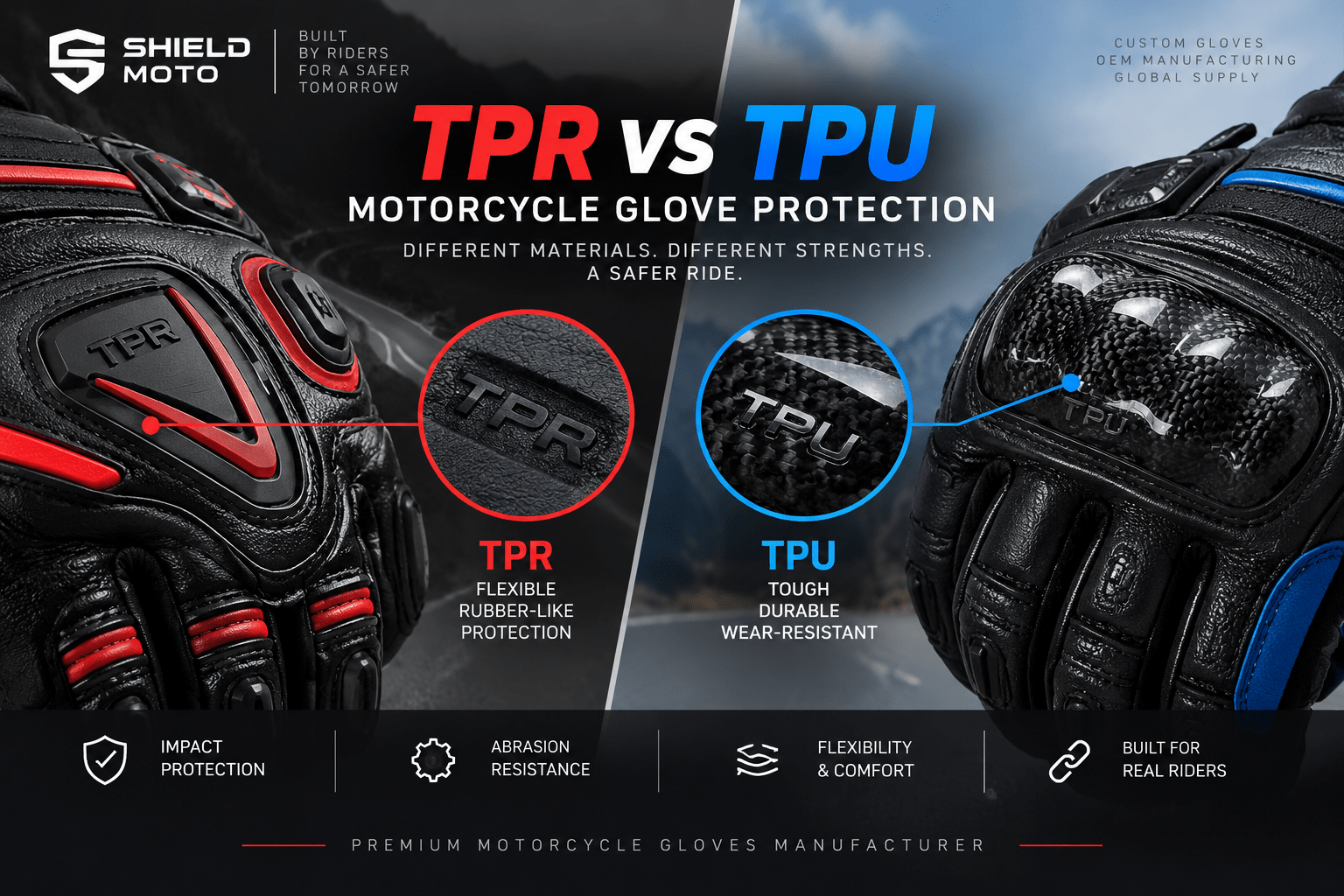
When choosing motorcycle gloves, TPR and TPU are two different thermoplastic materials that can be used in protective components, reinforcements, closures, and other glove constructions. Neither material is automatically the right choice for every application. The better option depends on the component’s required flexibility, abrasion resistance, impact-related design, durability, comfort, and the overall glove construction.
For motorcycle glove buyers, the important question is not simply “TPR or TPU?” It is where the material is used, what the component is designed to do, and whether the finished glove has been tested to the relevant motorcycle-glove requirements.
| Feature | TPR | TPU |
|---|---|---|
| Full name | Thermoplastic Rubber | Thermoplastic Polyurethane |
| Material family | Thermoplastic elastomer | Polyurethane thermoplastic elastomer |
| General feel | Rubber-like and flexible | Flexible with a wider range of hardness and mechanical properties |
| Flexibility | Generally very good | Generally very good |
| Abrasion resistance | Depends strongly on formulation | Often a key strength of TPU |
| Tear resistance | Formulation-dependent | Often strong |
| Impact-related applications | Can be suitable depending on design and grade | Can be suitable depending on grade and design |
| Processing | Suitable for thermoplastic molding | Suitable for thermoplastic molding |
| Typical glove consideration | Flexible components, tabs, flexible protectors | Protective components and parts requiring toughness and wear resistance |
| Best choice | Depends on the component and formulation | Depends on the component and formulation |
TPR is a broad term commonly used for thermoplastic rubber materials, while TPU is a specific polyurethane-based thermoplastic elastomer. Material performance can vary substantially between individual grades, so the material name alone should not be treated as a complete specification.
TPR stands for Thermoplastic Rubber. The term commonly describes rubber-like thermoplastic elastomers that can be processed using thermoplastic manufacturing methods.
TPR can provide flexibility, resilience, and a rubber-like feel. Its properties vary according to the particular formulation used. For glove manufacturing, that means a TPR component should be evaluated according to its hardness, geometry, thickness, attachment method, and intended function rather than simply being labeled “TPR.”
Shield Moto, for example, lists a TPR Velcro tab as part of the adjustable cuff system on one of its long racing glove models. This demonstrates that TPR can be used in flexible glove hardware and closure components rather than necessarily serving as the glove’s primary protective shell.
TPU stands for Thermoplastic Polyurethane. It is a thermoplastic elastomer made using polyurethane chemistry and can combine flexibility with mechanical properties such as toughness, tensile strength, and abrasion resistance.
TPU formulations can be engineered for different requirements. Lubrizol, for example, describes TPU compounds used in fabric-coating applications as providing toughness, flexibility, and abrasion resistance, while specific TPU grades can be formulated for particular combinations of low-temperature flexibility, abrasion resistance, and cut resistance.
This makes TPU useful for motorcycle gear components where the designer needs a balance between flexibility and mechanical durability.
The most important distinction is that the material does not determine the protection level by itself.
A motorcycle glove’s protective performance depends on the complete construction, including:
For motorcycle protective gloves, EN 13594 specifies requirements and test methods covering areas including sizing, ergonomics, mechanical properties, impact protection, marking, and user information.
Therefore, saying that “TPU gloves are safer than TPR gloves” would be an oversimplification. A properly designed glove must be evaluated as a complete product.
Both materials can be formulated to provide substantial flexibility.
This matters because motorcycle gloves must allow riders to operate:
A rigid protective component may provide structural advantages but can interfere with dexterity if its geometry and placement are poorly designed.
TPR is often associated with a soft, rubber-like feel and good flexibility. TPU can also provide excellent flexibility, with formulations available across a broad range of hardness and mechanical properties.
For glove development, the objective should therefore be the right balance between protection-related design and unrestricted control, rather than simply choosing the softer or harder material.
Abrasion resistance can be important for motorcycle gloves because some areas of the glove can experience repeated contact, friction, or wear.
TPU is widely used where abrasion resistance and toughness are important. Technical TPU materials can be formulated to provide strong abrasion and tear resistance.
TPR performance is more formulation-dependent. Different thermoplastic rubber families and compounds can have substantially different mechanical and environmental properties.
For a glove manufacturer or product developer, the correct approach is to compare the specific material grade and finished component, not generic TPR and TPU labels.
Knuckle protection is one of the areas where motorcycle glove designers may use molded protective materials.
The protector should be considered as part of the complete glove design. Important questions include:
Shield Moto currently lists TPU carbon knuckle protection on one of its long racing glove models. The same model also incorporates SuperFabric protection, palm reinforcement, leather construction, and other protective features.
This illustrates an important principle: protective performance comes from the complete glove system rather than one polymer alone.
TPR can be useful where flexibility and a rubber-like component are required.
One Shield Moto long racing glove uses a TPR Velcro tab in its adjustable cuff system. The component contributes to the cuff and closure design rather than being presented as the glove’s sole protective element.
For custom glove development, flexible TPR components may therefore be considered for areas such as:
The exact suitability depends on the required material properties and component design.
No.
TPU can offer useful mechanical properties, including toughness, abrasion resistance, and flexibility, but the presence of TPU does not automatically make a motorcycle glove compliant with a safety standard or superior to a glove using another material.
Similarly, TPR should not automatically be considered inferior.
A proper product evaluation should consider:
For protective motorcycle gloves, EN 13594 addresses the finished glove’s requirements and test methods rather than simply assigning a protection level based on whether the protector is made from TPR or TPU.
There is no universal winner.
A practical material-selection approach is:
These are general material-selection considerations, not guarantees of finished-glove performance. Different grades can behave very differently.
For motorcycle glove buyers, the polymer choice is only one part of the decision.
Look at the entire glove:
Check what type of protector is used, where it sits, and how it is integrated into the glove.
The palm is a high-use area where reinforcement, grip, and material durability can be important.
Look for appropriate construction around the fingers and joints without unnecessarily restricting movement.
A secure closure helps maintain the glove’s intended position during riding.
A poorly fitting glove can create pressure points, reduce dexterity, and affect control.
If a manufacturer claims compliance with a motorcycle glove standard, ask for the relevant documentation and confirm exactly which model and configuration were tested.
EN 13594 covers requirements and test methods for protective motorcycle gloves, including mechanical and impact-related requirements.
For motorcycle brands developing a custom glove, the decision should be made during product development rather than simply added as a marketing feature.
A manufacturer should discuss:
Shield Moto provides OEM and private-label motorcycle glove manufacturing, with customization covering areas such as material selection, design, packaging, and branding according to its website.
For a brand developing a new glove, the useful question is therefore not simply “Can you make it with TPU?” It is:
Which material and construction are appropriate for the intended riding application and required product specifications?
Before approving a custom TPR or TPU component, ask the manufacturer:
These questions help separate a genuine product specification from a simple material-name comparison.
TPR and TPU can both have useful applications in motorcycle glove construction, but neither should be judged in isolation. TPR is commonly associated with flexible thermoplastic-rubber components, while TPU can provide combinations of flexibility, toughness, abrasion resistance, and tear resistance depending on the formulation.
For riders, focus on the finished glove’s construction, fit, intended use, and verified protection requirements.
For motorcycle brands and B2B buyers, evaluate the specific polymer grade, protector design, construction, testing requirements, and finished product specification before selecting TPR or TPU.
If you are developing a motorcycle glove collection, Shield Moto provides OEM and private-label manufacturing and custom biker glove production. Its custom glove range includes material and design customization, with pre-production samples available according to the current website information.
The appropriate next step is to discuss your intended riding application, glove construction, material requirements, branding, and prototype requirements with the manufacturer.