Need help? Ask an expert your product and motorbike gloves questions
Need help? Ask an expert your product and motorbike gloves questions
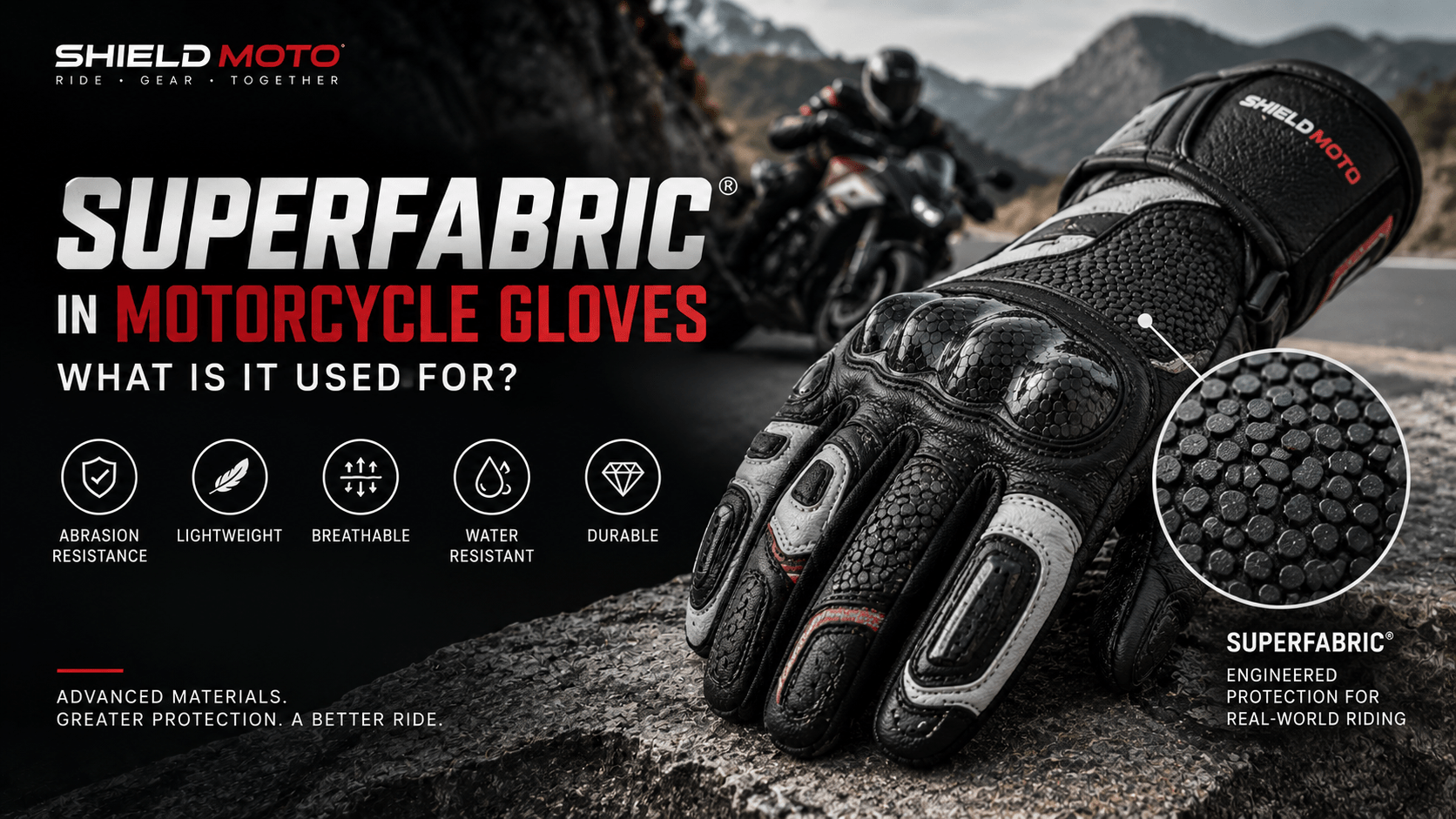
SuperFabric® is a high-performance material used in motorcycle gloves primarily in high-wear and high-abrasion areas such as the palms, fingers, knuckles, and back of the hand. Its characteristic surface consists of small protective guard plates bonded to a fabric base, giving the material a combination of abrasion resistance, flexibility, breathability, and relatively low weight.
For motorcycle glove manufacturers, SuperFabric is therefore not simply a decorative textile. It is a material option that can be strategically incorporated into a glove where additional abrasion performance and durability are important.
SuperFabric® is an engineered protective textile that uses tiny hard guard plates distributed across a flexible fabric substrate.
The construction is designed to combine the flexibility of a textile with the protective characteristics of its guard-plate surface. SuperFabric’s motorcycle-apparel materials are marketed for applications including motorcycle jackets, pants, and gloves.
Unlike a conventional leather panel, SuperFabric can provide a different combination of:
The exact characteristics depend on the specific SuperFabric material selected.
The main reason SuperFabric is used in motorcycle gloves is its abrasion-resistant construction.
During a motorcycle accident, the hands can contact the road surface. For this reason, glove designers pay particular attention to materials used on exposed and high-wear areas.
SuperFabric states that its motorcycle materials are used in areas such as palms, knuckles, and other high-abrasion zones.
A glove manufacturer can therefore use SuperFabric selectively rather than making the entire glove from the material.
SuperFabric can be incorporated into several parts of a motorcycle glove depending on the product design.
The palm is one of the most important areas for material selection.
SuperFabric identifies palms as a motorcycle-glove application, particularly where abrasion resistance is required.
A SuperFabric palm panel can be combined with leather or other materials to create a multi-material glove construction.
Finger areas can experience repeated contact, flexing, and abrasion.
SuperFabric’s motorcycle applications include finger panels, and manufacturer examples show the material being used across fingers and other high-wear sections.
SuperFabric can also be incorporated around the knuckle region.
This can be particularly relevant when the glove combines textile material with separate hard knuckle protectors or other reinforcement.
The material itself should not be confused with a certified knuckle protector. Its function depends on the overall glove construction.
The back of the hand is another area where SuperFabric can be incorporated.
Pittards-style leather systems and textile systems can be combined with protective materials, but SuperFabric is specifically promoted for motorcycle apparel applications involving abrasion-resistant areas.
Some motorcycle glove designs also incorporate SuperFabric around wrist areas.
Its suitability depends on the pattern, intended protection, flexibility requirements, and other components used in the glove.
Abrasion resistance is one of the primary reasons manufacturers consider SuperFabric.
The material’s small guard plates are designed to provide a protective surface that resists abrasion. SuperFabric specifically promotes its motorcycle-apparel materials for high-abrasion applications.
However, the performance of a finished motorcycle glove depends on the complete construction, not the material alone.
Protective material needs to work with the movement of the hand.
SuperFabric describes its materials as flexible while providing protective performance. This can make the material useful in glove areas where protection needs to coexist with hand movement.
SuperFabric’s construction contains small gaps between its guard plates.
According to the manufacturer, these gaps allow air to pass through the material, contributing to breathability.
This can be useful for motorcycle gloves because hands can become uncomfortable when heat and moisture accumulate inside the glove.
Certain SuperFabric materials are designed with water-resistant characteristics.
SuperFabric also notes that a waterproof-breathable membrane can be added to some material constructions when additional performance is required.
Water resistance should therefore be distinguished from claiming that every SuperFabric motorcycle glove is waterproof.
SuperFabric’s motorcycle-apparel literature states that most of its materials can dry significantly faster than untreated leather.
This characteristic can be useful in motorcycle gloves exposed to rain, perspiration, or changing weather.
SuperFabric also highlights stain resistance as a material benefit.
For motorcycle gloves, this can help the material remain easier to maintain when exposed to road dirt, oils, and everyday contamination.
Protective materials can add bulk and weight to riding gear.
SuperFabric describes some of its materials as extremely lightweight while still providing protective performance.
The actual weight of a motorcycle glove will still depend on its complete material package, protective components, lining, stitching, and construction.
SuperFabric does not necessarily replace leather in every motorcycle glove.
In many designs, the two materials can serve different purposes.
| Feature | SuperFabric® | Leather |
|---|---|---|
| Abrasion Resistance | Designed specifically for high-abrasion applications | Depends on leather type, thickness and construction |
| Flexibility | Flexible engineered textile | Depends on leather type and tanning |
| Breathability | Small gaps between guard plates allow airflow | Depends on leather and perforation |
| Water Performance | Certain materials provide water resistance | Depends on treatment and leather type |
| Drying | Designed for relatively fast drying | Generally varies by leather type |
| Surface Structure | Protective guard plates over fabric | Natural leather surface |
| Use in Gloves | Palms, fingers, knuckles and high-wear areas | Can be used throughout the glove |
| Construction | Often integrated as selected panels | Can form the primary glove material |
The better choice depends on the glove’s intended application rather than assuming one material is universally superior.
Yes. A motorcycle glove can use a combination of SuperFabric and leather when the design calls for different material characteristics.
For example, a manufacturer might develop a glove using:
The precise configuration should be determined by the glove’s design requirements.
Shield Moto already uses multi-material construction in its motorcycle gloves. For example, its Long Racing Gloves product page lists goat skin leather for the backhand, goat skin and Chamude® leather for the palm, and SuperFabric® protection on the fingers, backhand wrist, and palm.
No.
SuperFabric is a material; a safety rating or certification applies to the finished product or a defined test result.
A glove containing SuperFabric should not automatically be described as certified or fully protective simply because the material has abrasion-resistant characteristics.
The complete glove needs to be evaluated according to the applicable requirements and testing for its intended market.
This distinction is especially important for motorcycle brands developing OEM or private-label products.
SuperFabric can be particularly relevant to performance-oriented motorcycle gloves where abrasion resistance and flexibility are important.
For racing gloves, manufacturers may consider SuperFabric for:
Shield Moto’s existing Long Racing Gloves provide an example of this type of multi-material approach, combining leather with SuperFabric protection.
For a racing glove, however, SuperFabric is only one part of the specification. The manufacturer also needs to consider the glove pattern, closure system, palm reinforcement, knuckle protection, finger construction, cuff design, fit, and applicable testing.
SuperFabric can also be considered for touring and everyday motorcycle glove designs.
Its combination of abrasion resistance, flexibility, breathability, and relatively quick drying can be useful where a glove needs to balance durability with comfort.
The material specification should still be selected according to the intended riding environment.
A lightweight summer glove, a long-distance touring glove, and a track glove may require different combinations of materials.
For an OEM or private-label project, material selection should begin with the product requirements.
Determine whether the glove is intended for:
Determine where the glove requires additional abrasion resistance.
Possible areas include:
SuperFabric does not have to cover the entire glove.
Combining it with leather or other textiles can allow the manufacturer to balance:
For hot-weather gloves, breathability can be an important design consideration.
For wet-weather products, the manufacturer should establish whether water resistance alone is sufficient or whether a waterproof-breathable membrane and other construction features are required.
“SuperFabric” is not enough information for a production specification.
The manufacturer and material supplier should confirm the exact material construction, color, weight, backing, treatment, availability, and intended application before production.
For brands developing custom motorcycle gloves, SuperFabric can be specified as part of the material package.
Customization may include:
Shield Moto states that its OEM and private-label manufacturing services can be customized around brand identity and performance requirements, including material selection, design, packaging, and branding.
For a brand specifically requesting SuperFabric, the important step is to communicate where the material is required and what performance objective it is intended to support.
An OEM motorcycle glove project using SuperFabric should have a clear material specification before production approval.
A practical development process can include:
Shield Moto identifies itself as an OEM and private-label motorcycle glove manufacturer and lists R&D, cutting, printing, stitching, and quality-assurance capabilities.
SuperFabric is used in motorcycle gloves primarily where manufacturers want an engineered material for abrasion-resistant and high-wear areas.
The material can be incorporated into:
Its key material characteristics include abrasion resistance, flexibility, breathability, water resistance in applicable constructions, quick drying, and stain resistance.
It does not automatically make a glove certified or safe by itself. The finished glove must be considered as a complete product, including its construction, protective components, fit, stitching, closures, and applicable testing.
For motorcycle brands, SuperFabric can therefore be most useful when it is treated as one component of a carefully engineered glove specification, rather than as a standalone safety solution.
SuperFabric is primarily used in high-wear and abrasion-exposed areas such as palms, fingers, knuckles, and other sections of motorcycle gloves. Its engineered guard-plate construction is designed to provide abrasion resistance while retaining flexibility.
Not universally. SuperFabric and leather have different characteristics and can also be combined in one glove. SuperFabric is particularly relevant where engineered abrasion resistance, flexibility, breathability, and quick drying are desired.
Yes. SuperFabric specifically identifies the palm as a motorcycle-glove application, and motorcycle glove examples use the material in palm and other high-wear areas.
Yes. SuperFabric materials are used in finger areas of motorcycle gloves, including examples where the material is incorporated into fingers, knuckles, and palms.
Not every SuperFabric material should be described as waterproof. SuperFabric promotes water-resistant and breathable characteristics for its motorcycle materials, and some constructions can incorporate a waterproof-breathable membrane.
No. The presence of SuperFabric alone does not establish certification of the finished glove. Any certification or compliance claim should be based on the specific finished product and applicable testing documentation.
Yes. A motorcycle glove can combine SuperFabric with leather and other materials. Shield Moto’s Long Racing Gloves, for example, combine goat skin leather, Chamude® leather, and SuperFabric protection in different parts of the glove.
Shield Moto offers OEM and private-label motorcycle glove manufacturing and states that its customization process can include material selection, design, branding, and packaging. Brands requesting SuperFabric should confirm the exact material specification and availability for their project.
For motorcycle brands and retailers, the right material strategy starts with the intended use of the glove.
If SuperFabric is required, define the target riding application, high-wear zones, complementary materials, protective components, fit, branding, and applicable testing requirements before finalizing the production specification.
Shield Moto’s OEM and private-label manufacturing model can be relevant for brands developing custom motorcycle glove collections where material selection and product construction need to be coordinated from the development stage.