Need help? Ask an expert your product and motorbike gloves questions
Need help? Ask an expert your product and motorbike gloves questions
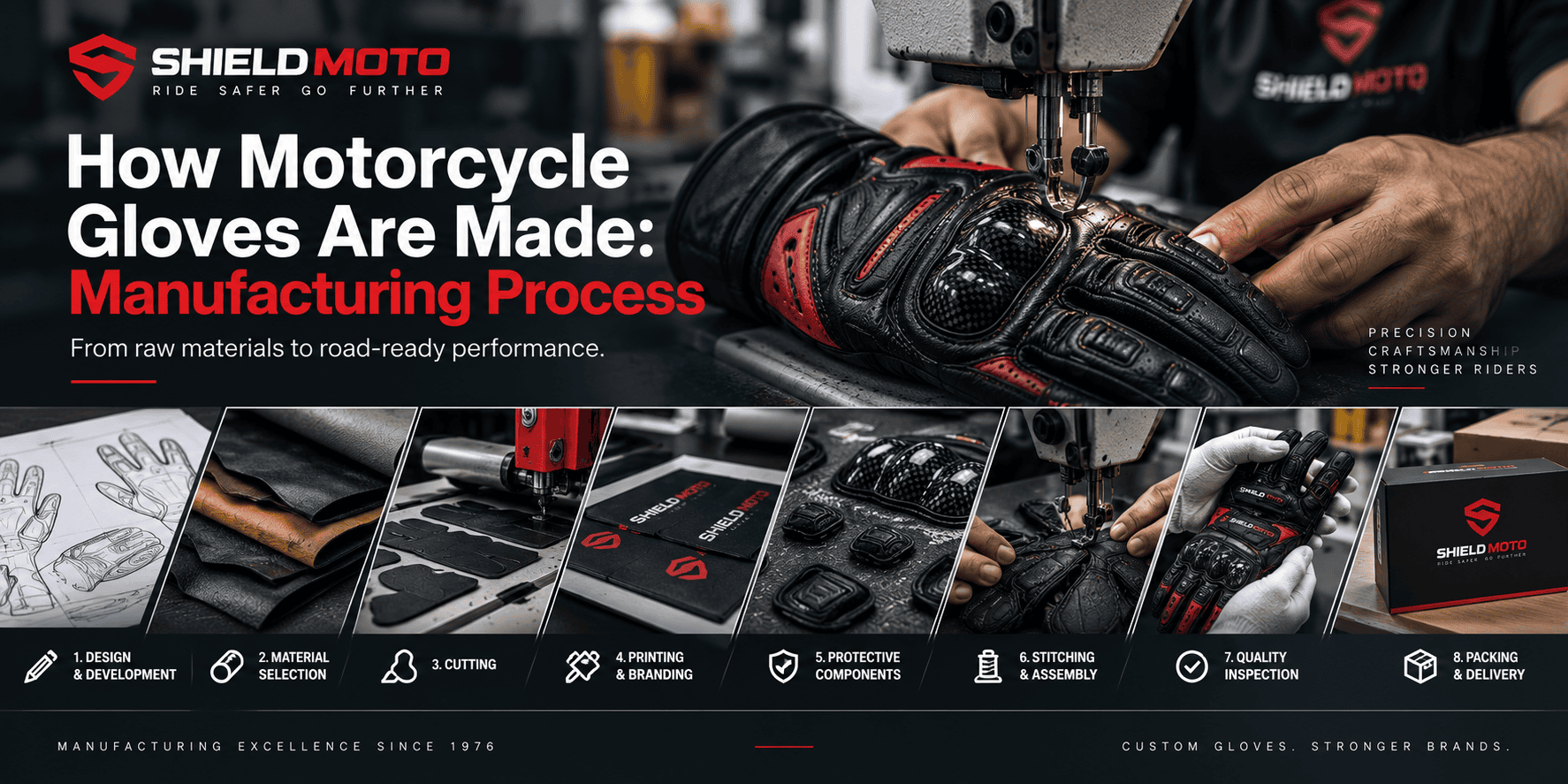
Motorcycle gloves are made through a combination of product design, material selection, pattern development, cutting, printing or branding, stitching, reinforcement, assembly, quality inspection, and packaging. The exact process varies by glove type, materials, protective features, riding application, and whether the gloves are standard production, custom, OEM, or private-label.
For a motorcycle rider, understanding the manufacturing process helps explain why gloves differ in fit, flexibility, durability, protection features, and price. For motorcycle brands and retailers, understanding the process is even more important because manufacturing decisions affect product specifications, customization, sampling, quality control, and final production.
A typical motorcycle glove manufacturing process follows these stages:
Not every glove follows exactly the same sequence. Racing gloves, winter gloves, motocross gloves, vintage-style gloves, and custom biker gloves can require different construction methods and components
Manufacturing begins before any material is cut.
The manufacturer and buyer first define what the glove is intended to do. A commuter glove may prioritize convenience and flexibility, while a racing glove may require a different construction approach, longer wrist coverage, and additional reinforcement.
Typical specifications can include:
For OEM and private-label projects, the product specification may also include the customer’s logo, colors, packaging, labeling, and other brand requirements.
The goal at this stage is to establish a clear product specification before production begins.
A motorcycle glove cannot simply be cut from a flat piece of material without a carefully developed pattern.
Patterns divide the glove into individual sections that can be cut and assembled into the final three-dimensional shape.
Depending on the design, patterns may cover areas such as:
Pattern development has a direct effect on fit and dexterity.
A poorly developed pattern can create excessive material around the fingers, pressure points, restricted movement, or an uncomfortable palm shape. A well-developed pattern helps the finished glove conform more naturally to the hand while allowing the rider to operate motorcycle controls.
For custom and OEM projects, pattern development is particularly important because the buyer may have specific requirements for fit, appearance, construction, and riding application.
The materials used in a motorcycle glove depend on the intended product and its construction requirements.
Common manufacturing choices can include leather, textile materials, synthetic materials, mesh, lining materials, reinforcement fabrics, and other specialized components.
The appropriate material depends on factors such as:
There is no single material that is automatically best for every motorcycle glove.
For example, a lightweight warm-weather glove may require a different material combination from an insulated winter glove. A race-oriented glove may also require a different construction strategy from a casual vintage-style riding glove.
For B2B buyers, material selection should therefore be connected to the intended market and use case rather than treated as an isolated specification.
Once the pattern and material specifications are established, the selected materials are cut into the required components.
Precision is important because motorcycle gloves contain relatively small components, particularly around the fingers, thumb, palm, and wrist.
Cutting must account for:
Different manufacturing environments may use manual, mechanical, automated, or computer-controlled cutting equipment depending on the material and production requirements.
According to the Shield Moto business information supplied for this project, its manufacturing capabilities include cutting operations as part of its production process. The supplied company information also identifies cutting presses and CNC equipment within its production infrastructure.
Many motorcycle gloves contain visual branding or design elements.
Depending on the product specification, these may include:
Branding becomes particularly important for OEM and private-label motorcycle gloves.
A motorcycle brand may require its own logo, colors, graphics, labels, and packaging rather than a generic manufacturer design.
Shield Moto’s supplied business information identifies printing as one of its manufacturing capabilities. Its custom manufacturing offering also includes branding and customization requirements for motorcycle brands and other B2B buyers.
Motorcycle gloves can contain additional components designed for specific areas of the hand.
Depending on the glove design, these may include:
The purpose of a reinforcement depends on its location and construction.
For example, a reinforced palm adds additional material to an area that can experience substantial contact and wear. A knuckle protector is positioned over the knuckle region to provide additional protective coverage.
These design features should not automatically be interpreted as proof of a particular safety rating. Safety performance depends on the complete glove design, applicable standards, testing, and verified certification or conformity information.
After the individual pieces are prepared, the components are progressively assembled.
Stitching is one of the most important manufacturing stages because numerous small sections must be joined into a wearable three-dimensional product.
The assembly sequence can include:
The exact sequence depends on the glove construction.
Stitching also has to balance structural requirements with flexibility. Excessive stiffness around the fingers can affect dexterity, while poorly controlled seams can create discomfort or affect the glove’s durability.
Shield Moto’s supplied company information identifies stitching and quality assurance among its manufacturing capabilities.
The wrist and cuff are important parts of motorcycle glove construction.
Depending on the design, a glove may use:
The closure system needs to work with the overall glove pattern and intended riding application.
Long racing gloves, for example, generally extend farther over the wrist than short riding gloves. That changes the cuff construction and can provide greater coverage around the wrist area.
Short gloves may use a simpler cuff design and can be convenient for everyday riding depending on the rider’s preferences and motorcycle setup.
Quality control should take place throughout manufacturing rather than only at the very end.
Inspection can involve checking areas such as:
For B2B buyers, quality assurance is particularly important because a production issue repeated across a large order can affect an entire product batch.
A useful manufacturing process therefore includes clearly defined specifications and inspection requirements before full production begins.
Shield Moto’s supplied business information identifies quality assurance as part of its manufacturing capabilities.
Once the gloves pass the required inspections, they move through final finishing and packaging.
Finishing may include:
Packaging requirements vary by customer.
A motorcycle brand selling under its own label may require customized packaging, product labels, barcodes, inserts, or other retail requirements.
For wholesale and private-label buyers, packaging should therefore be discussed during product development rather than treated as an afterthought.
Shield Moto’s supplied company information identifies packing as part of its manufacturing capabilities.
Motorcycle Glove Manufacturing Process at a Glance
| Manufacturing Stage | Main Purpose |
|---|---|
| Product Design | Define the glove’s purpose and specifications |
| Pattern Development | Create the components required for the glove shape |
| Material Selection | Choose materials appropriate to the intended application |
| Cutting | Produce individual glove components |
| Printing & Branding | Apply graphics, logos, and other brand elements |
| Component Preparation | Prepare reinforcement and protective components |
| Stitching | Join individual components |
| Assembly | Build the complete glove |
| Closure Installation | Add wrist and cuff fastening systems |
| Quality Inspection | Check construction, appearance, and specifications |
| Finishing | Complete final product preparation |
| Packaging | Prepare gloves for shipment or retail |
The manufacturing process changes according to glove type.
Racing gloves generally require a more complex construction than basic riding gloves.
The design may involve extended cuffs, multiple reinforcement zones, protective components, articulated finger construction, and closure systems intended for a race-oriented application.
The pattern and stitching process must accommodate these additional components without unnecessarily restricting hand movement.
Winter gloves require manufacturing decisions related to insulation, lining, weather conditions, cuff construction, and overall bulk.
Adding insulation changes the internal volume of the glove, so pattern development and sizing need to account for the additional layers.
Motocross gloves commonly emphasize lightweight construction, flexibility, ventilation, grip, and a close hand fit.
The manufacturing approach can therefore differ considerably from a heavier road or racing glove.
Vintage-style gloves often emphasize a particular visual design, material appearance, panel construction, and traditional styling.
The manufacturing process still requires precise pattern development and assembly even when the final appearance is intentionally classic.
Custom biker gloves can involve additional development work because the buyer may specify:
The manufacturing process therefore becomes a product-development workflow rather than simply a standard production run.
For a motorcycle brand, the process usually begins with a product brief rather than an existing off-the-shelf model.
The buyer and manufacturer may define:
OEM manufacturing involves producing motorcycle gloves according to the buyer’s agreed product requirements and specifications.
The exact relationship and scope depend on the manufacturer’s capabilities and the project agreement.
Private-label manufacturing allows a buyer to sell manufactured gloves under its own brand.
The product may use an existing construction or a customized specification, depending on what the manufacturer offers.
For a brand developing its own motorcycle glove range, OEM or private-label manufacturing can be more appropriate than purchasing generic wholesale products when customization and brand ownership are important.
Shield Moto identifies OEM, ODM, private-label, custom manufacturing, and wholesale among its business models and capabilities.
Before placing a B2B order, buyers should establish the product requirements in writing.
Important questions include:
The last question is particularly important. Buyers should not assume that a manufacturer’s general capabilities automatically apply to every product specification.
For custom and private-label gloves, a sample provides an opportunity to evaluate the proposed product before committing to larger-scale production.
A sample can help a buyer review:
Sampling can also identify design problems that may not be obvious from drawings or specifications alone.
For a B2B buyer, it is better to resolve these issues during product development than after production has been completed.
Motorcycle gloves look relatively small, but they contain many individual components and require precise assembly.
The main challenges include:
Finger panels, fourchettes, closures, labels, and reinforcement sections require accurate cutting and assembly.
The glove must conform to the shape and movement of a human hand rather than remaining a flat product.
The glove needs sufficient articulation for hand movement and motorcycle control operation.
Different areas may require different materials or layers depending on the product specification.
Additional protective components must be incorporated without making the glove unnecessarily restrictive.
For wholesale and private-label production, the same specification must be reproduced consistently across the production order.
Shield Moto is a Pakistan-based motorcycle glove manufacturer and motorbike gear brand associated with Solehre Brothers Industries. The supplied company information states that the business has a history dating back to 2002 and provides motorcycle glove manufacturing, OEM, private-label, custom manufacturing, and wholesale solutions.
Its stated manufacturing capabilities include R&D, cutting, printing, stitching, quality assurance, and packing. The supplied information also identifies substantial production infrastructure, including stitching machines, cutting presses, CNC machines, printing equipment, production halls, and an annual production capacity exceeding six million gloves. These figures should be treated as company-stated capabilities and confirmed for the specific project when relevant.
For motorcycle brands, retailers, distributors, and other B2B buyers, the relevant question is not simply whether a manufacturer can make a glove. The more important question is whether the manufacturer can reproduce the required design, materials, construction, branding, quality requirements, and packaging consistently.
When comparing manufacturers, look beyond product photographs.
Evaluate:
A manufacturer that can clearly explain the development and production process gives buyers a better basis for evaluating whether the supplier is appropriate for their product.
Motorcycle gloves are typically made by developing a product specification and pattern, selecting materials, cutting individual components, applying branding where required, preparing protective or reinforcement components, stitching the pieces together, installing closures, inspecting the finished product, and packaging it.
Motorcycle gloves can be manufactured from leather, textile, synthetic, mesh, lining, reinforcement, and other specialized materials. The material combination depends on the glove’s intended use, construction, weather requirements, flexibility, durability, and design.
There is no universal manufacturing time. Production timing depends on factors such as product complexity, sampling, material availability, customization, order requirements, and production scheduling. Buyers should request a project-specific timeline from the manufacturer rather than relying on a generic estimate.
Custom motorcycle gloves generally begin with a product brief covering design, colors, materials, branding, construction, sizing, and other requirements. The manufacturer then develops or adapts the product, prepares samples where applicable, and moves into production after the specification is approved.
OEM motorcycle glove manufacturing is a manufacturing arrangement in which a supplier produces gloves according to an agreed customer specification or product requirement. The exact scope depends on the manufacturer’s capabilities and the project agreement.
Private-label manufacturing allows a business to sell manufactured motorcycle gloves under its own brand. Depending on the supplier, the buyer may be able to customize elements such as design, materials, branding, colors, and packaging.
Pattern development determines how the individual glove sections fit together. A well-developed pattern helps control finger movement, palm fit, cuff construction, comfort, and overall glove shape.
Check the manufacturer’s relevant product capabilities, materials, customization options, sampling process, quality procedures, branding capabilities, packaging options, and ability to meet your technical specifications. For safety-related products, also request appropriate documentation for any claimed standards or certifications.
Making motorcycle gloves is a multi-stage manufacturing process that combines product development, pattern engineering, material preparation, precision cutting, component assembly, stitching, reinforcement, finishing, quality control, and packaging.
For individual riders, understanding the process makes it easier to evaluate differences in glove construction and features. For motorcycle brands and retailers, the manufacturing process becomes even more important because product specifications, customization, sampling, quality assurance, and production consistency all affect the final product.
If you are developing a motorcycle glove collection for your own brand, the next step is to define the product specification clearly and discuss the requirements with a manufacturer capable of supporting the intended design and production model.
For OEM, private-label, wholesale, or custom motorcycle glove projects, Shield Moto can be considered as a manufacturing option based on its stated motorcycle glove and custom manufacturing capabilities.