Need help? Ask an expert your product and motorbike gloves questions
Need help? Ask an expert your product and motorbike gloves questions
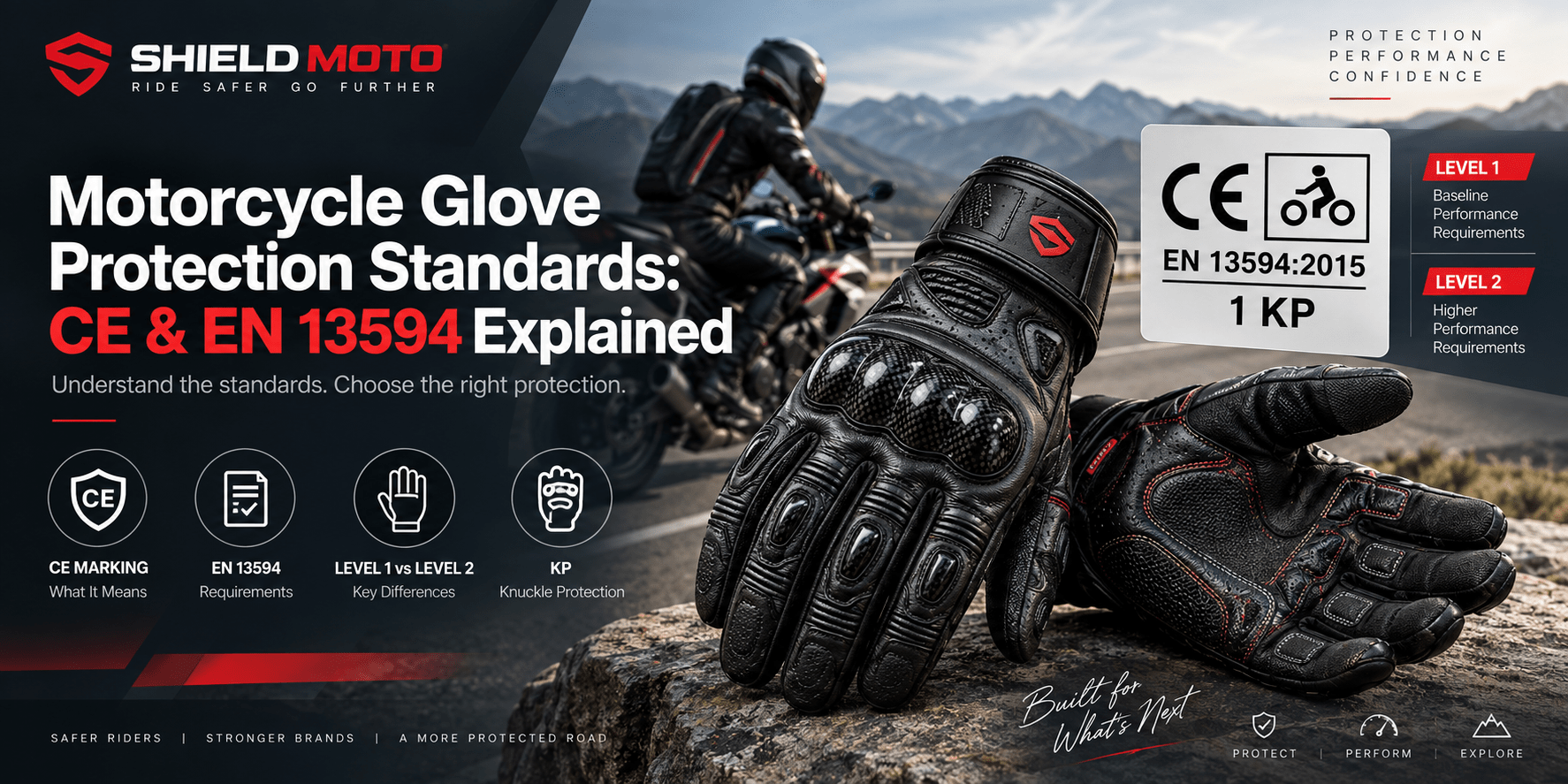
If you are comparing protective motorcycle gloves, CE marking and EN 13594 are two of the most important terms to understand. EN 13594:2015 is the European standard specifically covering protective gloves for motorcycle riders, including requirements and test methods for mechanical performance and protection.
The key point is that CE marking is not itself a protection level. CE indicates conformity with applicable EU requirements, while EN 13594:2015 provides the technical framework used to assess protective motorcycle gloves. Under the EU PPE Regulation, manufacturers must follow the applicable conformity-assessment process before placing compliant PPE on the EU market.
For riders and motorcycle brands, understanding the difference helps when choosing, specifying, testing, or sourcing motorcycle gloves.
EN 13594:2015 is the European standard for protective gloves for motorcycle riders. It establishes requirements and test methods covering areas such as glove construction, restraint, tear and seam strength, cut resistance, impact abrasion resistance, and knuckle impact protection.
The 2015 edition replaced the earlier EN 13594:2002 version and expanded the standard beyond its previous restriction to professional motorcycle riders. It also introduced a second performance level and added clearer requirements relating to knuckle protection.
In practical terms, EN 13594 gives manufacturers, testing organizations, brands, and buyers a defined way to evaluate whether a motorcycle glove meets specified protective-performance requirements.
CE means that the manufacturer declares the PPE conforms to the applicable European Union requirements and has completed the required conformity-assessment procedure. It does not mean that every CE-marked motorcycle glove provides the same level of protection.
For motorcycle gloves sold as protective PPE in the EU, Regulation (EU) 2016/425 establishes requirements for PPE design, manufacture, conformity assessment, technical documentation, instructions, and CE marking.
This distinction is important:
| Term | What It Tells You |
|---|---|
| CE Marking | The PPE has been assessed for conformity with applicable EU requirements |
| EN 13594:2015 | The relevant technical standard for protective motorcycle gloves |
| Level 1 | Lower performance requirements designed with relatively lower ergonomic constraints |
| Level 2 | Higher performance requirements |
| KP | Knuckle protection has passed the applicable impact-protection assessment |
A buyer should therefore look beyond the letters CE and check the actual performance marking and documentation.
EN 13594:2015 defines two performance levels.
Level 1 provides the baseline performance level, while Level 2 requires higher performance in several areas. The higher level can involve additional material, construction, or protection and may therefore have greater ergonomic or weight implications. BSI confirms that the 2015 standard introduced this second performance level.
| Feature | Level 1 | Level 2 |
|---|---|---|
| Overall protection level | Lower | Higher |
| Cuff length requirement | ≥ 15 mm above wrist | ≥ 50 mm above wrist |
| Restraint force | ≥ 25 N | ≥ 50 N |
| Palm tear strength | ≥ 25 N | ≥ 35 N |
| Main seam strength | ≥ 6 N/mm | ≥ 10 N/mm |
| Palm cut-resistance index | ≥ 1.2 | ≥ 1.8 |
| Impact-abrasion single value | ≥ 3 seconds | ≥ 6 seconds |
| Impact-abrasion mean value | ≥ 4 seconds | ≥ 8 seconds |
| Knuckle impact assessment | Optional | Mandatory |
These figures reflect the EN 13594:2015 performance requirements summarized by technical testing references.
Important: A glove’s overall declared level is determined by the applicable required tests rather than simply selecting the strongest-performing individual feature. A glove can achieve Level 2 performance in some tests while its overall declared level remains Level 1 if another required test limits the overall classification.
KP means “Knuckle Protection.”
Under EN 13594:2015, knuckle impact protection is optional for Level 1 gloves but mandatory for Level 2 gloves. Gloves that pass the applicable knuckle-impact assessment can carry the KP designation. Satra+1
The knuckle test assesses impact attenuation around the knuckle area. Under the standard’s requirements, testing uses a 5 J impact energy, with different limits applying to Level 1 and Level 2 performance. Level 2 requires a mean transmitted force of no more than 4.0 kN and an individual result of no more than 5.0 kN.
So:
CE + Level 2 + KP indicates a motorcycle glove that has been assessed against the higher EN 13594 performance level and has passed the applicable knuckle-protection assessment.
EN 13594 is not simply a “knuckle protection” standard. It evaluates multiple aspects of protective glove performance.
The glove must have an appropriate system to help keep it secured to the hand.
The standard specifies different restraint-force requirements for Level 1 and Level 2 gloves.
This is important because protective features are less useful if the glove cannot remain appropriately positioned during an incident.
The standard evaluates the resistance of relevant glove areas to tearing.
Different requirements apply to areas including the palm, back of the hand, fingers, and fourchettes, with Level 2 requiring higher performance than Level 1.
3. Seam Strength
Construction quality is evaluated through seam-strength requirements.
For example, the published EN 13594:2015 requirements specify minimum main-assembly seam strengths of 6 N/mm for Level 1 and 10 N/mm for Level 2.
This is particularly relevant when developing motorcycle gloves because protective performance depends not only on the shell material but also on how individual panels are assembled.
Cut resistance is evaluated using the applicable EN 388 test methodology.
The standard specifies minimum cut-resistance indices for relevant areas, with Level 2 requiring higher performance than Level 1.
5. Impact Abrasion Resistance
The standard also evaluates impact abrasion resistance, particularly in the palm area.
The Level 2 requirement is more demanding than Level 1, with published requirements of at least 6 seconds for a single abrasion result and 8 seconds for the mean result, compared with 3 and 4 seconds respectively for Level 1.
6. Knuckle Impact Protection
Knuckle impact attenuation is optional for Level 1 but mandatory for Level 2.
Testing evaluates whether the knuckle protection can limit transmitted impact force within the specified requirements.
Why Glove Construction Matters
A motorcycle glove’s protective performance does not come from one material or one component.
The complete construction can include:
The appropriate combination depends on the glove’s intended use and the performance level being targeted.
For example, Shield Moto’s published Long Racing Gloves SH-07-7001 include a dual wrist/cuff closure system, goat-skin construction, Chamude® reinforcement, TPU carbon knuckle protection, SuperFabric® protection, EVA palm reinforcement, and additional leather reinforcement. The product page also identifies the model as CE compliant.
However, “CE compliant” should not automatically be interpreted as Level 2 or KP unless the specific product’s certification documentation and marking establish that classification.
Does a More Protective Glove Always Mean a Better Glove?
Not necessarily.
A higher performance level can introduce trade-offs involving:
EN 13594 recognizes this balance by providing different performance levels rather than treating protection as the only design objective. BSI notes that the 2015 standard introduced a second performance level, while product technical documentation commonly explains that Level 2 can involve greater weight or ergonomic constraints.
For everyday commuting, touring, sport riding, and track-oriented applications, the right specification should therefore consider both the required protection and the glove’s intended riding environment.
Start with the riding application rather than simply looking for the highest-sounding marketing claim.
Look for a balance of:
A rider may prioritize:
Race-oriented gloves generally place greater emphasis on:
The relevant certification and product documentation should always be checked rather than assuming that a racing appearance automatically means a particular CE performance level.
Fit is a protection consideration, not just a comfort issue.
A motorcycle glove should allow the rider to operate the controls without excessive restriction while keeping the protective components correctly positioned.
Poor fit can create:
EU PPE requirements also recognize ergonomics, appropriate positioning, adjustment, and sizing as part of PPE design.
Fit is a protection consideration, not just a comfort issue.
A motorcycle glove should allow the rider to operate the controls without excessive restriction while keeping the protective components correctly positioned.
Poor fit can create:
EU PPE requirements also recognize ergonomics, appropriate positioning, adjustment, and sizing as part of PPE design.
For brands, retailers, distributors, and motorcycle clubs sourcing protective gloves, certification should be treated as a product-development and verification issue, not merely a marketing phrase.
Before placing a production order, ask the manufacturer:
This distinction is especially important for private-label products. A buyer should not assume that putting a new logo or colorway onto a glove automatically preserves the compliance status of a previously tested configuration.
Under Regulation (EU) 2016/425, manufacturers have responsibilities relating to technical documentation, conformity assessment, production conformity, identification, instructions, and the EU Declaration of Conformity.
One of the biggest mistakes in motorcycle glove sourcing is treating a marketing statement as equivalent to certification evidence.
For example:
“Impact-resistant knuckle” is a product-design or marketing description.
“EN 13594:2015 Level 2 KP” is a specific performance and marking claim that should be supported by the applicable conformity and testing documentation.
Similarly:
“Premium leather motorcycle glove” says something about material positioning.
It does not establish compliance with EN 13594.
For B2B buyers, the safest approach is to request documentation supporting the exact model, configuration, and declared performance.
Shield Moto is a Pakistan-based motorcycle glove manufacturer operating under Solehre Brothers Industries, whose history dates to 2002. The company states that it provides OEM and private-label manufacturing and develops customized motorcycle glove solutions around brand identity and performance requirements.
Its published manufacturing ecosystem includes categories such as racing gloves, winter gloves, vintage gloves, custom biker gloves, half-finger gloves, and motocross gloves.
For brands developing a custom motorcycle glove, the relevant discussion should include:
Shield Moto’s custom biker glove page specifically states that its custom manufacturing service can accommodate logo and colorway development, embroidery, sublimation printing, material selection, and pre-production sampling.
The company also provides a sample-request route for buyers who want to evaluate a product before bulk production.
For a certification-sensitive project, however, the exact compliance status of the specific final glove configuration should be confirmed before making a certification claim.
Before purchasing or sourcing protective motorcycle gloves, check:
EN 13594:2015 is the European standard covering protective gloves for motorcycle riders. It establishes requirements and test methods covering areas such as restraint, tear and seam strength, cut resistance, impact abrasion, and knuckle impact protection.
CE marking indicates conformity with applicable European Union requirements for the PPE. It is not itself a protection level. Buyers should also examine the applicable standard, performance level, markings, and supporting documentation.
Level 2 has more demanding performance requirements than Level 1 across several areas. Level 2 also requires knuckle impact protection, while knuckle impact protection is optional for Level 1.
KP means Knuckle Protection. Under EN 13594:2015, KP indicates that the glove has undergone the applicable knuckle-impact assessment and achieved the required performance for that designation.
Level 2 provides higher specified performance than Level 1, but a higher protection level can involve additional weight, bulk, or ergonomic considerations. The appropriate glove depends on the riding application and the rider’s priorities.
Yes. EN 13594:2015 provides two performance levels, and Level 1 is a recognized performance level. CE marking should therefore not be interpreted as automatically meaning Level 2.
A brand should ask about the applicable standard, declared performance level, KP status, testing and conformity documentation, tested configuration, materials, protective components, sampling, and production-change controls. This helps distinguish an actual compliance-supported product from a glove carrying unsupported marketing claims.
Shield Moto states that it provides OEM and private-label motorcycle glove manufacturing and customizes products around requirements such as materials, design, branding, packaging, colors, embroidery, and sublimation printing. Its custom biker glove service also states that pre-production samples are available.
EN 13594:2015 provides the technical framework for evaluating protective motorcycle gloves, while CE marking indicates conformity with applicable EU PPE requirements. Understanding the difference between CE, Level 1, Level 2, and KP helps riders make better purchasing decisions and helps motorcycle brands specify the right requirements when developing private-label or OEM gloves.
For B2B buyers, the most important step is to move beyond general claims such as “CE approved” and verify the specific glove model, declared performance level, applicable documentation, and tested configuration.
For brands developing a new motorcycle glove collection, Shield Moto can be considered as an OEM/private-label manufacturing partner, with its published capabilities covering custom motorcycle gloves, product development, branding, materials, and sampling.