Need help? Ask an expert your product and motorbike gloves questions
Need help? Ask an expert your product and motorbike gloves questions
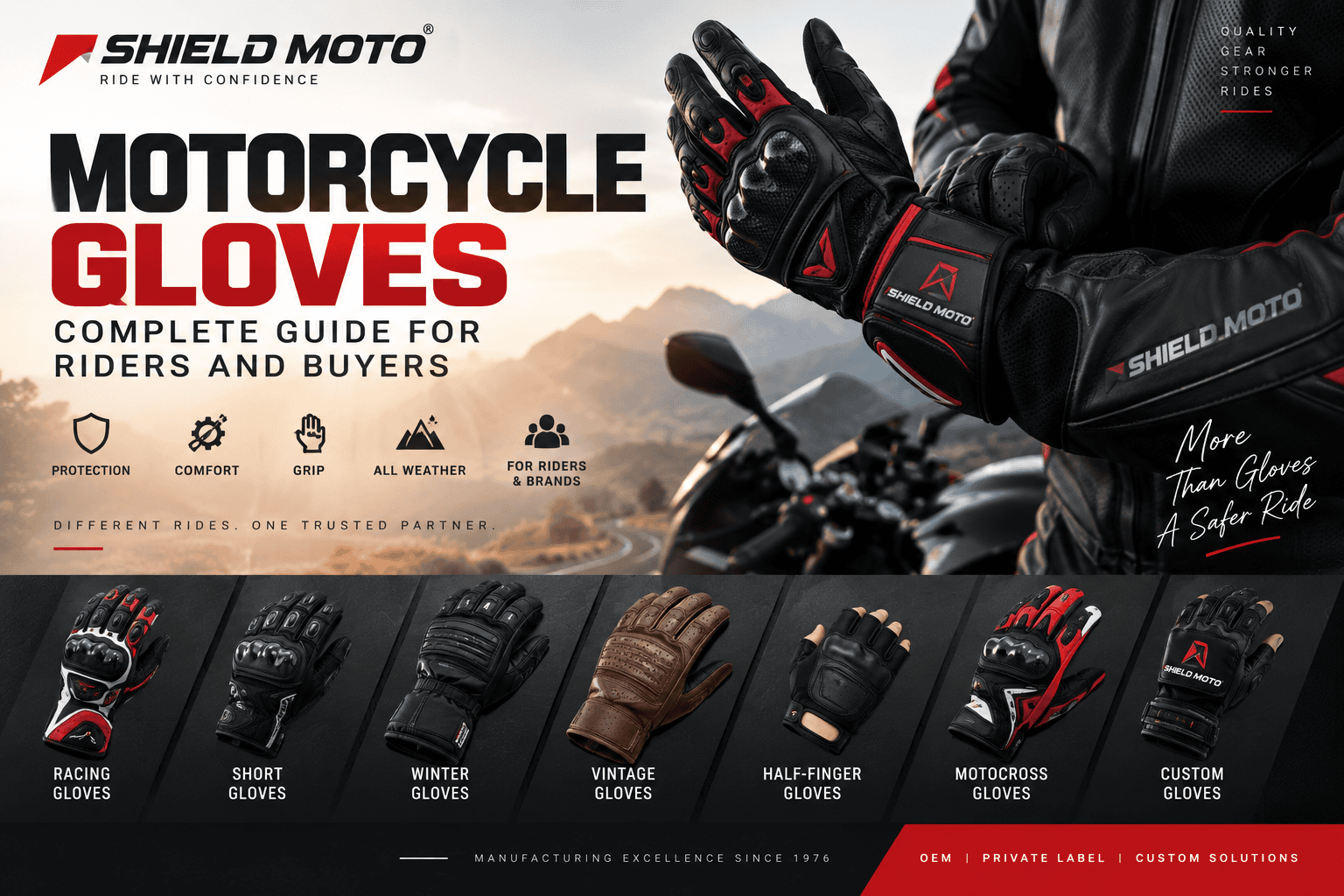
Motorcycle gloves are designed to give riders a combination of hand coverage, grip, comfort, dexterity, and protection-related features. The right pair depends on how you ride, the weather, the level of coverage you want, and the construction features that matter for your use case.
For everyday commuting, a short riding glove may be practical. Track-focused riders may prefer long racing gloves with extended wrist coverage and additional protective construction. Touring, winter, vintage, and motocross riders may have different requirements.
For motorcycle brands, retailers, distributors, and clubs, the decision is different again: material selection, construction, customization, sampling, branding, quality assurance, and manufacturing capability become important sourcing considerations.
Motorcycle gloves are purpose-designed riding gloves intended to provide hand coverage while allowing riders to operate motorcycle controls.
Unlike ordinary fashion or work gloves, motorcycle-specific designs can incorporate features such as reinforced palms, knuckle protection, finger reinforcement, wrist closures, grip materials, ventilation, insulation, and extended cuffs.
The appropriate combination depends on the riding application.
A useful way to evaluate motorcycle gloves is to consider five areas:
No single glove design is automatically ideal for every rider.
A motorcycle rider needs to maintain control of the handlebars, switches, levers, and other controls while wearing the gloves.
That creates a design trade-off.
Additional reinforcement or protective components can add coverage and structure, but excessive bulk may affect dexterity. Conversely, a lightweight glove may provide excellent flexibility while offering a different level of coverage and construction.
This is why glove selection should be based on the rider’s actual use rather than simply choosing the most heavily constructed model.
Shield Moto’s current product range includes long racing gloves, short racing gloves, winter gloves, vintage gloves, custom biker gloves, half-finger gloves, and motocross gloves.
Long racing gloves extend farther over the wrist than short gloves.
They are particularly relevant for riders looking for a race-oriented design with extended wrist coverage. Depending on the model, long gloves can incorporate additional reinforcement, protective components, wrist adjustment systems, and specialized grip materials.
For example, one Shield Moto long racing model uses a dual wrist closure, adjustable cuff, elasticated wrist, leather flex areas, Chamude® reinforcement, TPU carbon knuckle protection, SuperFabric® reinforcement, and an EVA-reinforced thenar area.
These are product-specific features and should not automatically be assumed to apply to every racing glove.
Short racing gloves provide a shorter cuff and can be convenient for riders who prefer less wrist coverage.
They can be suitable for riding applications where ease of use and a compact cuff design are priorities.
The actual protective and construction features should always be checked for the individual model.
Winter motorcycle gloves are designed for colder riding conditions.
Depending on their construction, important considerations can include:
Shield Moto currently lists a dedicated Winter Gloves category and describes its winter range as insulated and waterproof.
Vintage-style gloves emphasize classic styling and are particularly relevant to cruiser, classic, and touring-oriented motorcycle aesthetics.
Shield Moto identifies vintage gloves as part of its current product range and positions them toward riders looking for an old-school styling approach.
Motocross gloves are designed around off-road riding requirements.
Riders should consider:
Off-road use can place different demands on glove construction than road riding or track use.
Half-finger gloves prioritize finger freedom and a lightweight feel.
They may appeal to riders who prioritize breathability and control, but buyers should evaluate whether the reduced finger coverage is appropriate for their intended riding environment.
Custom motorcycle gloves are developed around a specific brand, organization, club, or product requirement.
Customization can involve areas such as:
The exact options available depend on the manufacturer’s capabilities and the agreed product specification.
Shield Moto offers custom biker gloves and states that its OEM/private-label capabilities can include material selection, design, packaging, and branding customization.
Material selection affects the feel, construction, durability, flexibility, grip, weather suitability, and appearance of a glove.
There is no single material that is universally best for every application.
Leather is widely used in motorcycle glove construction because it can provide a combination of durability, flexibility, structure, and a premium appearance.
Different leather types and constructions can behave differently, so buyers should evaluate the complete glove rather than judging performance from the word “leather” alone.
Shield Moto’s product documentation, for example, identifies goat skin leather in the backhand and palm of a specific long racing glove and uses Chamude® leather as a reinforcement material.
Textile constructions can be useful where flexibility, ventilation, weight, or specific weather characteristics are priorities.
The appropriate textile depends on the glove’s intended application and construction.
Reinforcement materials may be incorporated into areas that receive additional wear or require additional structural support.
Examples can include:
A reinforcement should be evaluated according to its intended function rather than assumed to provide a particular safety performance without supporting testing or certification information.
The palm is one of the most important areas to examine because it interacts directly with the motorcycle controls.
Consider:
A reinforced palm can add material to a high-wear area, while grip materials can help the rider maintain contact with the controls.
Knuckle protectors are designed to add protective coverage around the knuckle area.
The construction can vary considerably between models.
For a specific glove, buyers should verify what type of protector is used and whether any claimed standard or certification has actually been documented.
Finger construction can include reinforcement, protective components, flexible panels, or additional material.
The design needs to balance coverage with the dexterity required to operate motorcycle controls.
The wrist and cuff influence both coverage and how securely the glove stays positioned.
Common design considerations include:
Long racing gloves generally provide more wrist coverage than short gloves, although the exact construction differs between products.
Grip is important because motorcycle controls require precise hand movements.
A glove may use specialized palm materials, reinforcement, textured surfaces, or leather treatments to influence grip.
For example, one Shield Moto racing model specifies Chamude® leather reinforcement for grip in wet conditions.
Ventilation can be particularly important for warm-weather riding.
Potential design considerations include perforated materials, ventilation panels, breathable textiles, and construction that allows airflow.
However, ventilation should be evaluated alongside weather conditions and the glove’s other requirements.
Cold-weather gloves need different priorities from summer riding gloves.
Insulation, lining, cuff design, and weather resistance can become more important, while excessive insulation may affect dexterity.
This is why dedicated winter motorcycle gloves can make more sense for cold-weather riding than using a lightweight racing or summer glove.
Motorcycle glove protection should not be evaluated solely through marketing language.
One important standard to understand is EN 13594, which covers protective gloves for motorcycle riders. The standard addresses areas including sizing, ergonomics, innocuousness, mechanical properties, impact protection, marking, and user information, along with corresponding test methods.
A glove should not be described as compliant with a particular standard unless the relevant compliance has been verified for that product.
Likewise, terms such as:
should not be used without appropriate evidence.
A better approach is to describe the actual construction feature and explain its intended function.
For example:
A reinforced palm adds material to an area exposed to wear, while a knuckle protector is designed to provide additional coverage around the knuckle region.
This distinguishes design characteristics from independently verified safety performance.
| Feature | Long Motorcycle Gloves | Short Motorcycle Gloves |
|---|---|---|
| Wrist coverage | Extended | Shorter |
| Typical application | Racing, performance riding, riders wanting more coverage | Everyday riding and riders preferring a compact cuff |
| Cuff design | Extended cuff | Short cuff |
| Convenience | Can require more adjustment | Generally easier to put on and remove |
| Dexterity | Depends on construction and fit | Depends on construction and fit |
| Best choice | Riders prioritizing extended coverage | Riders prioritizing convenience and shorter cuff design |
Neither design is automatically better for every rider. The appropriate choice depends on riding style, environment, comfort preferences, and the construction of the individual glove.
A motorcycle glove should fit securely without creating excessive pressure points.
Important considerations include:
Fit can influence comfort, dexterity, grip, and control.
A glove that is too loose may move around during riding, while one that is too tight can create discomfort and restrict movement.
Always use the manufacturer’s actual size guide when available rather than relying on generic measurements.
Consider long racing gloves with extended wrist coverage and a construction appropriate for performance riding.
Examine the palm, knuckle, finger, wrist, closure, and reinforcement details rather than choosing based only on appearance.
Convenience can become more important.
Short gloves may be practical where a shorter cuff and easier on/off are preferred.
Touring riders may need to balance comfort, weather conditions, grip, durability, and longer-duration wear.
Look for construction designed around colder conditions, including insulation and weather resistance where required.
Prioritize fit, grip, flexibility, breathability, and construction appropriate for off-road riding.
Vintage gloves can provide a classic appearance while allowing the rider to select construction appropriate to their actual riding environment.
For a motorcycle brand, retailer, distributor, or club, buying gloves is different from choosing a single pair for personal use.
The buyer should establish a clear product specification before approaching manufacturers.
Start with the intended customer.
Is the product designed for:
The answer influences the entire glove specification.
Specify the required:
For private-label products, establish:
Sampling is particularly important for custom products.
A sample allows the buyer to assess:
Do not move directly into bulk production when important product specifications remain unverified.
Quality requirements should be defined before production.
Discuss inspection procedures, acceptable tolerances, materials, construction requirements, packaging, and any applicable testing or certification requirements.
Before placing an order, confirm the manufacturer’s actual:
These details can vary by project and should be confirmed directly rather than assumed.
| Manufacturing Option | Best For | Main Consideration |
|---|---|---|
| OEM | Brands with defined product requirements | Product specification and manufacturing execution |
| Private Label | Businesses selling products under their own brand | Branding, packaging, and product customization |
| Custom Manufacturing | Brands requiring a tailored glove design | Development, sampling, materials, and construction |
The terminology can vary between suppliers, so buyers should focus on the actual scope of work rather than relying only on the label used for the manufacturing model.
Motorcycle gloves involve many small components and production steps.
Shield Moto states that its manufacturing infrastructure includes 600+ stitching machines, automatic palm stitching machines, 50+ cutting presses, 15+ CNC machines, sublimation machines, heat-transfer printers, and 15 production halls, with stated production capacity exceeding 6 million gloves annually.
The company also identifies R&D, cutting, printing, stitching, quality assurance, and packing within its production operations.
For a B2B buyer, these capabilities are relevant because a custom glove program can involve multiple stages from development through finished-goods packing.
However, infrastructure alone should not replace product-specific verification, sampling, quality checks, and agreement on specifications.
Shield Moto is a Pakistan-based motorcycle glove manufacturer operating under Solehre Brothers Industries, whose history the company traces to 2002. Shield Moto states that it specializes in OEM and private-label manufacturing and provides customized solutions based on brand identity and performance requirements.
Its current product ecosystem covers multiple motorcycle glove applications, including racing, winter, vintage, custom biker, half-finger, and motocross gloves.
For brands and B2B buyers, Shield Moto can therefore be relevant when the requirement involves:
The appropriate manufacturing route depends on the buyer’s product requirements, target market, customization needs, and commercial specifications.
Before selecting a supplier, ask:
These questions help separate a genuine manufacturing partner from a supplier that simply resells generic products.
Before purchasing or sourcing motorcycle gloves, check:
A good motorcycle glove should match the rider’s intended use while providing an appropriate balance of fit, dexterity, grip, comfort, construction, and protection-related features. The right choice depends on riding style, weather, coverage requirements, and the specific design of the glove.
Long gloves extend farther over the wrist and generally provide more wrist coverage, while short gloves use a shorter cuff. Long gloves are commonly associated with racing and performance-oriented applications, while short gloves may be preferred for convenience in everyday riding.
Some motorcycle gloves are specifically designed for racing and track-oriented riding. Long racing gloves can incorporate extended wrist coverage and additional protective or reinforcement features. Riders should evaluate the actual specifications and any applicable certification of the specific model rather than assuming every motorcycle glove is suitable for racing.
Brands should define the rider, intended application, materials, construction, protection requirements, branding, packaging, target market, quality requirements, sampling process, MOQ, and lead time before selecting a manufacturer.
OEM manufacturing generally involves a manufacturer producing products according to the buyer’s defined product requirements. The exact commercial and development relationship should be agreed between the buyer and manufacturer.
Private-label manufacturing involves products being manufactured for sale under the customer’s brand. Depending on the manufacturer’s capabilities, the project may include product design, materials, branding, packaging, and other customization requirements.
Yes, motorcycle gloves can be developed around specific product and branding requirements when the manufacturer supports customization. Shield Moto states that its OEM and private-label services can include material selection, design, packaging, and branding customization.
Motorcycle gloves should fit securely without excessive pressure or loose movement. The fingers should have appropriate length, the palm should remain comfortable, and the rider should be able to operate the motorcycle controls naturally.
The best motorcycle gloves are not necessarily the most heavily constructed or the most expensive. They are the gloves whose design, fit, materials, coverage, and features match the rider’s actual requirements.
For individual riders, start with riding style, weather, fit, coverage, grip, and construction.
For motorcycle brands and B2B buyers, add product development, materials, customization, sampling, quality assurance, branding, packaging, and documented compliance requirements to the evaluation.
Shield Moto provides motorcycle glove categories for different riding applications and offers OEM and private-label manufacturing for businesses developing branded glove programs.
For a custom or private-label project, the practical next step is to define the product specification and request a sample or discuss the requirements directly with the manufacturer.