Need help? Ask an expert your product and motorbike gloves questions
Need help? Ask an expert your product and motorbike gloves questions
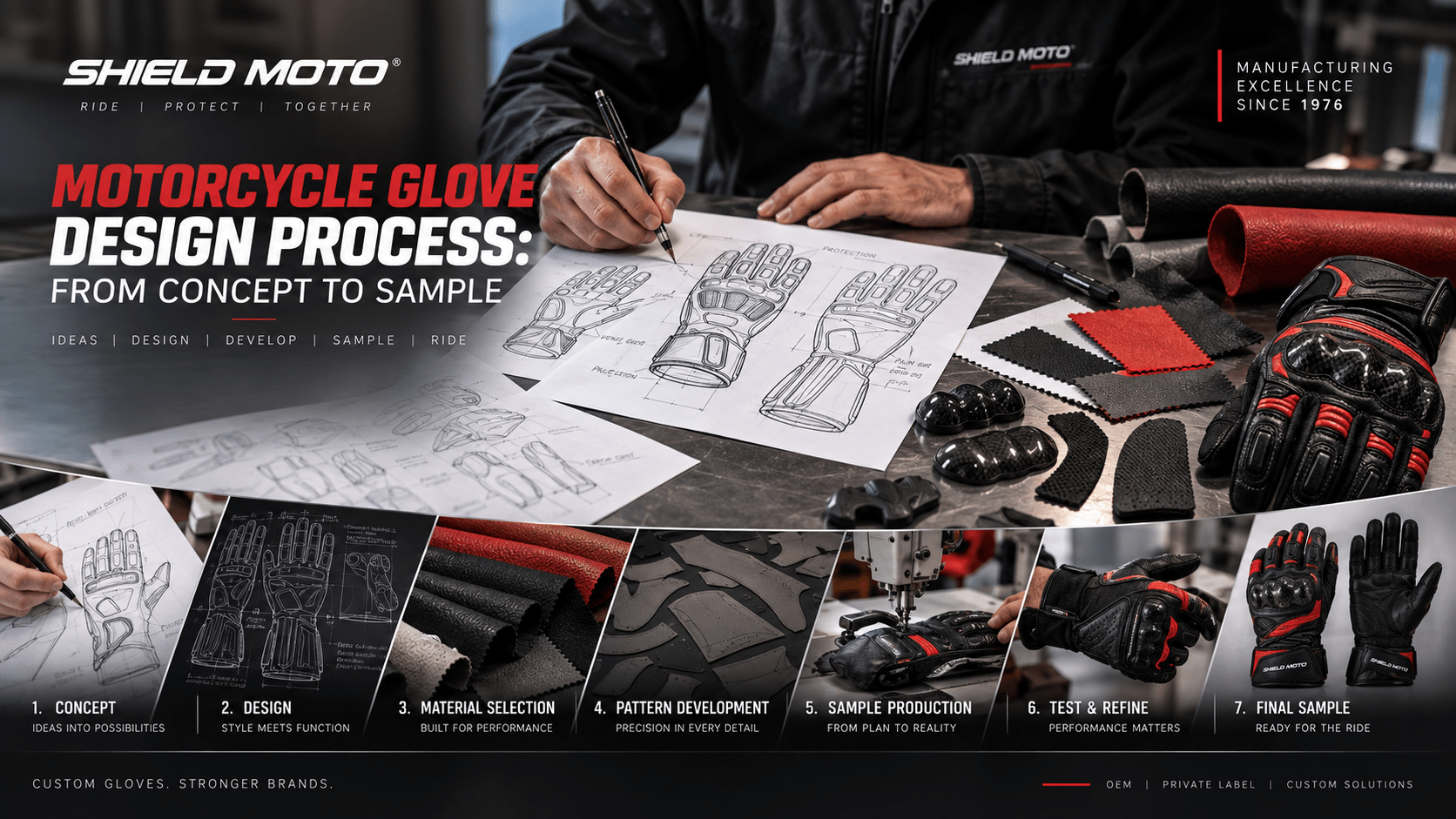
Designing a motorcycle glove for a new brand involves much more than choosing a color and adding a logo. A successful motorcycle glove design moves through several stages: defining the riding application, developing the concept, selecting materials, creating the pattern, engineering the construction, producing a sample, evaluating the sample, and preparing the approved design for production.
For motorcycle brands, retailers, distributors, and private-label businesses, understanding this process makes it easier to communicate with a manufacturer and avoid costly changes later.
The motorcycle glove design process is the sequence used to turn a product idea into a physical glove sample that can be evaluated before bulk manufacturing.
A typical development workflow includes:
The exact workflow can vary depending on whether the project is OEM, ODM, private label, or a customized version of an existing glove.
Every motorcycle glove project should begin with a clear product concept.
Before a manufacturer develops patterns or samples, the brand should determine what the glove is supposed to achieve and who will use it.
Important questions include:
A clear concept gives the manufacturer a framework for making later design decisions.
A track-oriented racing glove may require a very different construction strategy from a vintage-inspired cruising glove.
The two products may differ in:
The design should therefore begin with the intended use rather than the visual appearance alone.
The next step is identifying the product category.
Common motorcycle glove categories include:
The category affects almost every later design decision.
For example, a long racing glove normally requires a different cuff and wrist approach from a short riding glove. A winter glove may require insulation and weather-resistant construction that would not be appropriate for a lightweight summer glove.
Choosing the category early helps prevent conflicting specifications during development.
Once the product requirements are defined, the brand and manufacturer can establish the visual direction.
This stage may include:
For a private-label product, branding needs to be integrated into the design rather than added as an afterthought.
The manufacturer should know where the logo, printed graphics, embroidery, labels, and other brand elements need to appear before production begins.
Material selection is one of the most important technical decisions in motorcycle glove development.
Different applications may require different combinations of flexibility, durability, grip, breathability, weather resistance, comfort, and abrasion resistance.
Potential material considerations include:
| Material Consideration | Why It Matters |
|---|---|
| Leather | Can provide a traditional or premium glove construction |
| Textile | Can support different performance and weather requirements |
| Palm material | Important for grip, durability, and control |
| Reinforcement material | Used in selected high-wear or protective areas |
| Lining | Influences comfort and internal feel |
| Insulation | Relevant for cold-weather gloves |
| Grip material | Can improve interaction with motorcycle controls |
There is no single material that is automatically appropriate for every motorcycle glove.
The material should be selected according to the product’s intended application and construction.
The pattern transforms the design concept into the individual pieces that will eventually be cut and assembled.
A motorcycle glove pattern may include separate pieces for:
Pattern development is particularly important because a motorcycle glove must accommodate a hand that is repeatedly gripping and operating motorcycle controls.
The designer needs to consider hand position, finger movement, thumb mobility, palm shape, and the relationship between different panels.
For performance-oriented gloves, the pattern may be developed around a partially flexed hand position.
This can help the glove conform to the riding position instead of relying entirely on the material to create the curve when the rider grips the handlebar.
The result depends on the complete pattern, material selection, seam placement, and sizing.
Protection-related components should be considered during design development rather than added at the end.
Depending on the intended glove, the design may include:
The position of each component matters.
For example, a knuckle protector needs to work with the shape and movement of the hand. Palm reinforcement needs to be compatible with the palm pattern and the rider’s grip.
A manufacturer should also distinguish between a design feature and a verified safety or compliance claim.
The presence of a protective component alone does not establish a particular certification or performance level.
The palm and fingers require special attention because they are constantly involved in gripping and control operation.
The manufacturer may evaluate:
Small changes in these areas can affect how the finished glove feels.
This is why a product specification should describe both the desired appearance and the intended functional behavior.
For OEM and private-label motorcycle gloves, branding is normally incorporated during product development.
Possible customization areas can include:
Brands should provide high-quality artwork and clear instructions about logo size, placement, colors, and usage.
It is also useful to establish which branding elements are essential and which are optional.
This prevents unnecessary revisions when the first physical sample is produced.
The first physical sample is an important milestone in the motorcycle glove design process.
A digital design can show appearance, but it cannot fully demonstrate:
A sample allows the brand and manufacturer to examine the actual product.
For this reason, brands should avoid treating the first sample as automatically production-ready.
It is better to view it as a physical version of the current design that needs evaluation.
Sample evaluation should be systematic.
A useful review can cover five areas.
Check whether the glove fits the intended hand dimensions and whether the fingers and thumb sit correctly.
Check whether the wearer can move the fingers naturally and operate motorcycle controls.
Look for pressure points, uncomfortable seams, excessive material, or restrictive areas.
Inspect stitching, panel alignment, reinforcement placement, closures, and material transitions.
Check colors, logos, graphics, labels, proportions, and overall brand presentation.
The sample review should document specific changes rather than relying on general comments such as “make it better.”
Motorcycle gloves should be evaluated in the context of their intended use.
For example, a glove designed for riding should be examined while the hand is positioned around motorcycle controls.
This can reveal issues that may not be obvious when the hand is simply held open.
The evaluation may identify:
The objective is to identify these issues before bulk production.
It is normal for a product to require revisions after sample evaluation.
Potential revisions may involve:
The number of revisions depends on the complexity of the product and how closely the first sample matches the original specification.
A detailed design brief can reduce unnecessary revisions because the manufacturer has clearer requirements from the beginning.
Once the sample meets the agreed design requirements, the brand can approve it for production.
Before approval, the buyer should confirm:
The approved sample should become the reference point for production.
Any later changes should be documented rather than made informally.
The design process can differ depending on the manufacturing model.
| Manufacturing Model | Typical Approach |
|---|---|
| OEM | Brand develops specific product requirements and the manufacturer develops the product around those requirements |
| ODM | Manufacturer’s existing product or design framework is adapted to the customer’s requirements |
| Private Label | Existing or developed products are sold under the customer’s brand, with customization depending on the manufacturer’s capabilities |
| Custom Manufacturing | Product is developed around specific design, material, branding, construction, and functional requirements |
The terminology and exact commercial relationship should always be confirmed with the manufacturer.
A good product-development brief can make the sampling process considerably clearer.
A brand should ideally provide:
Not every specification needs to be finalized before the first discussion. However, the more important requirements are defined early, the easier it is for the manufacturer to understand the project.
A glove can look impressive in a product rendering but still require major changes after physical sampling.
Function should be evaluated alongside appearance.
Material affects pattern behavior, stitching, flexibility, weight, and comfort.
It should be considered early.
Motorcycle gloves are used while gripping controls. The pattern should therefore be evaluated in the intended riding position.
Protection components can affect dimensions, seams, movement, and appearance. They should be integrated during product development.
Low-quality logos or unclear artwork can create unnecessary delays during printing or embroidery.
A sample should be evaluated systematically before bulk production.
Shield Moto’s website identifies R&D, material selection, design, manufacturing, quality assurance, and customization as parts of its motorcycle glove manufacturing capabilities.
The company offers motorcycle glove categories including long racing gloves, short racing gloves, winter gloves, vintage gloves, custom biker gloves, half-finger gloves, and motocross gloves.
For brands developing their own motorcycle glove collection, the most relevant service is its OEM, ODM, private-label, and custom manufacturing capability.
Shield Moto’s custom glove offering allows buyers to specify areas such as leather selection, colors, logos, printing, embroidery, sizing, protection features, and packaging, subject to the requirements of the individual project.
The purpose of sampling is to turn specifications into something that can be physically evaluated.
A sample allows the buyer to answer questions that cannot always be resolved through a drawing or specification sheet:
This makes sampling an important quality and product-development checkpoint.
Before approving a motorcycle glove for production, review:
Concept
Design
Materials
Construction
Protection
Sample
Production
The timeline depends on design complexity, material availability, sampling requirements, revisions, and order size. A manufacturer should provide a project-specific schedule rather than relying on a generic timeline.
Yes, custom motorcycle gloves can be developed around specific design, material, branding, sizing, construction, and functional requirements, depending on the manufacturer’s capabilities.
A sketch or reference image can be helpful, but it should ideally be accompanied by written information about materials, colors, protection, sizing, branding, and intended use.
Many manufacturers provide development or pre-production samples. Shield Moto’s current custom-glove page specifically states that pre-production samples are available for approval of fit, materials, and branding before bulk production.
OEM development generally involves producing a product around a customer’s specified requirements. Private-label manufacturing generally involves selling a manufacturer’s product or developed design under the customer’s brand, with customization depending on the project.
Branding should be considered during the initial product-development stage so logo placement, colors, printing, embroidery, labels, and packaging can be integrated into the final design.
Sample approval gives the buyer an opportunity to evaluate the physical product before bulk production and identify problems with fit, construction, materials, branding, or component placement.
Ask about design development, available materials, sample production, customization, protection components, quality assurance, production capabilities, packaging, testing or certification requirements, and the process for approving the final production sample.
A successful motorcycle glove does not begin on the production line. It begins with a clear product concept and moves through design, materials, pattern development, construction, customization, sampling, evaluation, and approval.
For brands developing motorcycle gloves, the most important principle is to treat the glove as a complete product rather than a graphic design exercise.
A clear technical brief, appropriate materials, carefully developed pattern, physical sample, and structured approval process can help turn a concept into a production-ready motorcycle glove.
For brands interested in developing custom motorcycle gloves, the next practical step is to prepare the product requirements and discuss the concept with an experienced motorcycle glove manufacturer.